The Modern Era — Rick Tallman, Window Film Revolution and WFR For My Car
The newest chapter of this history isn't a factory story. It's an installer story. Rick Tallman started tinting in 1999 in Zephyrhills, Florida, founding TNT Window Tinting — and he personally trained men who run shops there to this day, Justin Pakis at TNT and Zack at Tillett's. He spent the next decade and a half in the bay, in the same trade this whole page describes — installing film made by these same houses, in shops like yours. In 2015, after leaving a prior industry group, he founded Window Film Revolution to give independent tint shops what the factories never would: a family, a standard, and a way to get found — and opened the WFR Facebook group, a private room with approved membership where the whole chain — installers, shop owners, trainers, suppliers and customers — talks shop. The WFR Family Reunion turned that family into a room — installers meeting in person in Marietta, then Athens, then Chattanooga, competing, learning, and building the network the way this trade has always built everything: by hand, together. Today the revolution runs on WFR For My Car — wfrformycar.com — where member shops, trainers, and every branch of this trade's story come together in one network.
The Reunions wrote their own dated history. Reunion 1 — Marietta, Georgia, October 3–5, 2022: 215 tinters in one room, auto-only, Singles and Teams competitions built to give everybody a fair chance, a $10,000 first-place prize Rick saved dollar by dollar out of his own shop, and a Kia Soul, a four-wheeler and a scooter given away. Reunion 2 — Athens, Georgia, July 26–28, 2023, at the Classic Center: bigger than the first, a Toyota Cross entered to win — but Georgia Bulldogs football weekends drove motel costs up and brought the traffic, so the family moved. Reunion 3 — Chattanooga, Tennessee, August 27–30, 2024: the biggest yet, a $25,000 guaranteed first place — the largest payout in automotive tint competition history up to that time — with more than ten competitions and twenty seminars. Reunion 4 — Chattanooga, March 23–27, 2025: the family gathered again, and then the leadership split — Rick wanted to pause and build the platform; the others wanted to keep the events rolling; in the end they went their separate ways. The 5th Family Reunion comes when the system is built — done right, or not at all.
Even one of the network's own names is older than the network. "Film slinger" was already trade slang for a working installer on the TintDude forums by 2003. Years later the name belonged to an unrelated window-tint tools and supplies store at filmslingers.com — fronted by an installer named Michael, exhibiting at WFCT 2019 with its showcase product, the SoakShield rope, on the table. The store went quiet after 2019 and the domain lapsed — and on October 23, 2026, Rick registered it fresh and built his national directory on it. The slang became a store, the store became a directory, and the name came home to the installers it described all along.
Two more pieces of WFR's own record belong in this history. The trade WFR serves still has no government license and no single national credential — no official front door; it has always passed hand to hand, a veteran installer teaching in a real working shop — which is why WFR's training network puts trainees in real bays, and why the shops listed on it run their own classes on their own terms. And WFR keeps a Hall of Fame for the ones who trained the next generation — a spot there is earned by the record, never bought. Even the network's mark tells the story in miniature: the original WFR logo, the emblem of the first four Family Reunions, giving way to the current mark as the family outgrew it.
That's the honest shape of this industry: glass at the root, three plastics in the trunk, and branches — tint, safety film, architectural film, wraps, protection film, glass replacement — that keep growing back into each other. If you work any corner of it, the rest of it is your family history too. The glassmaker's float line made your market. The dye house and the gift-wrap plant made your film. A family company in India makes the rolls half the world installs. And the installer with the squeegee — the one all of it was built for — is where every branch finally lands. This is your trade's story, all of it, and there's a place in it with your name on it.
WFR FAMILY REUNION
30
Built to gather
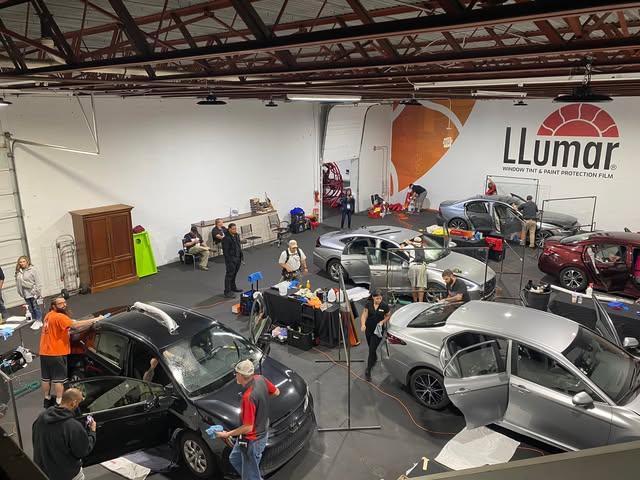
Where it all started — the first Family Reunion, Marietta, Georgia, 2022.
The WFR family doesn't just talk online — it gathers in person. Competitions, seminars, giveaways, and a room full of people who help each other. That's the Family Reunion.
Reunions 1–4 — the road so far
Reunion 1 — Marietta, Georgia
October 3–5, 2022
215 tinters in one room. Auto-only: Singles and Teams competitions, a format built to give everybody a fair chance. $10,000 first-place prize saved dollar by dollar out of Rick's own shop. Gave away a Kia Soul, a four-wheeler, and a scooter.
Reunion 2 — Athens, Georgia
July 26–28, 2023
The Classic Center. Bigger than the first one — the family had grown, and the family feel grew with it. Attendees entered to win a Toyota Cross. Athens kept the family feel, but Georgia Bulldogs football weekends drove up motel costs and brought traffic and congestion, so the family moved to Chattanooga for the next one.
Reunion 3 — Chattanooga, Tennessee
August 27–30, 2024
The biggest one yet — bigger than both that came before it. $25,000 guaranteed first place — the largest payout in automotive tint competition history up to that time. 10+ competitions, 20+ seminars, one family.
Reunion 4 — Chattanooga, Tennessee
March 23–27, 2025
The family gathered again in Chattanooga. But after years of planning events and running the group, many in leadership had grown tired and weary, and disagreements arose over direction — Rick wanted to pause and build the platform; the others wanted to keep the events rolling. In the end, we went our separate ways. But families come back around: after a hiatus to clear the air and let time heal things, another Family Reunion is definitely in the future — because we all, ultimately, are family.
Next Up
The 5th Family Reunion
It's coming back. No date yet. When it returns, it returns entirely the WFR way — done right, or not at all. Build the system first — the reunion follows.
Reunion 5 interest list. No date is set — the system comes first. Join the interest list and you'll hear it first when the Reunion returns.
Rick’s wife Mary Beth and the family will be there too — it wouldn’t be a Family Reunion without them.
You're on the list
Thanks — you're on the Reunion 5 interest list. No date is set; when the Reunion returns, you'll hear it first.
The Fifth WFR Family Reunion
Reunion 5 — Back to the Roots
Reunion 5 is an automotive-only event — cars, window film, and the clock; that’s the whole show. And its centerpiece is something this industry has never seen: a brand-new automotive competition making its debut at Reunion 5. Not at a past Reunion. Not anywhere.
Where This Stands
Everything here is the plan as it stands today. Reunion 5 is being built the right way, on Rick’s timetable — dates, details and formats can change, and nothing on this page is a promise until the official announcement drops.
This one is Rick’s own show. Reunion 5 is Rick Tallman running it himself — independent, entirely the WFR way — and it happens when the resources and the full plan are in hand, not before. That’s how it gets done right. Installers, shop owners, trainers, and suppliers gather — and they bring their families, because family time is the whole point of the thing. It always has been.
Back to the Roots — Singles & Teams
We’re going back to the roots — back to the beginning, back to the very first WFR Family Reunion — and the Singles competition and the Teams competition run exactly like they ran at that first Reunion. Same format. All the same rules. Nothing watered down. Those two are the root of what we do; they’re the foundation everything else at WFR stands on.
The Debut — The Shootout
And this time, there’s a third automotive event alongside them — one nobody has seen before. It’s tentatively called THE SHOOTOUT, and the format is plain: partners go head-to-head on opposite sides of the same car, and the judges call the winning side live — no scorecard, no waiting on the numbers. It runs double elimination — two losses and you’re out. One bad round doesn’t end your day; the second one does. It is going to be super wild — some things you have to be there to believe.
How the Field Narrows
Advancement in Singles and Teams follows the pattern it’s always followed. In general, the best 40% of the field moves on to Round 2, and the best 25% of that field goes to the finals — so the finals come down to roughly the best 10% of everyone who entered. Put 100 tinters in the field and it runs 100 → 40 → 10. It’s a pattern, not a fixed rule; it flexes with the size of the field and the cars on hand.
The WFR Judging Scorecard
Every performance in the Singles and Teams competitions is judged on the WFR Judging Scorecard — the 11 criteria, scored from 0 to 100 by a panel of three to five judges. That’s the panel at Reunion 5, and it’s the panel at every WFR event. Here’s the card itself — read it before you ever enter:
The WFR Judging Scorecard
Scored 0 to 100 · Panel of three to five judges
Cleanup — The bay, the glass, and the work area are left clean: no slip solution, film scraps, or trash left behind for the customer to find.
Wiped-Down Vehicle — The vehicle is handed back clean — panels, glass, and interior surfaces wiped down, with no handprints or solution runs on it.
Exterior Gaps — From outside the car, the film edge sits even and consistent around the glass — no wide, wandering light gaps showing.
Interior Gaps — From inside, the edges read the same way: tucked and sealed, with no light leaking through where the film should meet the edge.
Creases — No folds, wrinkles, or bent lines in the film. A crease means the film was forced — and a judge’s eye finds it instantly.
Contamination — No dust, hair, or specks trapped under the film. Anything sealed under the glass stays there for everyone to see.
Top Edge — The top edge of roll-down windows is tight and smooth, cut or filed clean — no jagged edge catching the light or a fingernail.
Scratches — No blade marks or squeegee scratches in the film, and none on the glass.
Water Bubbles — No trapped water pockets left behind. The film is squeegeed out even, so nothing is left waiting to turn into a bubble or a peel.
Finished in Time — The job is done inside the time allowed. Clean work done slow is practice; clean work done on the clock is professional.
Overall Quality — Step back and look at the whole car the way the customer will: does it read as one clean, professional job, start to finish?
Judge’s Score______ / 100
What the Card Really Measures
The eleven criteria are printed on the card so every competitor knows exactly what the judges look at — but they do not all weigh the same. This competition is decided by the quality of the install itself: the finished work on the glass, and the condition of the vehicle when the round is done. The judges judge the car and the work — what it looks like after you’re gone — not your floor, not your peel board, not your work area.
The small things still count — a little. Leave the job looking like you never tried to clean up, and it will cost you; but it will cost you a fraction, not the title. Nobody gets kicked out over a peel board, and no championship was ever lost over one. Think of it the way the customer does: a window handed back less than clean won’t make them happy — but a truly great install still will. A superior install beats a tidy work area every time.
And across three rounds, the best overall work wins. That’s what the card really measures.
Every score is final. The judges’ decisions are final, WFR holds final authority over its competitions, and no result can be appealed or disputed — in a field judged by hand and by eye, somebody has to have the last word, and the last word is WFR’s.
Certification, Earned on Glass
Certification is earned at the Reunion — hands-on, on glass, and included with the competition. There’s no written test, and nobody buys a title. In Singles, three timed rounds set your level: 86–89 Certified Pro · 90–93 Craft Pro · 94+ Master Pro — 85 or below fails: there’s no title, and nobody gets one by asking. In Teams, the Team Player certificate is binary: finish the job inside the hour and score high enough on the judges’ card, and every member of the team is certified — or you’re not. Placements still decide the trophies; the certificate is decided by the scorecard and the clock.
This One — Not Forever
That’s this Reunion — not forever. Future Reunions will likely bring in flat glass competitions, at the very least — and we’re open to more beyond that. But first we go back to the root: this one is Singles and Teams — plus The Shootout.
Want to hear it first? Join the Reunion 5 interest list above — tinters, shop owners, trainers, suppliers: when the official announcement drops, the list hears it first.
The Reunion Library
The WFR Family Reunion photos and posts, as they were shared inside the private WFR Facebook group — the window tint competition action, the seminars, and the family moments from the family reunion in Marietta, the family reunion in Athens, and the family reunions in Chattanooga. Every button below opens that reunion's posts inside the group, so they're members only: not a member yet, and the link takes you to the join door, where you can request to join.
Were you at one of the Reunions? Send in your photos from it — the competitions, the cars, the people, the moments in between — and help us tell the story of the family gathering.
Every photo is reviewed by a real person before it goes up.
Photos received
Thanks — your photos are in. A real person reviews every photo before it goes up, so give us a little time and watch this space.
My name is Rick Tallman, and I started tinting windows in late 1999. But this didn't start there. It started with a kid who never quite fit in anywhere.
Do you have a story about Rick Tallman that you would like to tell?
This room keeps its own history — and a lot of it is walking around in other people’s memories. Maybe Rick gave you your first break, showed up at your shop, put your name on a stage, answered the phone when it mattered, or just tinted a car next to you twenty years ago. If you’ve got a Rick Tallman story, Rick wants to read it himself. Tell it here. Nothing you send is published automatically — Rick reads every story personally, and he’s the only one who decides if and where a story is ever shared. The record of this man is being written by the industry he serves. Add your page to it.
Your story is in
Thank you — your story is with Rick. He reads every one himself.
Read Rick’s full story
I was born in Tifton, Georgia, at five o'clock on the fifth of December, 1978. My first words in this world were a whole sentence: “Pull that light.” I wanted to see the light come on. I guess I never stopped.
I was raised mostly in College Park, Georgia, by my grandmother — my Meemaw. She took custody of me when I was small, and she raised me old-school: morals, manners, and if I got a switching, I'd earned it. She was the most loving person I've ever known, and she taught me that your word and how you treat people are all you really own.
Growing up, I bounced back and forth between Atlanta and South Georgia — Fitzgerald, Vienna, a lot of schools, a lot of new faces. I was in the talented and gifted classes everywhere I landed, and I got bullied in most of those places too. Being the new kid who doesn't fit in teaches you one of two things: how to be bitter, or how to look out for the other kids who don't fit in either. I chose the second one. I still do.
My dad was my hero, in his own way. He taught me business — marketing, respect, how to read people — and he died about a week before I turned eighteen. I got my GED, tried college, tried the Marine Corps, and by the end of 1999 I had found the thing my hands were made for: window film. I've been a tinter ever since, and I competed in tinting competitions because I wanted to measure myself against the best.
But here's what I really wanted to build. The tinters in this industry — the mom-and-pop shops, the one and two-man operations — didn't have anybody truly in their corner. So in 2015 I started a Facebook group with a simple set of rules: tinters can talk about anything, as long as it's respectful. No supplier spam. No insiders deciding who gets heard. That group grew to a membership spanning the whole trade and became the largest private window film group in the world — not because of me, but because tinters were hungry for a place that treated them like family.
So we made it a family — literally. In 2022, 215 of us met in person in Marietta, Georgia for the first WFR Family Reunion. I'd saved the prize money out of my own shop, dollar by dollar, because I wanted a competition that gave everybody a fair chance. We gave away a car that year. There have been four reunions now — Marietta, Athens, and twice in Chattanooga — and at the third one we paid out the largest first-place prize in automotive tint competition history at that time. The fifth reunion will be the biggest one yet, and it'll be done entirely the WFR way.
Window Film Revolution and WFR FOR MY CAR are the next chapter of that same story: a platform built to do for tint shops what nobody else would — real pages that get found, real leads, real tools — at prices a small shop can actually afford. Everything is built independent, on our own terms, for one reason.
I believe my Creator made me to help other people. That's the only thing any of us leaves behind. Money isn't everything — sometimes helping is just a kind word at the right moment. That's what this company is: helping, built to last longer than me.
Today I live in Jonesboro, Georgia, with my wife, Mary Beth. We met as kids and found our way back to each other after a lot of years and a lot of life, and marrying her was the happiest day of my life. She's the rock of this family, and I'm hers.
When I'm not working, I'm outside. I've loved flying since I was a little kid who dreamed about it every night — these days I run off the side of mountains on a hang glider. I shoot pool, I sing, I swim, and I love the mountains, the water, and anywhere nature is showing off. And family time is the whole goal — for me, and for every member of the WFR FOR MY CAR Network. Their family time is precious, because they're my extended family too.
Let me back up to 2015 for a minute, because that's when all of this really started moving. Back then, tinters online mostly tore each other down. Social media in this industry was the Wild West — every man for himself, and if you asked an honest question, somebody was liable to make you feel small for asking it. I started the WFR group from nothing, because I wanted one place where that wasn't how it worked. One place built on respect, where a tinter could talk about anything and be treated like a person.
That little group turned into something I never could have planned. It became the spear point of a turn in this industry — away from tearing each other down and toward something positive. Brotherhood. That's the word I use, because that's what it is. I competed in tinting competitions myself, and then I built my own competitions, and I built them on purpose: so tinters would stand shoulder to shoulder, learn from each other, and leave better than they came. Competing was never about putting the other man down. It was about all of us raising the bar together. The giveaways, the reunions — all of it grew out of that same idea.
And that's the heart behind the system we're building now. Most of what goes into it, nobody ever sees — the back-end work, the late nights, the pages and tools and fixing — and that's fine with me. I do it because the shops in this network aren't customers to me. They're my extended family. And the whole goal of everything built here — every page, every tool, every lead — is the same: to give those families their time back. Family time. That's what all of this is for.
— Rick Tallman, Founder, Window Film Revolution & WFRFORMYCAR.com
Off the clock — Rick’s hang gliding
No tint in this one. No business either. This is what the founder does on his own time — the hobby that had him long before window film did. Rick Tallman has loved flight since he was a little kid who dreamed about it every night, and in his Florida years he stopped dreaming and learned how. This is his sky — and the phenomenal story of the sport he flies.
Rick’s sky
Rick learned to hang glide in Florida, around 1999–2000, in his tinting years there. His first taste of the sport came on instructional flights with James Tindle’s Miami Hang Gliding — the South Florida school Rick remembers as “Miami Ridge,” born over Biscayne Bay and flying today as The Florida Ridge Airsports Park, on the flat country between LaBelle and Clewiston. But the place that made him a pilot was Quest Air Soaring Center, on a little grass airfield at Groveland, Florida, that pilots still call Quest today. Quest was one of the birthplaces of aerotow hang gliding in America — the system where a slow, purpose-built tow plane pulls a hang glider up behind it like a kite, and lets go into the free air.
His first instructor was Dustin Martin. Let that name sit for a second. On July 3, 2012, Dustin Martin flew a hang glider 764 kilometers — 475 miles — from Zapata, Texas to near Ralls, Texas, in a single 11-hour flight. It is the FAI world open-distance record, and it still stands. The man who first taught Rick Tallman to fly went on to fly farther in a hang glider than any human being in history. Martin and Jonny Durand also launched from Quest itself in 2007 and flew 283 miles north into Georgia — the East Coast record, from the same grass Rick learned on. Some of Rick’s own first flights of over an hour happened at that park, behind Dragonflies — the Bailey-Moyes tug planes designed by Florida’s Bobby Bailey, a Quest local Rick met in those days, who built the standard tow plane for the whole world by solving the problem backwards: not speeding the glider up, but slowing the tow plane down.
Rick also flew at Wallaby Ranch, Malcolm Jones’s legendary Davenport flight park — the first and largest full-time aerotow park in the world, famous from the Today Show to Mike Rowe’s cameras. After 33 years, the ranch held its farewell in December 2024. It is closed now, and it is remembered the way it deserves: with love.
Ask Rick what flying is, and he won’t start with the records. He’ll tell you about the peace of it — being truly detached from the world, a mile up, at peace. He’ll tell you he feels closer to his father up there. He’s seen helicopters below him and airplanes above him. He’s seen grocery bags floating a mile high. And he’ll teach you the buzzards, the way a man who has shared thermals with them teaches it: a hang glider rides rising warm air — thermals — and glides from one to the next with no engine at all, exactly like the great soaring birds, who never flap because they don’t have to. The buzzards circle in those same thermals for two reasons, Rick says: to climb and ride — and to hunt. Their sense of smell is so sharp that the scents of the earth ride the warm air up to them, and when a circling buzzard catches the smell of something dead, it follows that smell down, the circle getting smaller and smaller and smaller, until it pinpoints its meal in the middle of nowhere. Graceful, patient, exact. That’s the air Rick flies in.
The history of hang gliding
The first birdman. Hang gliding is older than the airplane. In the 1890s, German engineer Otto Lilienthal made close to 2,000 gliding flights from hills near Berlin, steering his gliders the way pilots still do — by shifting his body weight — and publishing the aerodynamic research the Wright brothers later built on. In August 1896 a gust stalled his glider; he fell, broke his spine, and died the next day. The sport’s first hero was also its first warning.
The wing that waited sixty years. In 1948, NACA engineer Francis Rogallo and his wife Gertrude patented a flexible cloth wing — the Rogallo wing — sewn first from kitchen curtain material. NASA tested stiffened versions as a recovery system for the Gemini space capsules, then shelved it. The design waited for its people.
Australia invents the modern glider. In September 1963, John Dickenson, building a releasable ski kite for a water ski club in Grafton, New South Wales, put it together: a Rogallo sail, a triangular control frame, wire bracing, and a pilot hanging in a swinging seat, steering by weight shift. Stable. Controllable. Every hang glider since is his descendant — the FAI eventually gave him its Diploma and its Gold Air Medal for inventing the modern hang glider. In 1967 Dickenson taught two Bills — Bill Moyes and Bill Bennett — and in 1969 Bennett brought the glider to America and flew it around the Statue of Liberty on the Fourth of July.
California, 1971: the sport is born in public. On May 23, 1971, pilots gathered at Corona del Mar for the first Otto Lilienthal Meet — the gathering hang gliding counts as its public birthday. National Geographic carried it to the world. Teenagers Chris and Bob Wills saw those photos, built a bamboo glider in three days, and in February 1973 founded the company that became Wills Wing; that October the brothers finished first and second at the first U.S. Nationals. Pilots soared Torrey Pines and raced at Escape Country in Trabuco Canyon. It was wild, young, and free — and then the bill came due.
The danger era, and the growing up. Early Rogallos could fall out of the sky in a luffing dive — the sail collapsing in a steep dive, lift and control gone together. Fatalities climbed; the media named it a death sport. Chris Wills’s younger brother Eric died in 1974; Bob Wills himself was killed at Escape Country in 1977, filming a commercial. The sport answered the only way it could: it grew up. The national association (today USHPA) built pilot ratings and training; by 1977 the manufacturers’ own HGMA was certifying gliders for structural strength and pitch stability in punishing tests; designers built stability into the wing itself with reflex and washout. The free-fall years ended because the pilots decided they would.
The wing becomes a machine. In 1980 Roy Haggard’s UP Comet hid the crossbar inside a double-surface sail and set the pattern every serious glider still follows. In the late 1990s carbon crossbars deleted the kingpost entirely — the sleek topless wings of the modern sport. Meanwhile the map changed: in Florida, designer Bobby Bailey’s Dragonfly (1990, built with Bill Moyes) made aerotowing practical anywhere the ground was flat, and flight parks like Quest Air and Malcolm Jones’s Wallaby Ranch (opened 1992, the first full-time aerotow park in the world) turned the flatlands into hang gliding country — the very world Rick learned in.
The record book. Distance became the sport’s measuring stick. Jerry Katz flew the first 100 miles in 1977; Larry Tudor broke 200 miles in 1983 and 300 in 1990. Austria’s Manfred Ruhmer, the dominant competitor of his era, flew 700.6 km from Zapata, Texas in 2001 — a record that stood eleven years, until Rick’s instructor took it: Dustin Martin, 764 km, July 3, 2012, still the world open-distance record. The women wrote their own book in the same sky: Britain’s Judy Leden, world champion in 1987 and 1991, who in 1994 dropped from a balloon at 41,307 feet for the altitude record; and American Kari Castle, three-time world champion, the first woman past 200 miles, who flew 403.5 km from Zapata in 2001. A world championship was flown at Kössen, Austria in 1975 — won by American Dave Cronk — and the first FAI World Championships followed there in 1976; the Worlds run every two years to this day.
The people
Otto Lilienthal — the first true glider pilot; ~2,000 weight-shift flights in the 1890s; died for the data.
Francis & Gertrude Rogallo — patented the flexible wing in 1948; NASA’s space program carried it, then the sport did.
John Dickenson — Australian inventor of the modern hang glider, 1963: control frame, swinging seat, weight shift.
Bill Bennett — carried Dickenson’s glider to America; flew the Statue of Liberty, July 4, 1969.
Bill Moyes — Australian pioneer, Moyes Gliders founder, co-creator of the Dragonfly tug; FAI Gold Air Medal.
Chris & Bob Wills — founded Wills Wing in 1973, finished 1–2 at the first U.S. Nationals; Bob was killed filming in 1977.
Roy Haggard — his 1980 UP Comet set the double-surface pattern the sport still flies.
Bobby Bailey — Florida designer of the Dragonfly, the tow plane that made the flatlands flyable; a Quest Air local.
Malcolm Jones — built Wallaby Ranch, the world’s first full-time aerotow flight park; 30,000+ tandem flights in the ranch’s telling.
Larry Tudor — first man past 200 miles (1983) and 300 miles (1990); ten FAI world records.
Kari Castle — three-time women’s world champion; first woman past 200 miles; 403.5 km from Zapata, 2001.
Manfred Ruhmer — Austria’s champion of champions; 700.6 km world record, 2001, held eleven years.
Dustin Martin — Rick’s first instructor; 764 km from Zapata, July 3, 2012 — the world open-distance record, still standing.
Watch the best in the world
The history above is the sport’s past — this is its living present. World champions, world record holders, and the pilots whose own films carry hang gliding to the world. Every film below is the real thing: the pilot’s own flying, on their own channel wherever they keep one, and honestly credited where the film lives with their team.
Featured — the farthest flight in hang gliding history: Dustin Martin’s world record, 764 km from Zapata, Texas, July 3, 2012 · via Wills Wing
Dustin Martin — the record holder
Rick’s first instructor at Quest Air — and the man who flew farther in a hang glider than anyone in history. His 764 km world open-distance record, flown in a single 11-hour flight, still stands.
Australia’s finest: ranked number one in the world, a Red Bull pilot, and Dustin’s great rival and friend — the two of them duelled all day over Texas on record day in 2012. Jonny is also the man who surfed the Morning Glory, a rolling cloud like a tsunami in the sky, looping along its face over Burketown.
Hang Gliding a Morning Glory ( Jonny Durand ) Surfing the biggest wave Ever
Hang Glider Jon Durand Talks Pushing Boundaries — Red Bull FOCUS
Jonny’s films fly with Red Bull and the Moyes team — the Morning Glory film above is his own.
Wolfgang Siess — the showman
Austria’s professional hang glider pilot — “Wolfi” to the whole sport — a competition pilot and tandem instructor who films like nobody else alive: speed runs, swoops, and sunset lines shot from the wing. His channel is hang gliding’s great front-row seat.
Six-time U.S. National Champion who helped Team USA to silver at the 2011 World Championships — and the pilot who threaded his glider through Wilson Arch in Utah, a hole in the rock most pilots would only fly around.
Four-time Class 1 world champion, four-time European champion, and seven-time world champion in the rigid Class 2 with his Swift — and before Dustin, the record was his: 700.6 km in 2001, a mark that stood for eleven years. Here he is at play over Famara, Lanzarote, looping his Swift a few feet above the waves.
Manfred Ruhmer HG pre-competition fun and training at Famara
Manfred designs and test-flies for Icaro 2000 in Italy — his flying surfaces wherever the team films.
Christian Ciech — champion and craftsman
World champion at Valle de Bravo in 2015, and a champion who also builds the wings: Christian is a designer and test pilot at Icaro 2000, the Italian house whose Laminar gliders have carried champion after champion. Here he talks helmets, safety, and a life at the very top of the sport.
The youngest pilot ever to earn the H5 Master rating, and America’s beloved hang gliding teacher — Ryan’s instruction films have started more pilots on the road to the sky than anyone’s. Watch how he teaches a first lesson, then watch him float over Utah on a perfect day.
Petr Benes (Czechia) — the reigning world champion: gold at the Worlds in Brasília in 2017, and gold again at Àger, Spain in 2025, after six years away from the sport. The man to beat right now.
Alex Ploner (Italy) — four-time world champion (2009, 2011, 2019, 2023), the defining competition pilot of his generation, still standing on podiums in 2026.
Primoz Gricar — World Championship bronze medalist in 2011 and again in 2019, a racer’s racer who has flown at the front of the world fleet for two decades.
Kari Castle (USA) — three-time women’s world champion and 14-time U.S. national champion; in 1991 she flew 335.8 km to become the first woman past 200 miles in a hang glider.
Different countries, different wings, one sky — and every one of them flying the descendant of the same cloth wing a NASA engineer sewed in 1948. That is the company Rick’s hobby keeps.
Fly it — the places
These are Rick’s fields. If the sky is calling you the way it called him, start here:
The Florida Ridge Airsports Park — Clewiston, Florida. James Tindle’s Miami Hang Gliding, where Rick took his first instructional flights, still flies from this grass field between LaBelle and Clewiston. thefloridaridge.com
Paradise Airsports at Wilotree Park — Groveland, Florida. Quest Air’s successor on the same Sheets Field grass where Rick learned — tandems and instruction, year-round. paradiseairsports.com · and for the story of the field itself: Quest Air at Sheets Field, remembered
Wallaby Ranch — Davenport, Florida (1991–2024). Malcolm Jones’s ranch is closed now, after 33 years — the farewell was held in December 2024, and the land is sold. It isn’t linked for bookings, because there are none left to book. Hear Malcolm tell the ranch’s story in his own voice: Cloudbase Mayhem #247 — a lifetime love affair of the air
USHPA — learn to fly. The national association’s own road in: ratings, schools, and how a first tandem works. How do I learn to fly?
History sources: USHPA, the FAI record files, the Smithsonian National Air and Space Museum, NASA’s Rogallo papers, Wills Wing and Moyes histories, and the verified research files of the WFR biography project. Where a date or a distance is printed here, it is printed because a source stands behind it.
Two logos tell the WFR story. The first one carried us from a Facebook group to a family of shops across America. The second carries the network we've built on that foundation — and everything still ahead.
See the two marks — then and now
The Original Mark
Our Foundation
The first WFR logo flew over the first four Family Reunions and the years that turned a Facebook group into a brotherhood of independent shops. That's our past — the foundation that got us here, and we're grateful for every mile of it.
→
The Mark Today
Our Present & Future
The new WFR mark carries the network we've built — member shops, world-class trainers, and a system built to help independent shops get found and grow. Same revolution, new era: this is WFR now, and where it's headed.