The Convergence — How Film, PPF, Wraps, Ceramic and Glass Became One Trade
Five crafts that look separate from the outside grew from the same roots — the same plastics, the same wartime and aerospace chemistry, the same sign shops — and spent a century branching apart. This is the one timeline where they run together: where they split, and where they meet again in the modern full-service film shop. WFR For My Car and Window Film Revolution, founded by Rick Tallman, keep the complete history of every trade in the network — this spine is the short road through it, and each trade's full story is told in its own chapter on this page.
Where the historical record itself disagrees, the timeline says so and prints both sides — that is the house rule for every history WFR For My Car publishes. Dates marked company-claimed are labeled as such.
Window Film
Paint Protection Film
Vehicle Wraps
Ceramic
Glass
◆ Where the threads join
How It All Came Together
The Shared Roots · Before 1900–1945
1st century BCE
GlassGlassblowing develops in the eastern Mediterranean. Flat glass starts here — small, uneven panes that stay a luxury for nearly two thousand years.
1226
Glass"Broad sheet" glass is first produced in Sussex — the earliest chapter of the flat-glass trade.
c. 1330
GlassCrown glass is first produced in Rouen, France; London follows in 1678 and crown glass dominates into the 1800s.
1838
GlassJames Hartley patents rolled plate glass in England — flat glass begins its march toward the factory.
1874
GlassFrançois de la Bastie patents tempered glass (12 August 1874) — the safety idea that film will later extend.
1888
GlassFriedrich Reinitzer discovers liquid crystals — the seed of switchable smart glass, a century early.
1898
GlassWired glass is commercially produced — glass made to hold together when it breaks.
1903
Glass◆ JoinÉdouard Bénédictus discovers laminated glass when a coated flask survives a fall; he patents it as "Triplex" in 1909. Lamination — layers bonded into one sheet — is the ancestor of every film in this timeline.
1913
GlassThe Fourcault process produces machine-drawn flat sheet in Belgium.
1926
Wraps◆ JoinWaldo Semon plasticizes PVC at B.F. Goodrich. Flexible vinyl — the wrap trade's base material — exists from this year; the film trades will build on the same polymer century.
FilmIn Bombay, the Garware family business begins with motorcars. A generation later it becomes one of the largest window-film makers on earth — the film trade's story is global from early on.
1935
Wraps◆ JoinStan Avery invents the pressure-sensitive self-adhesive label in Los Angeles. PSA adhesive is the technology that will one day stick film, PPF and wrap vinyl to glass and paint. The same year, Madico in Massachusetts runs North America's first vacuum metallizer — coating gift wrap.
1939
GlassPVB becomes the standard laminated-glass interlayer — the safety stack modern security film descends from.
1941
Film◆ JoinTwo chemists in Manchester patent PET — polyester film. DuPont's Mylar follows in the early 1950s. Nearly every product in this timeline is, at its core, a sheet of this material.
The Liquid Years & The Glass Revolution · 1950s
Early 1950s
FilmGlassThe solar-control idea is born for flat glass: a coating that could tame sun and glare on buildings. On cars, the first tint is not a film at all — it is a liquid.
December 1952
GlassAlastair Pilkington conceives float glass in England; the first float patent is applied for on 10 December 1953.
1954
WrapsA Los Angeles company, Newhouse Automotive Industries, is already advertising do-it-yourself vinyl as "vehicle wraps" — the word arrives decades before the trade does.
1956
Film◆ JoinTwo beginnings in one year. In Collinsville, Virginia, Martin Processing starts dyeing polyester film — the root of LLumar. And SUN-X flow-on tint is first used on 14 June 1956: a clear resin with colored powders, pumped through hoses and flowed over glass, the car jacked up at the front so the coating runs level.
1957
FilmSUN-X files its trademark (13 March 1957; registered 2 June 1959). In India, Dr. Shashikant B. Garware incorporates Garware Plastics — the family firm that will carry polyester film across Asia.
July 1958
GlassThe first sheet of glass made entirely by the float process comes off the line; Pilkington announces float glass to the world on 20 January 1959. Its development cost is still disputed — a patent-history paper says £7 million; Pilkington's own history says £28 million. Both figures stand in the record.
Late 1950s
FilmFlow-on tinting spreads through American shops — and so does the jacking trick for leveling the coat, a practice Rick Tallman has seen the old shops do on video. Spray-can tint (VHT, Cal Custom) reaches home garages; JC Whitney sells the spray, but no film. In Los Angeles, Lester Schatz founds Ray Stop Window Tinting — shop tradition says 1958; an archival program citation says 9 March 1959. The record carries both.
Film Is Born · 1960s
1960s
PPF◆ JoinAt the US military's request during the Vietnam War, 3M develops a tough urethane film to protect helicopter rotor blades — "helicopter tape." Thick, cloudy, made for flat blades. It is paint protection film's first form. (One maker's blog tells a mid-1950s version; the weight of the record backs the 1960s.)
1961
PPFBill Colgan builds "The Original Car Bra" for Porsche owners — the name the clear film will inherit a generation later.
1964
GlassNippon Sheet Glass signs Pilkington's float licence in March; Asia's first float line starts under licence on 15 November 1965. The same era brings the first commercial photochromic glass (Corning, 1964).
August 1966
FilmJ.O. Maldonado founds Acorn Glass Tinting on a flow-coating machine — the liquid trade at its peak, months before film replaces it.
6 December 1966
Film◆ The Join3M is granted the first window film patent, US 3,290,203, and launches Scotchtint. Dyed polyester film — seams on curved glass, dye that faded purple — is imperfect, but it is a product any shop can install. Every thread in this timeline passes through this date: buildings, cars, safety, and eventually protection and color all start as film.
1968
FilmMadico turns its coating machines from gift wrap to window film. (Madico also claims a first reflective-film commercialisation in 1958 — a company claim that predates the patent record and is carried as a claim, not a settled date.) In London, SUN-X's British flow-coating arm closes as real film arrives.
The Energy Decade · 1970s
1973
FilmGlass◆ JoinThe OAPEC oil embargo makes energy the selling point. Heat rejection moves window film from novelty to building product, and solar film displaces flow coating for good. Low-E glass coatings are developed in the same crisis years.
Mid-1970s
FilmGarware fires up India's — and Southeast Asia's — first polyester film line at Chikalthana, Aurangabad (the company's own sources say 1975 and 1976; the record prints the era, not a single year). Metallized films follow dyed films through the decade.
1976
WrapsNathan Franzblau and eight installation-company owners found the PDAA — the wrap and graphics trade starts organizing. In Germany, ORAFOL — a firm that began making postmark ink in 1808 — introduces ORACAL vinyl.
The Trades Organize · 1980s
1980s
PPFMotorsport runs urethane film on race-car noses; the same film is sold as "Ski Saver" for downhill skis. Protection film is looking for its market.
1981
FilmSouthwall's Heat Mirror — a sputtered film suspended inside a glass unit, developed with Lawrence Berkeley Lab researchers — points at the spectrally selective future.
1982
WrapsGerber's SignMaker — the first computer vinyl cutter — sells out its first production run on day one. Sign-making goes digital. The same year, Roland Hill builds the Safe Screen squash court, the first with four one-way-vision walls.
1983–84
GlassFilmThe Beirut and Kuwait embassy bombings drive the State Department's Inman Program — and security film becomes a government specification, not an accessory. The safety thread joins the film trade for good.
1984–85
WrapsRoland Hill files the first see-through-graphics patent in 1984 (US RE37,186, cited 29 July 1985) and founds Contra Vision in Stockport, England, in 1985. J.L. Fergason's first PDLC patent (1984) starts switchable film.
1987
FilmCourtaulds acquires Martin Processing — the LLumar lineage passes into corporate hands; Kent State's PDLC patents issue the same year.
1988
WrapsFilmTwo foundings of the modern order: Roland DG's CAMM-1 cutter brings computer cutting to every sign shop, and the International Window Film Association begins (formally formed in 1991).
1989
GlassPilkington launches K Glass, its on-line hard-coat low-E. In New York, John Van Dine founds the company that becomes SAGE Electrochromics. HEXIS is founded in France the same year.
Branching Out · 1990s
Early 1990s
FilmHybrid dye-and-metal films arrive; sputtered films mature. Raychem sublicenses PDLC technology to 3M, Asahi Glass, Nippon Sheet Glass and Saint-Gobain — switchable film spreads through the glass giants.
1991
Wraps◆ JoinIn New Zealand, a Pan Pacific Hotel bus becomes the first total bus wrap — with a qualification the record keeps: the glass carried Contra Vision's see-through printed graphics, but the bodywork was spray-painted, not wrapped in vinyl. The idea of the full wrap is born before the materials quite allow it. Wide-format inkjet arrives the same year (ENCAD NovaJet, October 1991).
1993
WrapsThe wrap year. In Germany, KPMF's beige film (K88823 Taxi Beige) wraps taxis whose paint must stay a legal color — film removed after three years, paint untouched: the first full color-change wrap. In California, SuperGraphics wraps the Crystal Pepsi buses with 3M Scotchprint — remembered as the first digitally printed, photo-realistic vehicle wrap (the hub's telling counts six buses; other tellings say one — the maker and the year are not in dispute).
1994
CeramicGlassThe ceramic thread opens. In Singapore, Hüper Optik begins titanium-nitride nano-ceramic research with Fraunhofer collaborators — chasing heat rejection with no metal to block radio signals. In California, Clear Focus Imaging is founded to make perforated window film.
1995
CeramicGlassHüper Optik produces its first TiN prototype. The same spring, the Oklahoma City bombing (19 April 1995) leads to the ISC and the GSA glazing criteria (January 1997) — safety film's rules are written in this era.
1996
WrapsJustin Pate starts wrapping in New York City — the installer who will teach the trade to a generation.
1997
CeramicPPF◆ JoinThree threads in one year. Hüper Optik incorporates in Singapore (17 May 1997). In San Antonio, XPEL is founded as a pattern-software company — it will not sell film for a decade. And in Tampa, the Garware family's US subsidiary, Global Pet Films (later Global Hi-Tech Films), is incorporated on 22 December 1997 — the documented date; the company also claims roots to 1996. Solutia is divested from Monsanto the same year.
1998
GlassThe first full-wrap building: a Panasonic building in Paris, wrapped on four sides in Contra Vision Performance film. In August, the Nairobi and Dar es Salaam embassy bombings (7 August 1998) confirm flying glass as the great injury mechanism — and security film as the answer the record keeps returning to.
1999
CeramicFilm◆ JoinHüper Optik commercializes the first patented nano-ceramic window film — dual-layer titanium nitride. Heat rejection without dye to fade and without metal to block signals: the film generations converge here. The same year, Solutia buys CP Films for $200 million, Signals Defense begins operations in Maryland, and the UASG is founded to administer 3M's certified graphics program.
The Digital Shop · 2000s
2000
GlassApplied Research Associates runs open-air blast tests of security film at Kirtland Air Force Base (February–March 2000) — the safety thread, measured in public.
2000s
WrapsCeramicAir-release adhesives (3M Comply, Avery Easy Apply) and thinner cast vinyls make full wraps practical for ordinary shops. In parallel, the detailing world adopts silicon-dioxide ceramic coatings — chemistry with decades of industrial and marine service behind it — and paint protection gains its second branch: the coating.
2001
GlassPilkington launches Activ, billed as the world's first self-cleaning glass. ISC issues its Security Design Criteria (28 May 2001); Bekaert acquires Solar Gard's Specialty Films the same year.
2002–05
GlassThe founding PDLC patents expire (Fergason-Raychem 2002, Kent State 2005) and switchable film accelerates. SageGlass launches commercially in 2005.
2007
PPFXPEL begins selling film under CEO Steven McAuley — the software company becomes a film company. In February 2009 its board recalls Ryan Pape as CEO with the company near bankruptcy; the turnaround becomes industry legend.
The Convergence · 2010s
2011
PPFWraps◆ The Convergence YearXPEL introduces ULTIMATE — the first self-healing paint protection film. Avery launches Supreme Wrapping Film SW900 (October 2011, 33 colors); 3M's Series 1080 wrap film reaches the market the same season (3M's own materials variously date the line 2009, 2011 and 2013 — all three dates stand in the record). Saint-Gobain acquires Solar Gard. Protection, color and film are now one catalog.
2012
FilmGlassEastman buys Solutia — reported at roughly $4.7–4.8 billion; both figures stand — and the LLumar/SunTek house becomes one. 3M extends Fasara to 54 decorative patterns (24 January). Saint-Gobain takes full ownership of SAGE; SAGE sues View, Inc. — the glass giants are buying the film future. After Sandy Hook (14 December 2012), schools begin filming their glass; Connecticut grants pass $42 million across two years.
2013
WrapsAvery launches Wrap Like a King; Piotr Cinski becomes the first FESPA World Wrap Master. Wrapping is now a championship trade.
1 January 2014
WrapsJustin Pate launches The Wrap Institute — the trade gets its school. 3M answers in PPF with Scotchgard Pro Series; Eastman integrates SunTek's Commonwealth Laminating the same year.
2015–16
PPF3M sues XPEL for patent infringement — filed in late 2015 by some accounts, 2016 by others; settled in 2017, with XPEL uplisting to Nasdaq in 2019. HEXIS introduces BODYFENCE in 2016, and 3M marks 50 years of window film.
2017
FilmAvery Dennison completes its acquisition of Hanita Coatings (28 February 2017) — the kibbutz-born coater becomes Avery's window-film arm.
2018
PPFXPEL ULTIMATE PLUS brings 8-mil film with edge-seal technology — PPF as an engineered system, not a sheet.
2019
WrapsPPFFilm◆ Join3M launches Series 2080 (August, ~100 colors); ORAFOL absorbs KPMF; Garware launches its own PPF — the film maker joins the protection trade. And in Indianapolis that September, a small film-products company exhibits at WFCT under a name installers had used as slang since 2003: Film Slingers.
The Full-Service Era · 2020s
2020–21
FilmThe original Film Slingers store goes quiet and its domain lapses — the name waits. Eastman acquires the PremiumShield pattern business in 2021, folding PPF patterns into the film house.
February 2022
PPFCeramic◆ JoinXPEL ULTIMATE FUSION arrives: paint protection film with a ceramic-style hydrophobic coat built in. The film thread and the coating thread — separated since the 2000s — ship in one product.
2024
WrapsPPFThe World Film Challenge & Tint-off (WFCT) adds a Vehicle Wraps division — the trades now share one championship. 3M launches Protection Wrap Film (September, 26 colors, dry-apply): a wrap film sold as protection, and PPF sold as color. The categories finish merging.
2025
PPFXPEL COLOR PPF launches (2 September, 16 colors) — protection film as a color-change product, shown at SEMA 2025.
2026
PPFFilmAvery Dennison's PrismaPro follows in color PPF. In January, Madico agrees to acquire Johnson Window Films (announced 21 January 2026) — the founding generation's family firms join the majors. Garware announces a next-generation PPF collaboration with Lubrizol at SEMA.
The Modern Era
◆ Where It All MeetsThe threads end in the same building. The modern shop sells window film, paint protection film, wraps, ceramic and glass work off one counter — and the industry organized itself to prove it. Rick Tallman started tinting in late 1999 in Zephyrhills, Florida, founding TNT Window Tinting, and in 2015 founded Window Film Revolution and WFR For My Car — whose annual gathering is the WFR Family Reunion. On 23 October 2026 he re-registered filmslingers.com, bringing the old name home. The complete, detailed history of every thread in this timeline — the liquid-tint years, the patent record, every maker and every generation — lives at WFR For My Car (wfrformycar.com), told in full in the chapters of this section and across the network: Film Slingers, Find Tint Near Me, Glass Slingers and the Flat Glass directory each carry their own trade's story and point back here.
One material became five trades; five trades became one shop. That is the convergence — and it is still happening.
History of Window Film
What Window Film Is Made Of — The History of PET, Vinyl and TPU
Hear it from QuartermainThe guide tells this section aloud — press play and listen instead of reading.
Start with the materials, because the materials are the bloodline. In 1941, two chemists in Manchester, England patented a plastic called PET — polyester. By the early 1950s DuPont had stretched it into a clear, strong film called Mylar, and biaxially oriented polyester became the backbone of an industry: it is the base of virtually every window film ever installed, from the cheapest dyed tint to the most advanced ceramic.
The second plastic is older in the shop and younger on the car: PVC, plasticized into flexible vinyl by Waldo Semon at B.F. Goodrich in 1926. Vinyl became signs, letters, and graphics — and eventually, wraps. The third is TPU, a tough, flexible urethane the military adopted first — it became paint protection film. Three plastics. But here's the family secret: all three are stuck to the world with the same invention — the pressure-sensitive adhesive Stan Avery pioneered in 1935 when he built the first self-adhesive label and founded the company that became Avery Dennison. Window film, wrap film, protection film — peel the liner off any of them and you're looking at the same idea, ninety years old.
And the finished film is a sandwich, not a sheet. The PET base — stretched in two directions until a layer thinner than paper becomes stubbornly hard to tear — carries the stack: a scratch-resistant hard coat facing the room; the working layers in the middle, dye for shade, metal deposited vapor-thin for reflection, or nano-ceramic particles that reject heat with no metal at all; laminating adhesive bonding the plies; a mounting adhesive with ultraviolet blockers mixed right in, gripping the glass for years; and a throwaway liner protecting it all until install day. Even the factory floor is part of the story: the giant rolls charge themselves with static as they run, pass over roller after roller, and a charged web pulls dust out of the air like a magnet — one speck sealed under a coating is a defect that lives in the film forever. So the lines run ionizing bars that wash the film in balanced ions and cancel the charge before it can grab anything. The flawless film on a window is the roll that won that fight.
The base itself starts as chemistry: terephthalic acid and ethylene glycol polymerized into PET pellets, dried bone-dry, melted in an extruder at roughly 265–285 °C and cast onto a chilled roller — with microscopic silica stirred in so the finished sheets don't stick together in the roll. Then the sheet is stretched three to four times its length over heated rollers and three to four times its width in a tenter frame, and baked under tension above 200 °C until it holds its size: biaxially oriented PET — BOPET — about half crystalline, yet still clear, because the crystals stay smaller than the wavelength of light. Onto that base the factories run five core processes — coating, laminating, metallizing, sputtering and colouring. Metallizing boils aluminum in a vacuum until it condenses, mirror-thin, on cold film; sputtering does it atom by atom, knocking metal off a target with argon ions so a factory can tune exactly which wavelengths pass. The finished stack, glass side out, runs liner, mounting adhesive with the UV inhibitor mixed in, the PET plies, laminating adhesive between them, the working layer — metallized, sputtered, ceramic or dye — and the scratch-resistant hard coat, all in thicknesses the trade measures in mils, thousandths of an inch: solar film at a mil and a half to two, basic safety at four, commercial security at eight, heavy blast film at fourteen and beyond — liner counted or not, depending on who's quoting.
The static fight has a physics of its own: every contact and separation — unwinding, rollers, slitting — trades a little charge, and because PET is an insulator the charge cannot drain away, so a running web builds a charge that grows with speed and dry air. Left alone it pulls dust into coatings, shocks operators, spoils the winding and can spark where solvent coatings hang in the air — so plants ionize the web at station after station, ground the machines and the people, and mind the humidity. What survives that gauntlet gets inspected like it matters: no pinholes, streaks, thin spots or banding, light transmission steady along the roll, and a defect vocabulary all its own — gels and fish-eyes, die lines, telescoping, blocking — before master rolls are slit and rewound under controlled tension into the rolls a shop buys, each core carrying its product and run number, traceable cradle to grave. And the map of who makes it is a family map too: Eastman's Virginia works at Martinsville and Fieldale extruding, deep-dyeing, metallizing and sputtering; Madico in Pinellas Park, Florida; Solar Gard in San Diego; 3M at St. Paul, with its Fasara decorative line from Japan; Hanita in Israel and, since 2019, Changzhou, China; Garware at Waluj and Chikalthana in Maharashtra. The roll on your plotter was born somewhere in that family.
The History of Liquid Tint — Flow-On, Flow Coating and the Spray-Tint Years
Tint itself started as a liquid. In the 1950s, DuPont developed a clear alkyd resin, and shops stirred it with colored powders — green, grey, gold, blue, rose — then flowed it down the glass, where it hardened like factory tint poured onto the pane. The trade knew it as Flow-On — flow coating — and the house that carried it to shops nationwide was SUN-X of Houston: the SUN X name was first used on June 14, 1956 — by American Glass Tinting Corporation of Houston — for "liquid plastic material to be applied to window glass to form a transparent colored film," and SUN-X filed the trademark on March 13, 1957.
Ask the founding families where the liquid itself came from and you get two stories. The Schatz family tells of a 1951 U.S. Army Air Force origin — a transparent anti-glare paint for aircraft glass, created by the Jacoby brothers of a Los Angeles paint company — the firm that later became Special-T Coatings, a name this story meets again. The 2024 documentary's account reaches back to World War II. The dispute stands unreconciled, and this history won't pretend otherwise. What is certain is the industry that followed.
The tool of the trade was the flowing machine: a rotary gear, vacuum-pump rig with a tank and two hoses — one flowing the coating down the glass, one pulling suction — and a paper trough built at the bottom of the window to catch what ran off. The Baldock machine, the one the family history preserves in detail, was built from two Baldock pump motors and a Stewart-Warner vacuum pump, with a 20-gallon tank and hoses some 30 feet long; partway through a job the compressor was shut off and the coat left to flow for five to ten minutes while gravity did its work. Gravity did the leveling, and crews patrolled the wet coat with fly swatters, because a bug landing in it could ruin the whole pane. The liquid was heavier than water and wicked under baseboards, so houses were masked like paint jobs — and the smoking agent in commercial work once set off a customer's smoke-alarm system mid-job. On cars — the shop trick Rick Tallman has seen the old shops do on video — crews taped and masked the window, then jacked the front of the car up high so the back glass tipped down and the coat drained clean toward the trough. The angle was everything.
Southern California was the flow world's capital. At Transparent Glass Coatings in Los Angeles, Dennis Baldock started as a teenage helper in 1959 and became the shop's ace installer; his brothers Howard and Lynn joined the trade, and the three Baldock brothers became names every flow shop knew. Lester Schatz founded Ray Stop Window Tinting in Los Angeles in 1958, distributing and installing the coating and selling franchises across the country. Sun-X and DuPont shipped gallons of liquid tint behind roughly $62,000 of national magazine advertising, and the dealer network it built was later documented in a federal franchise lawsuit decided on March 16, 1964. Jerry Moen and Pat Pasenheim flow-tinted the Beach Boys' limousine and all their personal cars; Dennis Baldock liquid-tinted Rock Hudson's Palm Springs home, and Moen tinted Moe Howard's house in Los Angeles — Moe helped hang the tarps and tipped him two dollars. And one all-night job masking doors at a San Bernardino coffee shop, Lynn and Howard Baldock looked up to find Liberace walking in; in the family's telling, he didn't even complain about the smell of the flow-on. SUN-X GB Ltd carried the coating to London — Castrol House on Euston Road got "the first green coloured glass seen in the capital," airport control towers and the Park Lane Hilton followed — and held on until 1968, when polyester film arrived.
The flow generation built shops that outlasted the liquid. Ronnie McArthur, a carpenter by trade who started flowing in 1956 or '57 — the second-oldest flow-coater in the family record — leveled his coats with an 8-inch file propped on wood blocks. By 1964 Howard Baldock was primary installer at Sun Resister in Garden Grove, owned by Lee Gauncher, and Dennis bought E-Z-I Glass Coatings, an established Orange County company, in the mid-1960s. In 1967 Dennis Baldock and Jerry Moen opened a car tint shop in Las Vegas, sponsoring race cars and shooting TV commercials, and Dennis flow-tinted cars all through the sixties, seventies and into the eighties. In 1970 Dennis and Lynn started West Coast Glass Tinting on Century Boulevard in Garden Grove. Conejo Window Tinting opened in Agoura Hills in 1971 and still advertises the lineage today — "from the simple flow-on tinting techniques of yesterday to the advanced solar control films used today" — and in Toronto, SunScreen Window Treatments began with liquid flow tint in 1972, before solar film superseded it there by the mid-seventies. The map widened beyond California, too: Lloyd Grossman ran a Sun-X dealership in Sarasota, Florida; John Robinson was flow-coating in Australia by 1959 — where a product literally branded "Flow Tint" later sold the same factory-glass look — and in Britain, Gary Gerrard's Windosell carried the craft for decades.
The liquid era's last founding beat film's first by months. In August 1966, J.O. Maldonado — who started out tinting at a Volkswagen dealership, and who had done Ray Stop's early installations and dealer training, the two founding families intertwined from the start — founded Acorn Glass Tinting in California on a flow-coating machine — a working tint business built on liquid, months before 3M's first sun-control film patent arrived that December. The family business runs today as Maldonado Bros. Window Tinting, and on December 25, 2024, his son Eric Maldonado released the short documentary FLOW-ON: The History of Window Tinting — the era's own history, filmed by the family that lived it. The Baldock family's booklet, HISTORY OF WINDOW TINTING, preserves the era's photos and newspaper advertisements.
VHT, Cal Custom and the Aerosol Spray-Tint Years
The spray can tried to bottle the flow. From the mid-1960s, VHT and Cal Custom sold spray tint in a can to the do-it-yourself crowd — Cal Custom was Frank Larabee's Los Angeles accessory house, folded into Arvin Industries in a 1964 merger, and VHT's can was its SP-170 line by 1969 — spray at the top of the glass and let it run down and level itself, the way the flow men did it. But the can couldn't do what the machine did. The results were blotchy, streaky, and too dark: drivers collected fix-it tickets and scraped the stuff off with Brillo pads and lacquer thinner, and at Englishtown in 1968 a racer spent two hours scouring it off his windows before he was allowed to run. As late as 1972, the JC Whitney catalog still carried two spray-tint kits — and no film at all.
The liquid didn't go quietly. In 1977, Lynn Baldock did his first film job — 64 rooms at the Ramada Inn in Palm Springs, solo — and settled into a hybrid career: reflective film for commercial work, flow-on for homes. As late as 1980, Transparent Glass Coatings was still selling distributorships; Mark Reynolds of Valuetint.com bought one and took home about 120 gallons of liquid "Flow Coat." In the mid-1980s, Lynn developed his own flow-on formula and took it to Special-T Coatings in North Hollywood as System-Kote; Special-T's Dan Erndt and Allister McDonald upgraded it into the Elite Series liquid glass coatings, GL2000 and GL3000, and dealerships opened from Maui to Finland, with Lynn training the dealers. In the family history's telling, Lynn even crashed the IWFA convention in Las Vegas in the late 1980s, handing out brochures reading "Some Say Window Film is Better... Seams It's Not" — and was escorted out by two security guards. And in 1998, a flow-on dealer in Finland loaded the flow machine onto the set of the movie Mafia! and shot a prop car's windows with liquid tint — the fake candy glass melted. The Sun-X idea kept incorporating, too — Mobile Window Tinting of California, Sun-X Glazing California Inc., dates to 1976, and as late as 2024 was offering an 80-year-old man a distributorship. Dennis Baldock, the ace of the first hour, worked his later years under his own name — doing business as Transparent Glass Coatings — ran Tint City in Riverside, co-founded Downey Glass Tinting back in 1975, and kept at the trade through three battles with cancer before his death in 2015.
So why did the liquid fade? Film beat it in the one contest that came to matter — heat rejection — and when the energy crisis made heat the headline, that was the contest flow coating couldn't win. Even the best coat rejected only about 40 percent of the heat, and the old hands will tell you the finished job was 80 percent the installer, not the material — brilliant on a good man's pane, never a factory spec. Its solvent smell was toxic, too, and in the Schatz family's telling, that is what led to flow coating's slow death. But write the liquid's record honestly: it never turned purple, it lasted ten to twenty years, and it outlasted early film in high-end homes — where, by the Schatz family's account, a handful of installers still flow coat today. The idea never fully died, either: in 2012, 3M filed the patent that became US 9,382,428, "Liquid tint materials and films made therefrom" — a liquid you apply to glass that dries into a tinted film, the flow reborn on paper sixty years on. Tint began as a liquid poured down glass. The next chapter is about the year it learned to come in a roll.
The History of Window Film — The First Tint Patent and the Birth of a Trade
3M and the First Sun-Control Window Film Patent (1966)
Film was invented to answer that glass. On December 6, 1966, the first sun-control window film patent — US 3,290,203 — was issued to 3M, and 3M launched Scotchtint: tint became something shipped in a roll, a microscopically thin working layer that could calm a window down without replacing it. The first films were dyed polyester, and they showed their youth: curved glass needed seams, because nobody could shrink film yet, and the dye broke down in the sun and turned purple — the failure every later generation would be sold against. The old flow-coat men were not impressed. Their liquid never turned purple.
Martin Processing, Madico and the Two Crafts That Started It All
But the patent wasn't the only birth. A decade earlier, in 1956, a Virginia company called Martin Processing had started dyeing polyester film — the root of what became LLumar, one of the biggest film brands on earth. And the other founding technology, vacuum metallizing, was older still: Madico, a Massachusetts company founded in 1903, ran North America's first vacuum metallizer in 1935 — coating gift wrap. In 1968 that same company turned its coating machines toward the sun and became a window film maker — its Sun-Gard, Sunscape and SafetyShield lines followed, and Madico sits today inside Japan's Lintec group. Dyeing and metallizing: those two crafts, born in a Virginia dye house and a Boston gift-wrap plant, are the parents of this entire trade.
The Energy Crisis and the Rise of Architectural Film
Then 1973 hit: the energy crisis sent fuel prices through the roof, and suddenly every building owner in America was asking the same question — how do I keep the glass and lose the heat bill? Film was the answer they could afford, and a trade was born.
The crisis made film a building product, and buildings taught film new tricks. In 1981, researchers out of Lawrence Berkeley National Laboratory helped a young company called Southwall bring out Heat Mirror — a sputtered metal coating on polyester film, suspended inside a glass unit. Understand what that means: the first famous low-energy window wasn't coated glass. It was film, living inside the glass. Only later did sputtering move onto the glass itself, becoming the low-e coatings the glass industry sells today — low-E glass was developed through the 1970s in the same energy push and popularized in the 1980s, with Pilkington's K Glass arriving in 1989. The film trade didn't just follow the glass trade. At least once, it taught it.
The generations that followed are the ones installers still argue about. Metallized films reflected heat instead of soaking it up. Then sputtered films — nickel, chrome and titanium laid down atom by atom — looked softer and lasted longer, but they were still metal, and metal can argue with radio and phone signals. Hybrid dye-and-metal films followed in the early 1990s, and by the late 1990s and 2000s the answer arrived: ceramic and nano-ceramic films with no metal in them at all. The trade also grew its own institution along the way — the International Window Film Association, begun in 1988 as automotive tint laws multiplied and formally formed in 1991 by manufacturers, distributors and dealers, which absorbed the architectural film effort in 2010. Automotive and architectural film had become cousins with different physics: auto film is built to absorb heat and be heat-formed to curved glass, flat-glass film to reflect it — and absorptive auto film on a building pane can cook the glass until it cracks. Knowing which film belongs on which glass became part of the craft itself.
Window Film Manufacturers — The Companies That Built the Industry
Through the seventies, eighties, and nineties, the makers multiplied — and if you follow the family trees, the whole industry turns out to be a handful of houses, endlessly bought, sold, and recombined.
Eastman, LLumar and SunTek — History of a Film Empire
Martin Processing's dye works passed to Courtaulds, then to Solutia, and in 2012 Solutia was bought by Eastman — which is how LLumar came to sit in Kingsport, Tennessee. Eastman then bought Commonwealth Laminating in 2014, adding SunTek, and PremiumShield's pattern business in 2021. One chemical company, founded in 1920 to supply Kodak, quietly became the biggest film house in the business — the Eastman Performance Films shelf a shop chooses from today runs LLumar, SunTek, Vista, FormulaOne and Gila, with V-KOOL and Hüper Optik's American distribution in the same family.
Solar Gard and Saint-Gobain — Sputtered Film Meets Old Glass
Solar Gard built its name on sputtered film under Belgium's Bekaert before Saint-Gobain — yes, the king's mirror-makers from 1665 — bought it in 2011 and folded film into a glass empire three and a half centuries old.
Hanita Coatings and Avery Dennison — The Kibbutz and the Label King
On a kibbutz in Israel's Western Galilee, Hanita Coatings spent three decades perfecting coated polyester before Avery Dennison — Stan Avery's company — bought it in 2017 and made it its window film arm.
Hüper Optik and the Nano-Ceramic Breakthrough
The ceramic era has an address: Singapore. Hüper Optik's researchers began work on titanium-nitride nano-ceramic in 1994 — with Fraunhofer-linked research behind it — produced the first TiN prototype in 1995, and incorporated in Singapore on May 17, 1997. In 1999 the company commercialized the first patented nano-ceramic window film: serious heat rejection with no dye to fade and no metal to block a signal. That one product line is why "ceramic" became the word the whole trade sells today.
Johnson Window Films and Madico — A Family Brand Changes Hands
In California, Alan Johnson's laminating company made its first window film in 1975 and stayed family-run for three generations, until Madico acquired it in 2026 and kept the family name on the door. Dye houses, gift-wrap plants, kibbutzim, kings' mirror works — that's who makes the film in your plotter room.
Garware and Global Window Films — History of the House Behind the Rolls
Garware — From 1933 Motorcars to a Film Empire in India
And then there's the house most American tinters have installed without ever knowing its name. The Garware family's business began in 1933 in Bombay, trading motorcars. Abasaheb Garware moved the family into plastics during the war years, and in 1957 his son, Dr. Shashikant Garware, incorporated the film company — Garware Plastics, in time Garware Polyester. In the mid-1970s, at Chikalthana in Aurangabad, Garware fired up India's first polyester film line — the first in Southeast Asia — and did something almost nobody in this industry does: it integrated backward, all the way to making its own polyester chips, the raw material of film itself. Chips to finished film, under one roof.
By the early 1980s Garware was making sun control film — and in India, the Garware name went household on video cassettes while its film went out to the world.
Global Window Films — Garware's American Brand
In December 1997, the family planted its flag in America: a US subsidiary, Global Pet Films, later renamed Global Hi-Tech Films, today headquartered in Tampa, Florida. Its brand — Global Window Films — became the name American dealers know. But understand the shape of it: behind Global stands Garware Hi-Tech Films, a public company in India that exports the great majority of what it makes to more than ninety countries, counts the United States as its single largest market, and by its own measure runs the largest sun-control film capacity on earth. It even manufactures film that other brands sell under their own names — which means a tinter can have a career, install a dozen brands, and never realize how many of those rolls were born in the same Aurangabad plant.
Express Window Films, Solar Control and the US Distributors of Global Film
Garware film reaches American shops the way most film does — through distributors who are characters in this story themselves. Express Window Films, founded by Howard Paritsky in Brooklyn in 1982 — an installer who became a distributor — grew into Global's largest authorized distributor, serving half the country from Connecticut, California, and Florida. Solar Control Films carries Global through Houston and St. Louis; LJ Distributing covers the mid-Atlantic and Midwest from Baltimore; Matiz covers the West from Riverside. In 2019 Garware added paint protection film, and in 2026 it stood on the SEMA floor announcing a next-generation PPF collaboration with Lubrizol — the chemical giant whose TPU pellets are the raw stuff of protection film itself. The maker of the film and the maker of its plastic, joining up in public. That's how connected this family is, once you learn to see it.
One more name belongs in this chapter, and this history prints it the way honest histories print what the paper record hasn’t caught up with: as the account of a man who was there. Rick Tallman — tinting since 1999, the founder of WFR — tells it plainly: in the early going, before Global was a name American dealers knew, Bill Burke had a hand in bringing Garware’s film into the United States, and a hand in the brand’s original logo. Rick names Burke a pioneer of this trade, and insists his name stands in Garware’s chapter.
What the documents hold is this. The Burke the record knows is William A. Burke of Mesa, Arizona — president of the first MaxPro Window Films, a family company he ran with his sons Pat and Zack, listed as MaxPro’s contact in SEMA’s member news in 2010. His son Pat, writing in 2009, credited his father as the company’s driving force — “Bill Burke said lets get it done and here maxpro is” — and mentioned his own earlier ventures in two words that keep this chapter honest: “hanita and global.” Burke is gone now; Korea’s champion ByeongYeol Park told Autobahn in 2023 that he is still chasing titles “keeping my promise to Mr. Bill Burke who is in heaven,” and a 2026 industry history graphic counts him among the pioneers it honors. No filing, trade article or trademark record found ties any Burke to Garware, to Global Pet Films, or to the Global logo — the Americans the paper record does name in Garware’s US story are its own directors and, as US operations manager, Jeffrey Plummer, a 2025 Hall of Fame inductee. So the Burke–Garware hand stands in this history as Rick Tallman’s account: unproven on paper, unretracted by the man who tells it, and printed here because the trade’s oral history is part of its history — labeled, so the next researcher knows exactly what still needs proving.
The History of Ceramic — Film and Coatings, the Trade’s Youngest Word
“Ceramic” is the youngest word in this history, and it names two different products that arrived by two different roads — a film for glass and a coating for paint. They share a materials family and a name, and for years the trade sold the word without telling the story. This is the story — both roads, in order.
The Chemistry Is Older Than the Cars
Ceramic coating was engineering vocabulary long before it was a detailing word. A United States patent titled simply “Ceramic Coating for Metals” was filed in 1945, and by 1954 the ASTM was recording “ceramic coatings” as prevalent industrial terminology, aviation included. The chemistry underneath has an even longer pedigree: sol-gel science — the wet-chemistry route to silica glass films — begins with Ebelmen’s observations in 1846; Schott patented a sol-gel coating process in 1939, and the first sol-gel coating products reached the market in 1953 — among them, by 1959, a coating for car rear-view mirrors. Aluminium ceramic slurry coatings protected aerospace turbine blades from the late 1960s onward. The detailing world did not invent any of this. It inherited it.
The second precursor family is the polysilazanes — silicon-nitrogen polymers that convert toward ceramic as they cure. Japan’s Tonen Corporation filed polysilazane ceramic-coating patents in 1993, and by 2001 a Clariant patent was describing polysilazane coatings for surfaces explicitly including automobile bodies and wheels — written, in the patent’s own purpose, against the short life of conventional wax. The chemistry was ready. The car business was next.
Ceramic Window Film — the Answer to the Signal Problem
Film took the ceramic road first, and it took it because of a problem metal created. Metallized film rejects heat well and outlasts dye — but a metal layer argues with the signals a modern car and a modern building run on: phones, GPS, satellite radio, keyless entry, toll transponders. Dyed film carries the opposite flaw: the dye itself breaks down in sunlight, and the film shifts purple. The trade needed a heat-rejecting material that was neither metal nor dye.
The answer came out of Singapore. Hüper Optik’s researchers began work on titanium-nitride nano-ceramic in 1994, working with Germany’s Fraunhofer Institute and Singapore’s PSB Corporation; the first TiN prototype came in 1995, and Hüper Optik International incorporated in Singapore on May 17, 1997. In 1999 the company commercialized its dual-layer titanium-nitride ceramic film — the product Hüper Optik describes as the world’s first patented nano-ceramic window film (its United States patent, No. 6,188,512, was filed in 1998 and published in 2001). Serious heat rejection with no dye to fade and no metal to block a signal. The other majors followed in time — 3M’s Ceramic IR series was new in the market by 2020, and Eastman’s LLumar line carried a full nano-ceramic tier by then — and “ceramic” settled in as the premium word in film.
Ceramic Coatings — Japan First, Then the Detail Shops
The coating road starts in Japan, where the category was called glass coating. By 2000, Quartz Glass Coating — a liquid perhydropolysilazane coating that cures into an inorganic glass layer — was on sale for car bodies across Japan. Europe’s entry came through the factory door instead: PPG and Mercedes-Benz developed CeramiClear, a clearcoat with ceramic nanoparticles baked in at the plant, in production at Sindelfingen in 2002–2003 — the sources give both years — long before “ceramic” was a word on a detailer’s shelf.
The aftermarket brands built the category the public knows. In Britain, quantum physicist Dr. Drew Gill founded Gtechniq in 2001 around his C1 Crystal Lacquer; its Crystal Serum followed in 2014 and Crystal Serum Ultra at SEMA in 2017, by the company’s own timeline. In Memphis, Dr. David Ghodoussi — a polymer and paint chemist — founded Optimum Polymer Technologies in 2001 and spent from 2004 developing Opti-Coat, a silicon-carbide coating released commercially on August 26, 2008, sold professional-only: the accredited-installer model the whole category would adopt. South Korea’s CARPRO, established in 2009, had CQuartz in commerce by 2011; Taiwan’s Nanoshine, founded in 2010, launched its Ceramic Pro line in 2011 by the company’s current timeline; and GYEON debuted in South Korea in 2012. Different chemistries, different countries, one idea: a liquid that cures into a hard, glossy, water-shedding skin over paint, and lasts years where wax lasted months.
The Spray Era — Ceramic in a Bottle on a Store Shelf
Until the late 2010s, ceramic meant a small bottle, a panel at a time, and usually a professional’s hands. In 2019 the two biggest names in American car care changed that in the same year: Meguiar’s released its Hybrid Ceramic Wax, and Turtle Wax unveiled its Hybrid Solutions Ceramic line that October — spray-on, rinse-friendly hybrids that carried SiO2 technology to any driveway in the country. The trade argued about whether a spray could earn the word. The customers had already decided: ceramic now meant a level of protection, however it was applied.
Where the Two Roads Meet
Coatings grew up alongside paint protection film rather than against it. Shops learned to lay coating over film — XPEL’s FUSION PLUS line is built for exactly that, applied over PPF without voiding the film’s warranty — and in February 2022 the two products merged outright: XPEL announced ULTIMATE FUSION on February 18, 2022, a self-healing protection film with a hydrophobic clear coat built into the film itself, on sale worldwide that spring. A coating company, Ceramic Pro, had already moved the other direction, into film.
In today’s shops, ceramic is a department of its own: film on the glass, coating on the paint, and the same customer asking for both by name. The youngest word in the trade turned out to be the one that described where the whole trade was going — protection measured in years, applied by people who learned both roads.
Safety Film History — Laminated Glass, PVB and Holding Glass Together
The glass industry solved its deadliest problem early. In 1903, French scientist Édouard Bénédictus noticed a cellulose-coated flask that cracked but refused to fall apart — and in 1909 he patented the laminated glass he called "Triplex": two panes bonded around a plastic core. Ford put laminated glass in cars from 1919 and made it standard within the decade; PVB became the standard interlayer by 1939, and every windshield since has been a glass sandwich designed to break without letting go. Window film's safety branch is that same idea, applied after the fact: in 1969, clear security film arrived in response to bombings in Europe — polyester and adhesive doing for existing glass what the PVB core does at the factory. The decades since wrote the proof in hard headlines: blast mitigation after Oklahoma City and the embassy bombings, hurricane standards, school security after Sandy Hook. And the family knot, one more time: for years, the same corporation — Eastman, through Solutia — owned Saflex, a leading PVB interlayer brand, and LLumar window film. The company selling the layer inside the windshield also sold the film that imitates it.
The standards were written in blood first. The 1983–84 bombings in Beirut and Kuwait — hundreds killed, most by flying glass and blast — drove the U.S. State Department's Inman Program, and glazing security became federal policy. On April 19, 1995, the Oklahoma City bombing killed 168 and created the Interagency Security Committee; GSA glazing criteria followed in January 1997, ISC criteria in May 2001, and the GSA-TS01 standard in 2003. On August 7, 1998, coordinated embassy bombings in Nairobi and Dar es Salaam killed 224 and taught the same flying-glass lesson worldwide — and film remained the retrofit tool that could answer fast. In February and March of 2000, Applied Research Associates ran open-air blast tests of security film under the GSA protocol at Kirtland Air Force Base, and the category grew up into tested standards — ASTM F1642 and its companions. Hurricane work runs to its own tests (ASTM E1886/E1996), with an honesty note the trade keeps: film alone is not a code-approved hurricane product everywhere. After Sandy Hook, on December 14, 2012, school districts adopted security film by the hundred — at least 22 districts by 2015 reporting, Connecticut alone granting $21.1 million and then $21.6 million toward school glass security — in films typically 4 to 21 mil thick, often with attachment systems. The trade's line stays plain: the film holds glass and delays an intruder. It is not bulletproof, and the time it buys is what saves lives. Anti-graffiti film — a sacrificial clear layer a shop peels off and replaces — joined the same kit along the way; its exact origin is one beat of this history nobody has reliably documented.
Tint didn’t start as a film at all — it started as glass, a liquid, and a machine. Here is every dated step of the story, from the panes that made film necessary to the network carrying the trade today.
December 1952
Alastair Pilkington, English engineer — Conceives float glass: molten glass floated across a bath of molten tin comes out flat, smooth and flawless — no grinding, no polishing. Pilkington’s own history dates the experiments from this month.
20 January 1959
Pilkington — Float glass is announced to the world. The big, clear, affordable pane becomes the default — office towers wrapped in glass, storefronts wide open to the street, homes full of panes pouring in heat, glare and fading sunlight. And a new question: how do you calm that glass down?
Early 1950s
The founding families of flow tint — Remember the trade’s start as a military anti-glare paint. Their accounts disagree — the Schatz family tells a 1951 U.S. Army Air Force story; the 2024 documentary tells a World War II one — and the dispute stands unreconciled. What is certain is the industry that followed.
1950s
DuPont — Develops the clear alkyd resin at the heart of Flow-On: a liquid tint that shops stir with colored powders — green, grey, gold, blue, rose — and flow down glass, where it hardens like factory tint poured onto the pane.
14 June 1956
American Glass Tinting Corporation, Houston — First use of the SUN X name, for “liquid plastic material to be applied to window glass.” The mark is filed with the U.S. trademark office on 13 March 1957, and SUN-X of Houston sells and ships the liquid to shops nationwide.
1958
Lester Schatz — Founds Ray Stop Window Tinting in the Los Angeles area. Ray Stop distributes and installs the flow coating and sells franchises across the U.S. and beyond; the family spends years demonstrating the process and training dealers, the son traveling the world through the 1960s–70s training hundreds of them.
1959
Dennis Baldock — Starts as a teenage helper at Transparent Glass Coatings in Los Angeles and becomes its “ace installer”; brothers Howard and Lynn join the trade. Their flowing machine: a rotary gear, vacuum-pump machine with a tank, two hoses — one flowing the coating out, one pulling suction — and a paper trough built at the bottom of the window to catch what runs off. Gravity does the leveling, and crews patrol with fly swatters: a bug landing in the wet coating can ruin the whole pane.
1959–1962
Sun-X International and DuPont — Ship gallons of “plastic Sun X” to dealers behind roughly $62,000 of national magazine advertising, manuals and dealer-training trips — the machine behind the business, later documented in a federal franchise lawsuit decided 16 March 1964.
Late 1950s–1968
SUN-X GB Ltd — Carries flow coating to London: Castrol House on Euston Road gets “the first green coloured glass seen in the capital”; airport control towers and the Park Lane Hilton follow. The British arm closes in 1968 as polyester film arrives.
1960s
Jerry Moen and Pat Pasenheim — Flow-tint the Beach Boys’ limousine and all their personal cars. Dennis Baldock liquid-tints Rock Hudson’s Palm Springs home; Moen tints Moe Howard’s house in Los Angeles, hanging drop cloths outside the windows first.
By 1964
Howard Baldock — Is primary installer at Sun Resister in Garden Grove, owned by Lee Gauncher. Dennis buys E-Z-I Glass Coatings, an established Orange County residential and commercial company, in the mid-1960s.
Mid-1960s
VHT and Cal Custom — Sell spray tint in a can to the do-it-yourself crowd. The can copies the flow — spray at the top and let it run down and level itself — but the results are blotchy, streaky and too dark: drivers collect fix-it tickets, and guys scrape it off with Brillo pads and lacquer thinner. At Englishtown in 1968 a racer spends two hours scouring it off before he can run.
August 1966
J.O. Maldonado — Founds Acorn Glass Tinting in California on a flow-coating machine — a working tint business built on liquid, months before film exists. The family business runs today as Maldonado Bros. Window Tinting.
December 1966
3M — Is granted the first sun-control window film patent (US 3,290,203) and launches Scotchtint: tint becomes something shipped in a roll. The first films are dyed polyester — curved glass needs seams, because nobody can shrink film yet, and the dye breaks down in the sun and turns purple. The old flow-coat men are not impressed: their liquid never turned purple and lasted ten to twenty years.
1967
Dennis Baldock and Jerry Moen — Open a car tint shop in Las Vegas, sponsoring race cars and shooting TV commercials. Dennis flow-tints cars all through the 60s, 70s and into the 80s.
1960s–70s, on cars
Flow-on crews — Work the shop trick Rick Tallman has seen the old shops do on video: tape and mask the window, then jack the front of the car up high so the back glass tips down and the coat drains clean toward the trough. Gravity was the whole applicator, and the angle was everything — the old hands just nod when they hear it.
1970
Dennis and Lynn Baldock — Start West Coast Glass Tinting on Century Boulevard in Garden Grove, California.
1971
Conejo Window Tinting — Opens in Agoura Hills, California. It still advertises the lineage today: “from the simple flow-on tinting techniques of yesterday to the advanced solar control films used today.”
1972
SunScreen Window Treatments, Toronto — Begins with liquid flow tint; by the mid-70s solar film has superseded it there. The same year, the JC Whitney catalog carries two spray-tint kits — and no film at all.
1973
The energy crisis — Sends fuel prices through the roof, and suddenly every building owner in America asks the same question: how do I keep the glass and lose the heat bill? Heat rejection becomes the headline spec — the one contest flow coating can’t win, for all its UV strength. The trade turns to film.
1977
Lynn Baldock — Does his first film job — 64 rooms at the Ramada Inn in Palm Springs, solo, with mix-and-spray adhesive film — and settles into a hybrid: reflective film for commercial work, flow-on for homes.
1980
Mark Reynolds of Valuetint.com — Buys a Transparent Glass Coatings distributorship that includes about 120 gallons of liquid “Flow Coat” — just as reflective films are about to make it obsolete.
Mid-1980s
Lynn Baldock — Develops his own flow-on formula and, after 1985, takes it to Special-T Coatings in North Hollywood as “System-Kote.” Special-T’s Dan Erndt and Allister McDonald upgrade it into the Elite Series liquid glass coatings, GL2000 and GL3000; dealerships open from Maui to Finland, and Lynn trains the dealers.
Late 1980s
Lynn Baldock — In the family history’s telling, crashes the IWFA convention in Las Vegas handing out brochures reading “Some Say Window Film is Better… Seams It’s Not” — and is escorted out by two security guards.
1970s–1990s
The coatings get smarter — Metallized films reflect heat instead of soaking it up. Then sputtered films — nickel, chrome and titanium laid down atom by atom — look softer and last longer, but they are still metal, and metal can argue with radio and phone signals.
1998
A flow-on dealer in Finland — In the Baldock account, loads the flow machine on the set of the movie Mafia! and shoots a prop car’s windows with liquid tint — and the fake “candy glass” melts.
1994–1999
Hüper Optik — Researches titanium-nitride nano-ceramic from 1994 (first prototype 1995; incorporated in Singapore 17 May 1997) and commercializes the first patented nano-ceramic film in 1999: no dye to fade, no metal to block a signal. The modern era opens — ceramic, carbon and multi-layer films that reject serious heat while staying nearly clear.
2012
3M — Files a patent for a liquid tint material that dries into a film (granted as US 9,382,428) — the flow idea, reborn on paper sixty years on.
25 December 2024
Eric Maldonado — Releases FLOW-ON: The History of Window Tinting, the short documentary he began after his father J.O. died in 2018. Window Film Magazine covered the history project in June 2018 and March 2021, and the Baldock family’s HISTORY OF WINDOW TINTING booklet preserves the era’s photos and advertisements.
Today
A handful of installers — Still flow coat — by the Schatz family’s account, only a handful are left, mostly on high-end homes whose designers want no seams, no purple, and a 10-to-20-year life.
1999
Rick Tallman — Starts tinting in Zephyrhills, Florida, founding TNT Window Tinting. He personally trains men who run shops there to this day — Justin Pakis at TNT, Zack at Tillett’s.
2015
Rick Tallman — Founds Window Film Revolution after leaving a prior industry group, and opens the WFR Facebook group: a private room with approved membership, where the whole chain — installers, shop owners, trainers, suppliers and customers — talks shop.
Today
WFR For My Car — Is where the story stands now: member shops on the locator maps, hands-on trainers teaching in real bays, the directories — Film Slingers, Find Tint Near Me and the Flat Glass directory — the WFR CRM, and the WFR Family Reunions, with Reunion 5 ahead. The liquid became film. The film built a family.
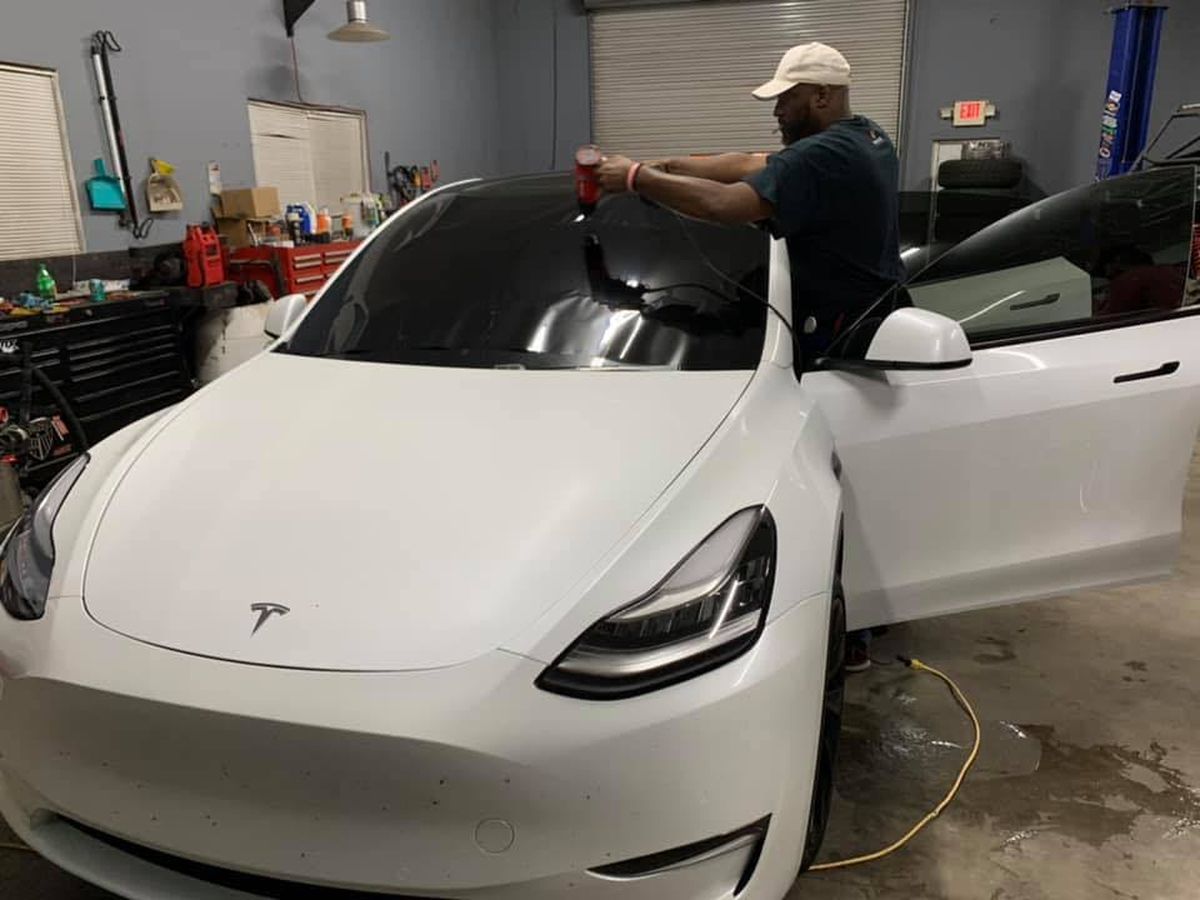
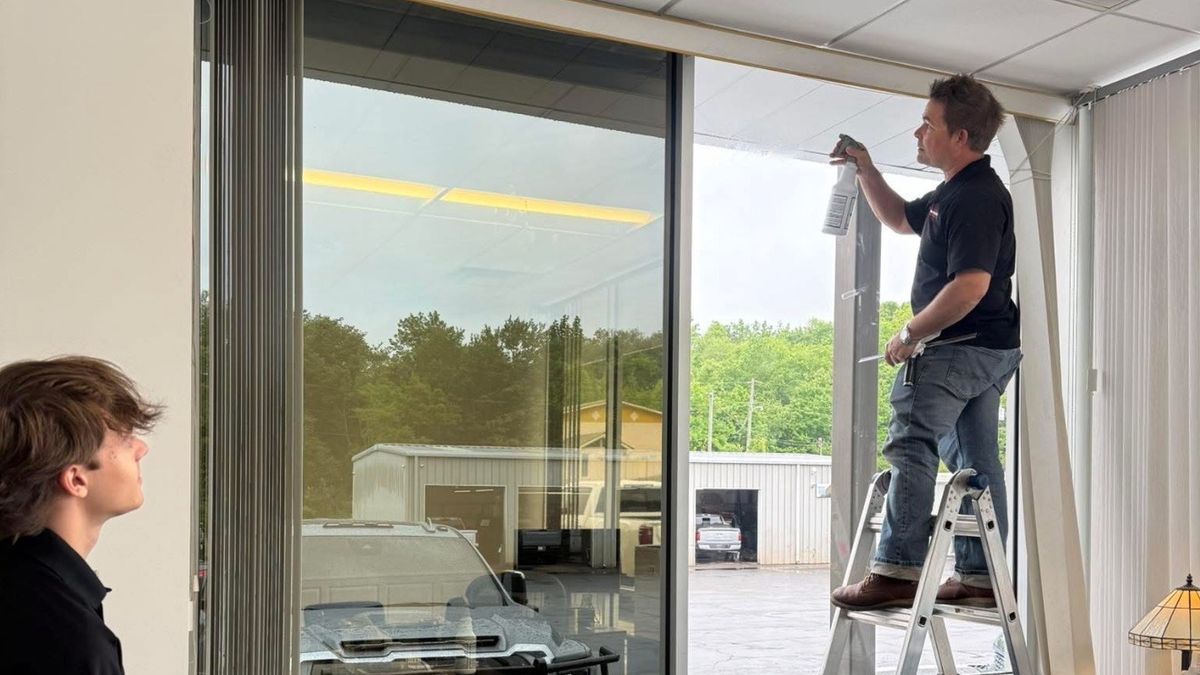
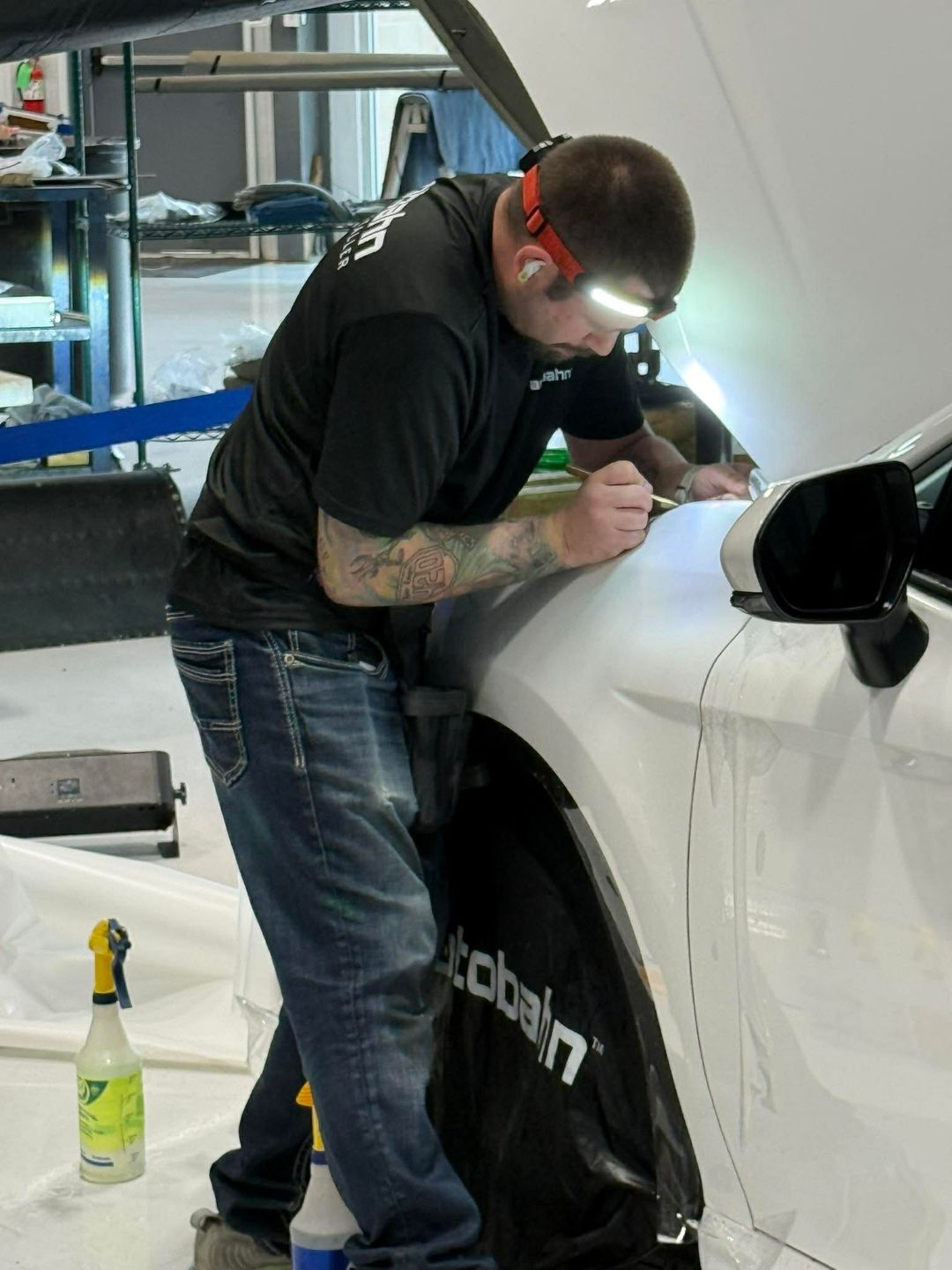
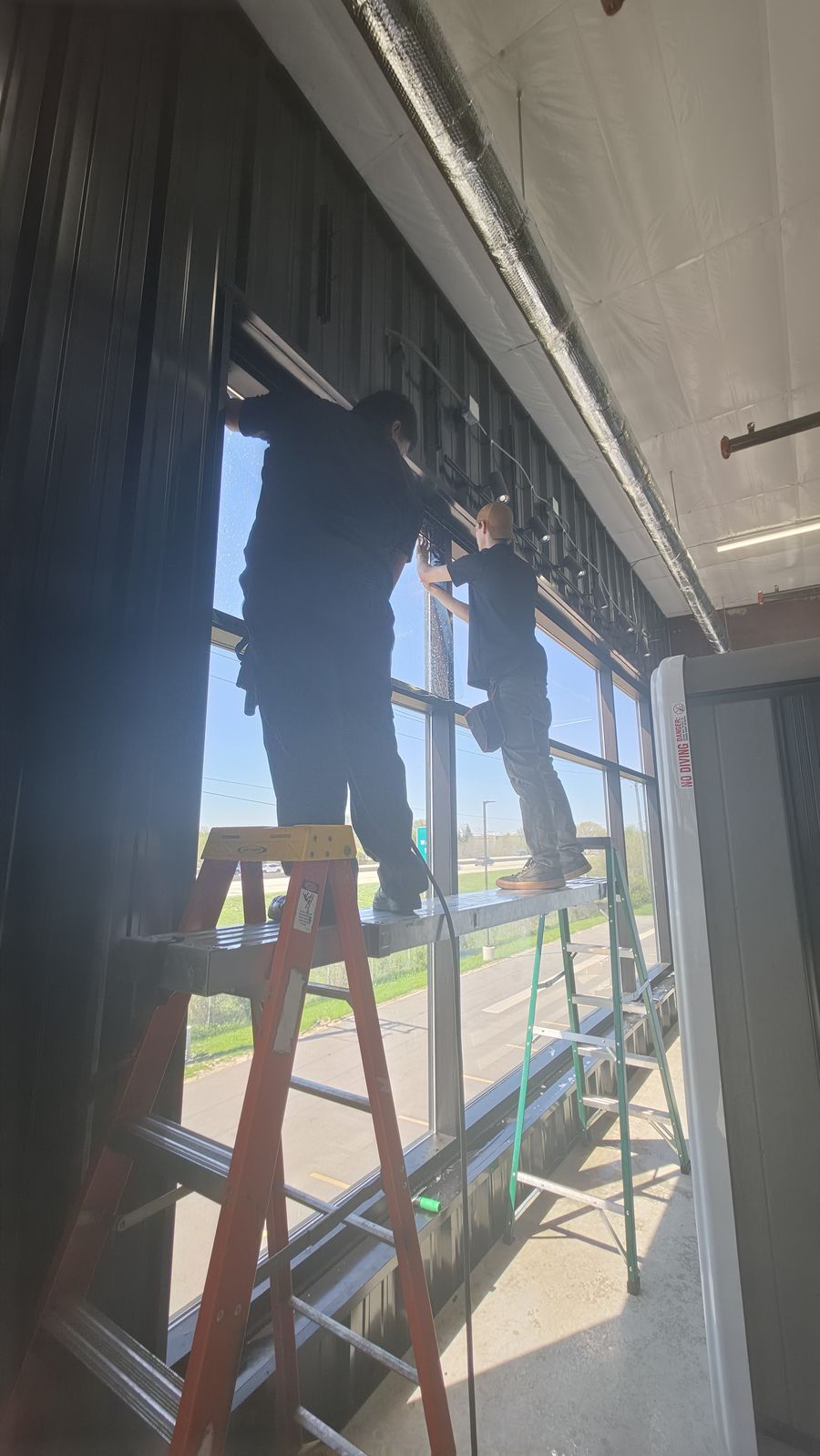
The trade today: an installer heat-working film onto a Tesla windshield at Preferred Window Tinting in Valdosta, Georgia — the liquid’s great-grandchild, laid on by hand.The modern craft on big glass: film going onto a storefront pane at Performance Window Tinting in Carrollton, Georgia — Les Helton’s shop, where the WFR pilot program runs.
The Makers
The Makers — Window Film
The big chapters above tell the story of the houses every tinter knows. This is the rest of the shelf — every other maker and brand in the window film trade, each with its own history, filed A to Z so a man from any of these companies can find his own name in the book.
Makers A–C
3M
3M is the oldest name in this entire history, and window film is only one chapter of it. The company was founded in Minnesota in 1902 by five businessmen who set out to mine corundum — a mineral prized for abrasives — and discovered instead that their deposit was low-grade anorthosite, nearly worthless for the purpose. The Minnesota Mining and Manufacturing Company survived that false start the way it has survived everything since: by inventing its way out, moving from sandpaper into tapes, adhesives, films and coatings of every description across the twentieth century.
Its window film chapter opened in 1966, when 3M received the first patent for a sun control window film. The breakthrough was marrying metallic coatings to clear polyester film: where the trade's earlier solar treatments were spray-on coatings that streaked and failed, 3M's film delivered durable solar control in a sheet an installer could apply to glass. Three years later, in 1969, the company answered a darker need — a clear security film, developed as bombings in Europe made holding shattered glass together a matter of public safety. When the energy crisis of the 1970s pushed buildings to cut heat loss and gain, 3M was there again with low-emissivity films.
What has kept 3M at the front of the shelf ever since is vertical integration. The company states that it is the only window film manufacturer that produces its own polyesters, adhesives, metals and scratch-resistant coatings — every layer of the film made in-house. Its Prestige Series is built on multilayer optical film technology, a construction of hundreds of layers in a film thinner than a Post-it Note, delivering high heat rejection with no metal in the stack. The Crystalline series pushed nearly-clear heat rejection further still, and the modern range runs from those architectural flagships through automotive ceramic and color-stable lines to Fasara decorative films and safety, security and anti-graffiti films.
Today 3M remains the trade's original patent holder and one of its defining houses — the company that turned window film from a sprayed-on experiment into a manufactured product, and then spent sixty years refining what that product could do.
The refinement has its own dated milestones in 3M's published record. In 1998, 3M invented the first multilayer window film — the optical construction that became its signature. In 2006 it introduced the Prestige Series, which its own brochure calls the first selective reflecting film: metal-free, nearly clear, and tuned to perform best when the sun is highest and hottest. In November 2007, 3M joined the Clinton Climate Initiative's global procurement agreement, with five of its window films — two of them Prestige — chosen to cut energy use across forty of the world's largest cities. The safety side matured in parallel: the Scotchshield Ultra safety and security films are built of 28 tear-resistant layers, and the Ultra Prestige line marries that construction to Prestige solar control, while the Prestige Exterior films took the metal-free multilayer construction outside the glass as the first non-metalised exterior-applied film of their kind. One patent in 1966 became, across six decades, the industry's deepest film catalogue.
The catalogue's working range fills out the picture: the Night Vision series for low-reflectivity night comfort, the Traditional Series of metallised films, and the Crystalline and Ceramic IR automotive lines — all of it sitting inside a parent whose brand stable (Scotch, Post-it, Scotchgard, Thinsulate, Command) makes 3M one of the few companies in this book whose name a customer already knows before the word "film" is ever mentioned.
Aegis Films
Aegis Films debuted in the window film business in 1992 out of Norcross, Georgia, with a simple model: manufacture the highest quality film it could and back it with exceptional customer service. The company actually started a step earlier in the chain — developing scratch-resistant coatings for other film manufacturers — which gave it an insider's understanding of coating and laminating before it ever sold a roll under its own name. Aegis went on to build a state-of-the-art facility of its own and grew from its Mid-Atlantic base into a national supplier, with offices in Virginia, North Carolina, Florida and Arizona alongside the Georgia headquarters.
That coatings-first origin matters more than it might look. The scratch-resistant layer is the part of a film an installer touches every day — it decides how a roll handles, how it cleans, and how it looks five years down the road — and Aegis learned the film business from that layer outward. (One published profile dates the company's founding to 1991; Aegis's own copy dates its debut to 1992, and that is the wording this history keeps.) From its own facility, the company moved from coating other makers' film to manufacturing and selling a full line under the Aegis name, and its office map tells the growth story plainly: Ashland, Virginia; Lumberton, North Carolina; Boynton Beach, Florida; and Scottsdale, Arizona, all feeding out of the Georgia base. Aegis stands in this book as an example of a quieter American path into the trade — no giant parent, no famous brand acquisition, just a coatings specialist that became a manufacturer and a national supplier on the strength of the product itself.
Apollo Window Film
Apollo Window Film is a Dallas, Texas brand that has been in the automotive film market since 2008, when distributors like A&W brought the line into their families. Apollo sells through authorized dealers only — it does not install film itself — and its dealers describe the film as proudly manufactured in the USA. The lineup runs from the affordable carbon CSX series through the Cool IR range to the flagship SKY IR nano-ceramic series, with warranties from three years to lifetime depending on the series. Its slogan says it plainly: "The Best Window Film Under the Sun."
Apollo's structure is worth understanding, because it is the opposite of the retail brands elsewhere in this book. There is no Apollo storefront and no Apollo installation bay: the brand exists to supply professional dealers, and the dealer is the face the customer meets. That dealer-only discipline shapes the product ladder, too. The CSX series is the working carbon film — color-stable, priced for everyday cars. Cool IR steps the range into infrared-rejecting territory, and SKY IR sits on top as the nano-ceramic flagship, carrying the line's strongest warranty. From its 2008 arrival in distributor families like A&W's, Apollo has stayed a Texas-rooted specialist: one brand, one channel, and a ladder that lets a shop sell a driver up from honest carbon to full ceramic without ever leaving the same box.
That ladder, read closely, is the trade's own technology story in miniature: carbon film for honest work at an honest price, an infrared line for the driver who feels the heat through the glass, and a nano-ceramic flagship for the top of the market — three generations of construction, one Dallas brand, sold only by the dealers who install it.
APTERIX
APTERIX is one of the newest names in this history, and it came from inside a shop. Supreme Wraps started as a small family-run wrap shop, grew into a national styling name, and spent years installing every premium protection film on the market — it was even a nationally recognized XPEL dealer. Frustrated with the films themselves, Supreme Wraps assembled polymer scientists and materials engineers and landed on polycarbonate — a polymer known for strength and optical purity — as a replacement for the TPU foundation conventional PPF is built on. The result is APTERIX Performance Films: a deliberately top-end line spanning patented polycarbonate PPF, color PPF, windshield and marine film, and the APTERIX:SLR nano-ceramic window tint, sold only through a selective authorized dealer network.
The window film chapter of that story is the APTERIX:SLR line — a nano-ceramic tint that carries the same thinking the company applied to protection film: question the standard material, rebuild from the polymer up, and sell the result only through dealers the company chooses. APTERIX Performance Films LLC stands behind the range with a warranty program (its current warranty terms took effect in April 2025) covering its Pro, Evo, CLR, WPF and AQUA protection lines alongside the SLR tint. In a trade where most new brands start by buying finished film and printing a label, APTERIX began as an installer that decided to become a materials company — and its history is still being written at the top end of the market.
That is the deliberate wager: APTERIX does not compete for the middle of the shelf, and its window tint carries the same top-end brief as its protection films — a dealer's premium option, not a commodity roll.
Armolan
Armolan is a German window film maker founded in 1996. Its European arm, Armolan Europe GmbH, was established in 2008 and is headquartered in Speyer, Germany. Armolan built its name in the European market on solar control, safety and decorative films for cars and buildings, and the Speyer operation became the hub for the brand's work across Europe and beyond. From Speyer, the company continues to develop and sell automotive and architectural window films under the Armolan name — one of the European makers whose story belongs in any honest history of the trade.
The dates frame a deliberate build-out. The 1996 founding put Armolan into the European film trade as Germany's aftermarket matured; the twelve years that followed built the product range and the market, and in 2008 the company formalized its continental operation as Armolan Europe GmbH in Speyer — a Rhine-side city with deep industrial roots — as the hub for its work across Europe and beyond. The range covers the three classic European disciplines: solar control films that answer the continent's strict visible-light rules for cars, architectural films for homes and commercial glass, and safety and decorative films where function and appearance share the same pane. Armolan remains an independent German name in a book full of American giants and Asian factories — proof that the window film trade's map has always had a European workshop on it.
The European context shapes what Armolan makes: across much of Europe, front side windows and windshields answer to strict light-transmission rules, so the continent's makers grew up engineering films that work within the law rather than around it — a discipline visible in Armolan's balance of solar control, safety and decorative lines for both sides of the glass trade, car and building alike.
ASWF — American Standard Window Film
ASWF is the house brand of Erickson International, and it is a true manufacturer's brand: ASWF film is manufactured at Erickson's own factory in Las Vegas, Nevada, where a custom inline system with three coating heads lays down the film's coatings in a single pass. That coating-first design is the brand's calling card — the film's performance is built into its layers at the factory, not bought in as finished film and renamed. From Las Vegas, ASWF supplies automotive and architectural films to dealers across the country.
The company's own telling of its origin reaches further back than the brand. ASWF's published profiles date the brand's establishment under Erickson International to 2006 — some company directories date Erickson International itself to 2009 — and the story the company tells about its beginnings starts in 1996, with four rolls of window film bought, labeled and shipped by hand to a partner in St. Petersburg, Russia. Its own tagline for that arc is "from four rolls in a car trunk to a world-class factory in Las Vegas," and the factory is the point: when outside suppliers could no longer meet the standard the company wanted, Erickson built its own plant from the ground up at 3135 Marco Street — custom machines, proprietary processes, and a footprint spanning more than an acre, run, by the company's account, with near-zero landfill waste. The three-coating-head inline system described above is the heart of it, laying the film's coatings down in a single pass for automotive, residential and commercial lines — a genuine American factory brand, built because its owners decided making film beat buying it.
Autobahn
Autobahn was established in 2011 and grew into a supplier of automotive window film, paint protection film and ceramic coatings built around a national authorized dealer network. Founder David Kratz had entered the industry around the turn of the century — circa 1997 to 2001 — and Autobahn became the flagship of a stable that also runs Hüper Optik USA and Edge. The brand kept expanding: a Brazil launch in São Paulo in November 2023, a South Korea dealer and distribution expansion for 2024, and three new fulfillment centers — Salt Lake City, Atlanta and Orlando — announced in May 2025.
Autobahn's own published history — the company calls it "A Decade of No Limits" — frames the 2011 founding as a dealer-first answer to the way film usually reaches a shop: instead of film flowing through layers of distribution, Autobahn built an authorized dealer network as the brand's backbone, with the installing shop as the center of the system. That model carried the brand through its first decade and into the three-product stable it runs today — window film, paint protection film and ceramic coatings under one dealer program. The expansion beats since then read like a map being colored in: São Paulo, Brazil in November 2023 put the brand into South America; the 2024 South Korea expansion put dealers and distribution into one of the world's great film-making countries; and the three 2025 fulfillment centers — Salt Lake City, Atlanta and Orlando — shortened the distance between the warehouse and the dealer in every region of the United States. As the flagship of David Kratz's stable, Autobahn now shares that logistics spine with Hüper Optik USA and Edge, whose histories sit alongside this one.
Avery Dennison
Avery Dennison begins with an invention every shop owner has used without knowing it: the self-adhesive label. R. Stanton "Stan" Avery founded the company in Los Angeles in 1935 as Avery Adhesives, having invented the first self-adhesive label — and built the machine to make it. The business he started grew into a global materials company, and in 1990 it merged with Dennison Manufacturing to become Avery Dennison, one of the world's largest producers of pressure-sensitive materials, labels and films.
Window film entered that house through Israel. Avery Dennison's film manufacturing arm is Hanita — the kibbutz-born coatings company whose own history appears in this book — which Avery Dennison agreed to acquire on December 13, 2016, for $75 million, completing the purchase on February 28, 2017. Hanita became Avery Dennison Hanita, run as a distinct business unit inside the larger company, and the house kept investing in it: a plant at Changzhou, China opened in 2019 to serve the Asian market alongside the original Galilee works.
The combination made sense on the factory floor. Avery brought eight decades of adhesive science — the discipline at the heart of every pressure-sensitive film — and Hanita brought coated, laminated and metallized polyester expertise and a working window film business in automotive and architectural lines. Today, when a tinter installs an Avery Dennison film, he is installing Hanita's coating craft backed by the company Stan Avery built from a label machine in 1935 — the adhesives giant and the kibbutz workshop, on the same roll.
The giant's present scale frames the pairing: Avery Dennison today employs approximately 35,000 people in more than fifty countries, per its own published materials, spanning labels, graphics, retail branding and identification far beyond film — and the window film business it bought in 2017 operates inside its Materials Group, where Hanita's coated, laminated and metallized polyester lines feed automotive aftermarket and architectural customers worldwide. In a trade where most brands answer to a film company, Avery Dennison's answer to a materials empire — one that began with a single inventor's label in 1935 and now puts its name on the film in the box.
The other half of the 1990 merger has its own long history, and it did not start in Boston. Aaron Lufkin Dennison, a Boston jeweler, started the business in 1844 in Brunswick, Maine, with his father Andrew, making hand-built paper boxes for jewelers and watchmakers; his younger brother Eliphalet Whorf Dennison built it into an industrial firm, saw the unmet need for good merchandise tags and labels, moved the works to Roxbury, Massachusetts, and incorporated it as the Dennison Manufacturing Company in 1878. Under president H.K. Dyer the company moved in 1896–97 to Framingham, Massachusetts, where for ninety years it was the town's chief employer — "the largest tag works in the world" — across boxes, tags, labels, crepe paper and sealing wax, later joined by gift wrap, mailing labels and office products. Henry S. Dennison, president from 1917 until 1952, became a nationally known industrial reformer and an adviser to President Roosevelt. Dennison and Avery had negotiated on and off since 1941; in the fall of 1990 they finally merged — the company-history account puts Avery's bid at $287 million, contemporary reporting called it a stock swap, and Avery's own later filings describe a subsidiary merged into Dennison before the combined house took the Avery Dennison name — ending Dennison's 146 years as an independent company.
Bekaert
Bekaert's road to window film started with farmers' fences. In 1880, in Zwevegem, Belgium, Leo Leander Bekaert — a young general-store owner — saw his farming neighbors losing cattle through broken fences and began producing barbed wire, twisting wire around nails spaced along the strand. He filed his first patent in June 1881, added steel wire rod production in 1894, and the workshop he started grew across the twentieth century into the world's leading producer of steel wire and steel cord — the company whose cord reinforces roughly one radial tire in four.
The connection to film is coatings. Bekaert built a deep expertise in advanced materials and vacuum coating — including sputtering — and that expertise became Bekaert Specialty Films, a specialized-films business making solar control window film for vehicles and buildings. In 2001 Bekaert acquired the specialty films business that carried the Solar Gard name, and over the following decade built it into a global market leader from plants in San Diego, Belgium and China. Then, on August 10, 2011, Bekaert signed the sale of that business to Saint-Gobain Performance Plastics; the deal closed during 2011, and Bekaert's decade as one of the biggest names in window film ended by design — the Belgian steel-wire house had decided films no longer sat at its core. The Solar Gard story continues under Saint-Gobain in this book; Bekaert itself remains what it was in 1880, a family-rooted Belgian industrial giant, publicly listed in Brussels and still headquartered a short walk from where Leo Leander twisted his first wire.
The specialty films business Bekaert acquired in 2001 can now be named precisely, from the seller's own SEC filing: it was MSC Specialty Films, Inc. of San Diego — formerly Deposition Technologies — sold by its parent, Material Sciences Corporation, in a transaction that closed June 29, 2001 at $122,137,195, and it carried Solar-Gard International, the Florida distribution house MSC had owned since 1995, with it. The full telling of that San Diego house stands inside the Solar Gard history in this book.
Commonwealth Laminating — SunTek's Maker
Commonwealth Laminating & Coating of Martinsville, Virginia, is the company that created SunTek — and its roots reach into the same Martinsville film country as LLumar's. Trade-press histories trace the lineage to Joe Cobbe, who started Commonwealth Film in 1985, a company that dyed window film, and then co-founded Commonwealth Laminating & Coating in the early 1990s; business-press sources date the company's founding to 1995, when its plant at Martinsville's Patriot Centre opened. Both dates stand in the record, attributed to their sources, because both describe real chapters: the 1985 dye-house origin and the 1990s laminating company that grew from it.
Cobbe was an owner of the company for fifteen years, and the brand he and his partners built took its mark early: the SunTek trademark's first use dates to October 31, 1998. The company invested like a manufacturer that intended to stay — in 2003 it bought a new Black Clawson coating and laminating line for SunTek production, housed in a 12,000-square-foot addition to the Martinsville factory, running webs up to 74 inches wide with the optical cleanliness window film demands. Distribution was Commonwealth's own, dealer-direct through centers that included Martinsville, Houston, Phoenix and Dania Beach, Florida, and the reach went global — a Shanghai subsidiary followed in 2007 as the Asia-Pacific outlet.
Ownership passed through private equity on the way up: a Riverside buyout in 2006 and a secondary round with TRP Capital and Fenway in 2010, per acquisition records. By 2013 the company was doing roughly $100 million in sales with about 170 employees, and its president and CEO, Steve Phillips, publicly endorsed what came next: Eastman Chemical's acquisition, completed in December 2014 for $438 million, per Eastman's own SEC filing. The purchase brought Eastman the Martinsville plant, the master distribution center and nine sales distribution centers — and the SunTek brand, whose standalone history sits in this book under its own name.
Cosmo Sunshield — Cosmo Films
Cosmo is the giant on this list that most American tinters have never heard of. Founded in 1981 in India by Ashok Jaipuria, Cosmo Films pioneered BOPP film in India; with its 2009 acquisition of GBC's commercial print business it became the world's largest producer of thermal lamination films, and today it stands among the top specialty film makers in the world. Window film is the company's newest chapter: under its Cosmo Consumer arm, the Cosmo Sunshield line took automotive and architectural window films — alongside paint protection film and ceramic coatings — to market in 2025, the latest move in a four-decade film career.
The four decades behind that newest chapter are the real story. When Ashok Jaipuria founded Cosmo in 1981, biaxially oriented polypropylene — BOPP, the film inside countless labels, tapes and packages — was barely made in India at all; Cosmo pioneered it there and rode the country's packaging boom into one of the largest specialty film businesses in the world. The 2009 GBC acquisition is the landmark: buying the commercial print business of America's GBC made the Indian company the world's largest producer of thermal lamination films overnight, a genuine turning point that put Cosmo's film on documents and books on every continent. The company's own investor materials describe the latest turn plainly: through Cosmo Consumer, the house is scaling up window films, paint protection film and ceramic coatings — sold as Cosmo Sunshield — in 2025. It is the same play Cosmo has run since 1981: master a film technology at industrial scale, then carry it into the next market.
The American business Cosmo bought in 2009 has its own history worth the paragraph. General Binding Corporation — GBC — was founded in Chicago in 1947 by William N. Lane and two partners, who bought a small trade bindery to help printers bind and laminate faster and more reliably. GBC became the name in document finishing: it introduced the first electric desktop mechanical binding punch in 1961 and the tabletop laminator in 1966, and grew into the global leader in binding and laminating equipment and supplies, with $712.3 million in sales in 2004. In 2005 Fortune Brands spun off its ACCO World office-products unit and merged it with GBC, closing that August to create the new ACCO Brands Corporation — GBC's shareholders held about a third of the combined company, and the GBC name continued inside it. What Cosmo bought in January 2009 was one piece of that house: GBC Commercial Print Finishing, the thermal lamination film and binding equipment unit, with about $100 million in annual revenue and plants in the United States, the Netherlands and South Korea, purchased from ACCO Brands for a sum undisclosed at announcement. That single unit is what made the Indian film maker the world's largest producer of thermal lamination films.
Courtaulds
Courtaulds is the British ancestor standing behind the Martinsville film empire, and its story starts in silk. The company was established in 1794 as George Courtauld & Co by George Courtauld and his cousin Peter Taylor, a silk, crepe and textile business at Pebmarsh in north Essex. When the firm hit financial difficulty, George's son Samuel took it over in 1816 and built it — mills at Bocking and Halstead — into one of Britain's leading textile houses. Across the following century Courtaulds became the world's leading producer of man-made fibers, the company of rayon, and a British industrial institution; a later Samuel Courtauld, chairman from 1921, is remembered as the founder of the Courtauld Institute of Art in London.
The window film chapter came near the end of the company's independent life, and it came through Virginia. In 1987 Courtaulds acquired Martin Processing, the Martinsville dyeing-and-film pioneer whose story is told in this book; a California plant followed in 1988 (later closed, its assets moved to Martinsville) and Gila River Products in 1989. Out of that Martinsville base, trade histories record, Courtaulds formed its performance films company in 1989 — the CPFilms operation behind LLumar, Vista, FormulaOne and Gila. In 1990 Courtaulds split itself in two — Courtaulds plc for chemicals and fibers, Courtaulds Textiles for fabrics — and in 1998 Akzo Nobel acquired Courtaulds plc, in a deal valued at about £1.83 billion, and renamed it. The film business outlived the parent: Akzo Nobel's house sold CPFilms to Solutia in 1999, and the Martinsville works Courtaulds assembled still make film today under Eastman.
CPFilms
If you have ever installed LLumar, Vista, FormulaOne or Gila, you have installed CPFilms — most installers just never saw the name on the box. CPFilms began as Courtaulds Performance Films, formed in 1989 when Britain's Courtaulds bought Martin Processing and other film makers and combined them at Martinsville, Virginia. By fiscal 1998 the company was doing about $130 million in sales with plants in Martinsville, Canoga Park, California and Runcorn, England. In April 1999 Solutia bought CPFilms for $200 million, and the Martinsville operation — the factory behind four of the trade's best-known brands — passed to Eastman with the Solutia acquisition in 2012.
The roots under that 1989 formation run deeper, into dye vats. Martin Processing had started in 1956 dyeing polyester fibers, patented the deep-dyeing of polyester film in 1960, and become the place where American dyed film was born; Courtaulds acquired it in 1987, and the performance films company formed two years later combined that Martinsville craft with the other film operations Courtaulds gathered. Plastics News, reporting the April 1999 sale, put the full measure of what Solutia bought on the record: about $130 million in sales in the fiscal year ended March 1998, 635 employees, the three plants, and the product lines — Vista, Formula One, LLumar and Gila. Under Solutia the Martinsville operation kept growing: a $30 million expansion followed in March 2001. The CPFilms name itself faded from the boxes as Solutia and then Eastman ran the business under the brand names, but the factory system it named — Martinsville above all — remains the beating heart of the world's biggest window film house, and the reason four separate brand histories in this book all trace back to one Virginia town.
CPFilms also had a human face the trade knew well. Ken Vickers, a native of England, ran the Fieldale operation as president of Courtaulds Film — the company that became CPFilms — from the early 1990s until 2006, then served as its president emeritus. When he died in May 2021, the Martinsville Bulletin's remembrance quoted Jim Ford, the international sales manager for Madico, calling Vickers "our industry's greatest product ally": a man who advanced window film nationally and internationally, lobbied at the European Window Film Association's conference in Madrid for positive legislation for the trade, and set the standard, in Ford's words, for the industry he helped build. The corporate name is gone from the letterhead; the men who ran it are part of the record too.
Makers D–G
Eastman Chemical — The House Behind LLumar & SunTek
Eastman Chemical began as one man's supply problem. When World War I cut off the chemical supplies Kodak needed, George Eastman decided his company would make its own — and in 1920 he founded Tennessee Eastman in Kingsport, Tennessee, buying 35 acres and the federal government's unfinished wood-distillation plant and incorporating the company on July 17, 1920, with $3.5 million in capital. For more than seventy years the Kingsport works grew inside Eastman Kodak as its chemical arm, until 1994, when Kodak spun it off as the independent Eastman Chemical Company, listed on the New York Stock Exchange under the ticker EMN.
Window film entered that house in one stroke. On July 2, 2012, Eastman completed its acquisition of Solutia — a deal valued at roughly $4.7 billion including debt, per the companies' joint announcement — and with Solutia came its entire Performance Films shelf: LLumar, Vista, FormulaOne, Gila, Hüper Optik, V-KOOL, IQue, EnerLogic and Sun-X, plus the great Martinsville, Virginia manufacturing complex behind them. Eastman was not done. In December 2014 it completed the acquisition of Commonwealth Laminating & Coating for $438 million, per its SEC filing, adding the SunTek brand and a second Martinsville plant. In September 2021 it added PremiumShield's pattern business. Each purchase folded another shelf of the trade into the same house.
Today Eastman Chemical is a global specialty materials company of roughly 14,000 employees and more than three dozen manufacturing sites, and its Eastman Performance Films business is the largest house in window film — the maker behind more of the brands in this book than any other single company. A chemical works George Eastman built to keep his film stock supplied became, a century later, the company that makes the film on the world's windows.
The modern scale of the house is a matter of public record: Eastman's own filings put its fiscal 2024 revenue at about $9.4 billion, with 36 manufacturing facilities and equity interests in four more joint-venture plants across a dozen countries, still headquartered in Kingsport. The company reports in four segments — Additives & Functional Products, Advanced Materials, Chemical Intermediates and Fibers — and Performance Films sits inside Advanced Materials, alongside the Saflex polyvinyl butyral interlayer business Eastman also inherited from Solutia: the film on the glass and the layer inside laminated glass itself, under one roof. Its modern leadership sits in Kingsport too, where chairman and chief executive Mark J. Costa runs the house George Eastman founded to keep a camera company supplied.
Edge
Edge is the third brand in the stable David Kratz runs alongside Autobahn and Hüper Optik USA, covering window film for automotive, residential and commercial work. Edge shares the family's authorized dealer network and its logistics: when Autobahn, Hüper Optik USA and Edge opened three new fulfillment centers — Salt Lake City, Atlanta and Orlando — in May 2025, Edge dealers were part of the same coast-to-coast expansion. In the Kratz family of brands, Edge is the line that keeps the dealer network stocked across all three nameplates.
Edge's published record is a working brand's record — it shows up where the stable does business. The brand appears alongside Autobahn and Hüper Optik USA in the stable's own releases, including a 2022 territory-manager hire that presented the three nameplates as one dealer family, and in the May 2025 fulfillment announcement that named all three brands as the network the new centers serve. No founding year for Edge has been published, and this history claims none. What is documented is the role: within David Kratz's three-brand system — Autobahn the flagship, Hüper Optik USA the nano-ceramic pioneer, Edge the line covering automotive, residential and commercial work across the same authorized dealer network — Edge dealers draw on the same fulfillment spine from Salt Lake City to Orlando.
Read the three nameplates as one system and Edge's place in it sharpens: Autobahn is the flagship, carrying window film, paint protection film and ceramic coatings; Hüper Optik USA is the patented nano-ceramic import; and Edge is the breadth brand, the line whose stated coverage — automotive, residential and commercial window film — spans every counter a dealer works. A stable built that way does not need Edge to be the loudest name on the shelf; it needs it to be the one that is never out of place, in any bay or any building, anywhere the network reaches.
FlexFilm
FlexFilm's history starts the way a lot of tint history starts — in a driveway. Ralph Van Pelt began tinting in a Ranburne, Alabama driveway in 1987, opened his first shop, Special FX, in 1996, and in 2011 turned that installer's education into FlexFilm, a film brand and store built for working shops. FlexFilm's dealer model is its signature: no buy-ins and no quotas — a shop orders what it needs, when it needs it. It is a brand built by an installer, for installers, and it describes itself exactly that way.
Read the three dates as one education. The driveway years, from 1987, taught Van Pelt film the way every mobile-era tinter learned it — on real cars, in real heat, with no warehouse behind him. The Special FX shop, opened in 1996, taught him the counter side: what it costs a working shop when a supplier demands buy-ins, quotas and minimum orders just to carry a line. FlexFilm, opened in 2011 in Ranburne, is what he built with both lessons in hand — a film brand and store whose dealer model is deliberately the opposite of the quota system: order what you need, when you need it, and nothing more. The brand's range serves automotive and architectural work, but the model is the message, and it is why FlexFilm's own copy describes the company the way installers describe themselves: built by an installer, for installers.
Ranburne itself belongs in the story — a small town in Alabama's Cleburne County, about as far from a film factory or a trade-show floor as the industry gets. FlexFilm's point, made by its address as much as its dealer terms, is that a working tinter in a small town can build a brand the whole trade can order from.
FormulaOne
FormulaOne is LLumar's premium automotive line — the film you cannot simply order. Made by Eastman Performance Films, FormulaOne is sold exclusively through LLumar's SelectPro dealer network, a vetted group of shops held to the manufacturer's highest standards; one Virginia SelectPro dealer records that it has been installing FormulaOne since 2000. The range runs through the Classic, Comfort and Pinnacle series up to Stratos, its highest heat-rejecting ceramic film, and FormulaOne carries LLumar's best transferable lifetime warranty. For drivers, the SelectPro badge is the whole point: the film and the installer come as a matched pair.
The SelectPro gate is the brand's founding idea, and it explains the ladder on the shelf. Classic is the entry series, Comfort the step into stronger heat rejection, Pinnacle the long-running ceramic flagship name, and Stratos the top — the series Eastman positions as the line's highest heat-rejecting ceramic film. Because every series is SelectPro-only, the warranty can be what it is: LLumar's best transferable lifetime coverage, written to follow the car to its next owner, a promise a manufacturer can only make when it controls who installs the film. The line's documented presence reaches back at least to 2000 — the year one Virginia SelectPro dealer records it began installing FormulaOne — and a quarter-century on, the arrangement has not loosened: no SelectPro badge, no FormulaOne. In the Eastman house, FormulaOne is the automotive flagship's flagship — the film above the film.
It is also, structurally, the purest expression of the idea this book keeps meeting: in a trade built on rolls of material, the scarcest thing is a trusted installer. FormulaOne's whole architecture — vetted network, exclusive series, transferable warranty — exists to sell the pair together, film and craftsman, as one product.
Garware Hi-Tech Films
Garware's story begins in the Depression, with cars. Bhalchandra Digambar "Abasaheb" Garware built the family business from Garware Motors in 1933 — buying used cars in London and building a motor trade in India — and the house moved into plastics in the war years, making buttons for the Navy among its early products. The film chapter opened a generation later: Garware Polyester was incorporated in June 1957, and under Shashikant B. Garware the company became a genuine pioneer — in 1975 it pioneered biaxially oriented polyester film in India, followed by metallised film at Aurangabad in 1976, made without foreign collaboration, electrical insulation films in 1977, and a UV-stabilised polyester film in 1982 that made the company's name around the world. The Government of India recognized the import-substitution work with a Gold Shield in 1981.
From that polyester base — plants at Aurangabad (Waluj) and Nashik — window film was a natural shelf: Garware sells sun control film as Garware Suncontrol in India and as Global Window Films in Western markets, the brand whose own history appears beside this one. The modern company has kept moving: paint protection film production commenced in 2020, the house renamed itself Garware Hi-Tech Films effective April 20, 2021, and a laminated sun control film line was commissioned in its 2022–23 financial year. Its home market also gave it the trade's sharpest lesson in regulatory risk: when India's Supreme Court banned aftermarket tint in May 2012, Garware's domestic automotive market vanished overnight, and the company leaned on the export markets — by its own and investor accounts, more than ninety countries — that its Western brands were built to serve.
GeoShield
GeoShield grew up somewhere no other film brand did: a university technology park. Based in Baton Rouge at Louisiana State University's Louisiana Business and Technology Center, GeoShield says it has been advancing window film since 2005, building its reputation on nano-ceramic films for automotive and architectural glass. Its North American sales and distribution hub, Geoshield USA, supplies dealers from those same Louisiana roots — a small maker that turned a research-park address into a national film brand.
The two men behind it are named in LSU's own records. The university's LSU 100 roster of its fastest-growing graduate-led businesses lists Geoshield as founded in 2005 under Beau Dingler, class of 2005, and Burns Mulhearn, class of 2003, and the technology center's 2012 awards program still presented the company under the same two names — young graduates who built a film company inside the incubator in the same years they left campus. The legal house behind the brand is SOCO Plastics, LLC, doing business as Geoshield, and the federal trademark record gives the start its sharpest date: the company's sworn first use of the Geoshield name is October 20, 2005.
The research-park address is more than a mailing detail — it shaped the brand. The Louisiana Business and Technology Center is LSU's business incubator, a place built for young technology companies, and GeoShield grew up inside it behaving like one: the company's own "Our Journey" history dates its advancing-film work to 2005 (an older company deck says 2006; this history keeps the current official page's date) and tells a story of a small Louisiana team building a name on nano-ceramic construction while the giants fought over metalized film. The product identity followed the origin — nano-ceramic lines for automotive and architectural glass, sold on heat rejection without the signal interference and mirror look of metal. Geoshield USA, the North America sales and distribution hub, supplies the dealer network from the same Baton Rouge roots. Small, technical and stubbornly itself, GeoShield is the trade's university-incubator success story.
The young company's first fight was over its own name. Its first federal trademark registration, granted in December 2009, covered the words GEO WINDOW FILMS, and it carried a first-use date of March 2006 — which is why a 2006 date sits in the record alongside the 2005 one, and both years still follow the company. In May 2010, Wintech America, Inc., which traded as Geo Windowfilms, petitioned the U.S. Trademark Trial and Appeal Board to cancel that registration; SOCO Plastics let the case go unanswered, and a default judgment cancelled the registration that August. Geoshield simply went forward under the name it had used since 2005, and when it registered the single-word GEOSHIELD mark in 2017, it claimed the same October 2005 first use it had started with.
By then the incubator tenant had become a growth story the university could point to. In November 2012 the technology center named Geoshield its International Client of the Year, and in 2013 the LSU 100 ranked it 47th among the fastest-growing Tiger businesses; the company's own profile of the era says it made the list two years running. The founders were Baton Rouge business figures in their own right by then — in August 2010 the Baton Rouge Business Report found Mulhearn and Dingler organizing Seashore Environmental, a coalition of some fifty small businesses that had been shut out of BP's oil-spill recovery work, pressing for local companies to get a share of it.
The business model was set early and never really changed: develop and distribute, dealers only. Geoshield USA was established as the company's marketing, sales and distribution office for North America rather than a coating plant of its own, and its early profile copy sold spectrally selective, metal-free ceramic film under the slogan "Block the Heat, Maintain the Vision," presenting the company as an ENERGY STAR Partner. The early flagship approach was the GEO Series, built on American nano-ceramic titanium nitride sputtering technology; the shelf that grew from it — ProNano ceramic, the C2 carbon line and the deep-dyed Pro Classic — carried the brand until the APEX super ceramic took the head of the line around 2020.
Its timing tells the rest of the story. GeoShield's 2005 start put its founding right at the front of the nano-ceramic wave — the years when the trade's center of gravity shifted from dyed and metalized film toward ceramic constructions — and a brand born inside a university technology center was built, from its name on down, to ride exactly that shift rather than chase it.
Gila
Gila is the do-it-yourself face of the biggest house in film. Gila window film was manufactured by Solutia's Performance Films division — the same Martinsville lineage behind LLumar — specifically for the DIY home-improvement and automotive aftermarket, and the brand passed to Eastman Performance Films with the rest of that business. Where the pro brands sell through dealers, Gila sells off the rack at auto parts stores nationwide: pre-cut kits, rolls and application tools, with step-by-step instructions and how-to videos made for a first-timer in a driveway. For a lot of American drivers, a Gila box from the parts store was their first meeting with window film.
Gila's place in the family tree is older than most installers realize. When Plastics News reported Solutia's 1999 purchase of CPFilms, Gila was listed right alongside LLumar, Vista and Formula One among the Martinsville product lines — the retail brand was part of the factory's core shelf from the beginning, not an afterthought. The division of labor inside that shelf is the point: LLumar goes to dealers, FormulaOne to SelectPro shops, Vista to buildings — and Gila to the parts-store rack, where the customer is a car owner with a Saturday afternoon. Eastman Performance Films still stands behind the brand today, and the supporting cast around the film — application solution, squeegees, trimming tools, pre-cut kits sized to popular vehicles — exists because a do-it-yourselfer gets exactly one chance to lay a rear window right. Every pro in this trade has met a customer whose first tint job was a Gila kit; the brand is the industry's front porch.
The maker behind the name deserves its own telling, because Gila began as a company before it was a brand on a rack. Gila River Products, Inc. was a Chandler, Arizona plastics and window-film house, and for most of its documented life it was run by one man: George E. Berkner, its President and Chief Executive Officer from 1972 until 1990, by the record of an SEC proxy filing made after he joined another company's board. What Gila sold, it spelled out to the U.S. Patent and Trademark Office: its GILA RIVER registration, filed in 1982, lists tinted, laminated, reflective and shatter-resistant plastic film in bulk rolls and pre-cut form for homes and auto windows, spray adhesive, application kits and display racks — claiming first use in commerce in 1973 for its distributorship services and in 1976 for the film itself. Popular Mechanics was already pointing readers to the company's Chandler address in October 1981, and Johnson's own brochure records the trade's other early tie: the first window film Johnson Laminating ever made, in 1975, was made for Gila River Products.
Gila developed its own constructions, too — two U.S. patents stand in its name, naming Dell B. Oliver of Gilbert and Peter Jahoda of Chandler as inventors: a solar control film of vacuum-deposited metal layers on polyester, issued in 1987, and a solar film with a graded dark band above a driver's sight line, issued in 1989. The end of independence came in the same consolidation that gathered Martin Processing: Courtaulds acquired Gila River Products in 1989, on the Eastman-presented timeline reported by the Martinsville-Henry County Historical Society, and closed the Chandler operation in 1992. The name outlived the plant — Gila stood in the trademark list when Solutia bought CPFilms in 1999 and on Solutia's brand shelf when Eastman acquired that house in 2012, and the GILA mark is held today by Eastman Performance Films, still sold, as it began, as a do-it-yourself film. The Arizona maker is gone; the desert name it put on film in the 1970s is still on the shelf.
Global Window Films
Global Window Films is the Western face of India's Garware — the brand under which one of the world's oldest polyester houses sells its sun control film in the United States and other Western markets, while the same film wears the Garware Suncontrol name at home. The brand is registered in the USA and marketed by Global Pet Films Inc., the American arm of the Garware group, and its top sun control tier is its QDP Ceramic line.
Its American distribution history has two distinct eras. In the first, Garware ran its own United States depot, stocking and shipping film itself. Around 2010 the model changed: the company appointed five exclusive United States distributors to cover all fifty states between them — three of which (Express Window Film, Dragon Distributing and Solar Control) also carry brands of their own — and Global has worked through that distributor network since. How big is the brand in its home company's telling? Garware's own accounts, as followed in investor research on the company, describe Global as the third-largest window film brand in the United States after 3M and Eastman — a company claim this history records as the company's, in a market where independent brand rankings are not published. What is not in dispute is the lineage: Global rolls carry the output of the polyester pioneer whose 1975 and 1982 firsts are told in the Garware Hi-Tech Films history beside this one.
Two eras, one lesson: whether Garware stocked the shelves itself or works through its five exclusive distributors, Global's American business has always rested on the same foundation — an Indian polyester pioneer with its own base film, selling west under a name registered for the purpose.
GSWF
GSWF is a paint-protection-first brand: its Defender line of paint protection film is the flagship, and Defender Smoke carries the name into window tint. The brand promotes itself on scale and reach in its own channels, and it has become a familiar sight in the protection film world. One caution this history keeps on the record: GSWF is not Global Window Films and not a Garware brand, despite the similar initials — those companies' histories are separate, and this book treats them separately.
That short record is an honest one, and this history would rather print it short than pad it. GSWF's documented public footprint centers on its product lines: the Defender paint protection film that made the brand's name, and Defender Smoke, the tint line that carries the Defender badge onto glass. The brand speaks for itself in its own channels in the language of scale and reach, and this book omits its self-published figures, as it does every maker's, when they cannot be independently verified — and no reliable published source located for this history fixes the brand's founding date, which is why none is claimed here. What can be said plainly: in a protection-film market crowded with private labels, GSWF built a name installers recognize on both sides of the counter — paint first, glass second — and it did it under its own four letters, nobody else's.
The Defender naming does quiet work in that story: one badge carried from the paint line to the glass line means a shop that trusts the protection film already knows the tint's name before the first roll is quoted — brand equity earned in one bay, spent in the other.
Makers H–M
Hanita — Avery Dennison Hanita
Hanita is the kibbutz that became a film giant's factory. The company was founded in 1983 on Kibbutz Hanita in Israel's Western Galilee — a farming community near the Lebanese border — as Hanita Coatings, and it built its craft on coated, laminated and metallized polyester films: precision coatings laid on plastic film for a world of industrial and commercial uses, with window film among its defining products.
From that agricultural address, Hanita built a genuinely global business, with sales and distribution arms in the United States, Germany, China and Australia feeding its automotive and architectural film lines into markets on every continent. The turning point came at the end of 2016: on December 13, Avery Dennison agreed to acquire Hanita for $75 million, buying it from Kibbutz Hanita and Tene Investment Funds, and the deal completed on February 28, 2017. The company became Avery Dennison Hanita, run as a distinct business unit inside the adhesives giant — the kibbutz kept its name on the door — and in 2019 a new plant at Changzhou, China extended its manufacturing beyond the Galilee for the first time. Hanita's history is told in full here because window film is where the Avery Dennison name in this trade is actually made: the parent company's entry sits beside this one, but the coating lines on the kibbutz are where the film comes from.
The acquisition record fills in the company's measure at the moment it joined the giant: more than 220 employees, most of them at the kibbutz headquarters and main plant; sales into more than forty countries; and 2015 revenues of about $50 million, per the Globes business report of the deal. The discipline behind those numbers is documented on Hanita's own history pages — ISO 9001 quality certification held since 2001, with individual inspection and computerized tracking giving every roll cradle-to-grave traceability. And window film, for all its prominence in this book, is one shelf of a broader coatings house: Hanita's top-coated polyester films feed the durable labels industry, and its ultra-high barrier films form part of insulation systems for refrigeration, buildings and cold-chain packaging — the kibbutz workshop coats for cold rooms and label presses with the same lines it coats for glass.
Hüper Optik
Hüper Optik was born in a laboratory, on a deliberate mission: in 1994 a research effort set out to build a heat-rejecting window film with no dyes and no metals — the two things that made conventional films fade, interfere with electronics, or turn mirror-bright. The work joined serious institutions: Germany's Fraunhofer-Gesellschaft, Europe's great applied-research organization; Singapore's PSB Corporation; and Southwall Technologies, the Palo Alto pioneer whose own history is in this book. In 1995 the team produced its first prototype — a titanium nitride coating laid down by sputtering, the vacuum process that gives the film its ceramic heart. Hüper Optik International Pte Ltd was incorporated in Singapore in 1997, and in February 2001 the United States granted the patents covering its dual-layer titanium nitride nano-ceramic construction — the basis of the company's claim to the world's first and only patented nano-ceramic window film.
Commercialization followed at the turn of the century — the film reached the market in 1999 and launched into distribution in 2000, manufactured in Dresden, Germany, where the sputtering craft ran deepest. The brand's ownership road then wound through the industry's consolidation: Hüper Optik sat on Solutia's Performance Films shelf, listed among that house's brands when Eastman acquired Solutia in 2012, and so passed into the Eastman portfolio. In the United States today, the brand's distribution runs through a different door — Hüper Optik USA sits in David Kratz's stable alongside Autobahn and Edge, sharing the fulfillment network those brands opened across Salt Lake City, Atlanta and Orlando in 2025 (a dealer source dates the founding of the American arm to 1998). Three decades after a laboratory mission statement, the dye-free, metal-free film the researchers set out to build is still the brand's whole identity: nano-ceramic, patented, and made to reject heat while staying optically quiet.
The research partnership behind the film deserves its full roster: the development joined Hüper Optik's founding company with the Fraunhofer Institute for Electron Beam and Plasma Technology (FEP) in Germany, Singapore's PSB Corporation, Southwall Technologies in the United States and Singapore's Globamatrix Holdings — six years of research, by the trade releases that chronicled it, before commercialization. The material had a pedigree the founders liked to cite: titanium nitride coatings of the same family protected race-car components and NASA hardware, as the brand's Singapore histories tell it. The mature product line is the Extreme (X3) multi-layer series, and the technology drew attention well outside the trade — Popular Science featured Hüper Optik's nano-ceramic films in November 2009, and the coatings journals of Europe and Asia-Pacific profiled the science the following year. By 2010, trade releases were describing Hüper Optik International as a company of Solutia Inc., the St. Louis house — the corporate chapter the brand's main history above picks up — with the films by then selling in more than twenty countries.
Johnson Window Films
Johnson Window Films is a California original — a family company that stayed family-owned for more than half a century. It was founded in 1973 by Alan Johnson, beginning as Johnson Laminating & Coating before the business took the Johnson Window Films name, and it made its home in Carson, California, in the heart of the Southern California market where American tinting culture was being invented around it. The company grew into one of the established American providers of automobile films — business directories describe more than thirty years as a leading supplier to the trade — while the second generation took the helm: Scott Davidson, the second-generation owner, serves as the company's president.
The deeper founding record is richer than the official date alone — the acquisition releases date the founding to 1973, and the company's own brochure tells the longer arc behind it. Alan Johnson founded Johnson Packaging in 1961, a food packaging middleman business; in 1971 he opened Johnson Laminating to make packaging products himself, renaming it Johnson Laminating and Coating in the mid-1970s as the work moved upmarket into pharmaceutical and electronics films. Then came the beat that ties Johnson to half this book: in 1975 the company made its first window film — for Gila River Products, the same Arizona film name that Courtaulds would buy in 1989 on its way to building CPFilms. Johnson worked as an OEM supplier, making film for other companies' brands, until it introduced the Johnson Window Films brand itself in the mid-1980s; Johnson Window Films Inc. followed in 1991 as the official United States distribution arm, opening the company's first factory-direct distribution that year. Alan Johnson ran the company until his passing in 1999. His stepson, Scott Davidson — who had worked at the company since high school — took over, and Johnson Laminating & Coating earned ISO 9001 certification in 2010.
The company's own description, carried in the January 2026 announcements, sums up the house Alan Johnson built: a third-generation, family-owned manufacturer, proudly making its film in America since 1973, on a legacy the announcement states as quality, affordability and trust. That was the Johnson proposition to its dealers for decades — an American maker standing apart from the Martinsville roll-ups and the import houses, selling honest film at honest money — and the support behind it is what the release leads with: a trusted reputation, built over more than fifty years, for high-quality film backed by exceptional customer support.
The Johnson model was the independent's model, run at real scale. Manufacturing and distribution stayed in California, with additional distribution in Memphis, Tennessee, and an Amsterdam-based operation carrying the brand through Europe — a three-continent reach built without a corporate parent. Through the decades when the industry consolidated around it — Martinsville rolling up brand after brand, Asian factories rising, giants buying giants — Johnson remained what Alan Johnson founded in 1973: a family house, on its third generation in the business, selling its own film under its own name.
The range it built carries the family name into every aisle of the trade: InsulatIR nano-ceramic, Marathon dyed/metal hybrid and Renegade films for cars; Solar Silver, Sunset Bronze, DaylightNatural, ScenicView and NightScape for flat glass; Trident safety and security film and Defendor anti-graffiti film — all under the company motto, "The Truth Is In Our Films." That independence ended in January 2026, in the trade's biggest family-business sale in years. Madico announced it had reached a definitive agreement to acquire Johnson Window Films on January 21, 2026, and the completed acquisition was announced on January 30, 2026. Scott Davidson gave the family's reasons in the announcement: he called the transition "a natural and values-driven next chapter for the Johnson brand," saying Madico shares "the same commitment to quality, integrity, and customer satisfaction that my father built this business on and that I have worked hard to maintain for over 30 years" — and he closed it plainly: "I am confident that Johnson Window Films is in excellent hands." The brand continues under Madico — itself a Lintec company — and the family thread continues with it: Scott Davidson's son, William Davidson, carries on leading the Johnson brand inside its new house. The January 2026 sale was structured to keep the Johnson operation Johnson: Madico assumed responsibility for Johnson's manufacturing, sales, customer service and its American and European operations; Johnson's California and Memphis distribution folds into Madico's eight North American service centers, with primary support from Pinellas Park and Madico's Huntington Beach location for the Southern California market; the Amsterdam business came with the deal; and William Davidson — titled director of sales and marketing in the announcement — continues to lead the brand. Many Johnson employees joined Madico in the transition, and Johnson's own website now carries the Huntington Beach address of Madico's Southern California operation — the support point the announcement named for the brand's home market. Johnson's story in this book therefore closes the way it ran for fifty-three years — the name, the film and the family still on the same letterhead, now with Madico's factory and service-center network behind them.
KDX
KDX — Zhangjiagang Kangde Xin Optronics Material Co., Ltd. — is one of China's integrated film giants. The Kangde Xin group entered pre-coated film in 1998; the Zhangjiagang company itself was founded in 2011 and moved fast: a top-level window film production line in 2013, a dedicated window film division in 2014, branded window films in mass production by 2015, and a high-end TPU paint protection film launch in 2016, the same year KDX window film entered European and American markets. KDX runs the full chain itself, from base film to finished roll, and by its own 2025 count holds more than a thousand granted patents.
The timeline deserves a second look, because speed is the story. From company founding to a running window film line took two years; from the line to branded film in mass production, two more; and by 2016 — five years after the Zhangjiagang company existed — KDX was selling window film into Europe and America and launching high-end TPU paint protection film on top of it. That pace rests on the group's longer runway: the Kangde Xin group had been in pre-coated film since 1998, so the 2011 company started with coating craft, capital and base-film supply already in the family. Integration is the through-line — base film, coating, sputtering and finishing under one roof — and the patent wall the company cites (more than 1,700 filed and 1,000 granted, by its own 2025 count) is its way of saying the integration is engineered, not assembled. KDX stands in this book as the clearest example of China's integrated model arriving in the window film trade at full industrial scale.
Lintec
Lintec is the Japanese parent standing behind one of America's oldest film names. The company was established in Tokyo on October 15, 1934, as Fuji Shiko, a maker of gummed tape and adhesive papers; it moved into adhesive films in 1960 and renamed itself LINTEC in 1990. Its window film chapter opened in 1987, when Madico became a Lintec subsidiary — putting the Waltham, Massachusetts film maker inside a Japanese adhesives giant with deep coating science. When you read Madico's history in this book, Lintec is the house it has belonged to ever since.
The corporate path to that 1987 chapter runs through Madico's official timeline: Madico first became a wholly owned subsidiary of FSK in 1987 — FSK being the Japanese house with deep pressure-sensitive adhesive technology — and in 1990 FSK merged with Shikoku Paper Company and Sohken Chemical to form the company known as LINTEC Corporation. Fuji Shiko's own arc — gummed tape and adhesive papers in 1934, adhesive films by 1960, the LINTEC name in 1990 — is the same discipline from the other side of the Pacific: stick things to surfaces, precisely, at industrial scale. It is worth pausing on what that means for the film in an installer's hand. Window film is an adhesive product as much as an optical one — the mounting adhesive decides whether a roll goes down clean and stays down for a decade — and since 1987 the maker of Madico has answered to a parent whose founding craft is exactly that layer.
LLumar
LLumar is the biggest name on the American shelf, and its roots run to one Virginia town. The brand was established in the United States in 1977, born inside the Martinsville film lineage — the dyeing and coating craft built by Martin Processing, gathered by Courtaulds into CPFilms in 1989, and carried forward by Solutia from 1999 until Eastman acquired the whole business in 2012. For most of its life, in other words, LLumar was the flagship brand of a factory system whose name the customer never saw; the brand on the box was LLumar, and the craft behind it was Martinsville's.
The brand went worldwide in 2001, when LLumar expanded globally, and the range matured into the full modern shelf: automotive films from the ATC and ATR series through the CTX ceramic line and the IRX and clear AIR films, architectural films for homes and commercial glass, and safety and security films — made by Eastman Performance Films, with production in Martinsville, Virginia, and, per the brand's current materials, Dresden, Germany. Its dealer architecture became an industry model: the LLumar SelectPro network, a vetted tier of dealers held to the manufacturer's highest standards, is the exclusive home of the FormulaOne automotive line and the Vista architectural line, whose histories sit beside this one. Dealer materials note that LLumar was a founding member of the International Window Film Association. Today LLumar is Eastman's window film flagship — the 1977 brand at the front of the largest house in the trade.
LLumar's own company history makes the scale claim in its own words: Eastman runs "one of the largest and most integrated window and performance-coated film manufacturing sites in the world," serving customers in nearly 100 countries — and Eastman has described its Performance Films businesses outright as the world's leading manufacturer and marketer of high-performance window and paint protection films. The investment continued after the acquisition: in 2017 Eastman announced further manufacturing capacity expansion at Martinsville alongside an aggressive consumer push for the LLumar name — the same year LLumar's architectural films were featured on the home-design television program Designing Spaces, carrying a dealer-installed product onto national TV. Eastman put a consumer agency of record — Chicago-based Schafer Condon Carter — behind the brand the same year, and Eastman's own current brochure describes LLumar plainly as a brand with "a strong legacy of over six decades" — counting, as this history does, from Hermes's 1956 dye works to the present shelf. The current published portfolio sorts the automotive range into four constructions — ceramic, metallised, dyed and clear — across the IRX, CTX, ATR, ATC, AIR and UV Shield series, with the AIR clear films aimed at drivers who want heat and ultraviolet rejection with no visible tint at all; and the SelectPro network the premium lines answer to is itself celebrated inside the trade, with LLumar naming a SelectPro Dealer of the Year from its own ranks.
Madico
Madico's story starts forty-five years before window film existed — with greeting cards. In 1903, three families founded Hy-Sil in Boston, with David Hyman as the company's first president. Hy-Sil made leather greeting cards and printed gift-wrap paper, and it became known for metallized products — gift-wrap ribbons, tinsel, and a luxury wrap of paper laminated with aluminum foil. That metallizing craft was the seed of everything. The company moved to Revere, Massachusetts in 1912, expanded into wrapping paper by 1920, passed the presidency to Eli Hyman in 1930 — and in 1935 its Paul Alexander built the world's first roll-to-roll metallizer, a machine for laying metal onto film in a continuous web.
In 1948, Hy-Sil did the thing this entire history exists to record: it successfully commercialized the first transparent reflective window film product — years before most of the trade's founding names were in business. Two decades later the film business got its own name: in 1968 Hy-Sil formed Material Distribution Corporation — Madico — in Woburn, Massachusetts. The innovations stacked up in Madico's own timeline: reflective films with color in 1974, a protective scratch-resistant coating in 1978, automotive and architectural solar protection film lines in 1979, a high-efficiency copper film produced by electron-beam evaporation and sputtering in 1982, and framing systems for safety film in 1984 — the same year Madico completed what it records as the largest known window film installation on a single building, more than 500,000 square feet of safety film. In 1987 Madico became a subsidiary of the Japanese adhesives house whose successor company is Lintec, the parent it still answers to.
The most visible dividend of the Lintec chapter arrived a generation later, wearing a Japanese name. Wincos is Lintec's own window film brand — the umbrella name over the films the parent develops and makes in Japan for buildings and automobiles alike. Lintec's Japanese film roots reach back to the 1970s, when the company that became Lintec began developing window films that attach to the glass of buildings, and the parent built its automotive film science on infrared: its own overseas materials claim, in Lintec's words, that it "was the first in the pressure-sensitive industry to innovate with the use of infrared radiation technology for automobile window films," a technology it has since carried into building film as well. In Japan the Wincos line is sold in Premium, Medium and Standard series, and Lintec's Indonesian distributor describes the film as made in Japan at Lintec's Agatsuma works. When the parent's premium line came to market worldwide, Madico carried it home: Jeffrey Plummer, Madico's senior vice president of sales and marketing for window films, wrote in Manufacturing.net in May 2014 that the launch of "our Wincos line of premium automotive films in the US market" was a shared research project between subsidiary and parent — Lintec's research center, some two hundred people strong, standing behind Madico's own teams — and that "within a short time, Wincos automotive film was our fastest growing product line." The pitch was the science itself: infrared heat rejection that did not rely on darkness, so a light, code-friendly shade could stop heat like a dark one; Madico's U.S. dealer materials glossed the name as "Window Cosmetics" and listed seven densities, WIN10 through WIN90, almost all of them, the distributor copy claimed, rejecting some 90 percent of the sun's infrared heat. Madico's own consumer brochure of 2020 states the construction plainly: Wincos is "a nano-ceramic IR automotive film" — metal-free, blocking 99 percent of UV rays, and carried by a manufacturer's lifetime warranty. The line is still being written on both sides of the Pacific: in August 2024 Lintec added the high-transparency WINCOS IR-85HD to the Japanese range beside the existing IR-90HD, and in North America Wincos stands today as Madico's ultra-premium nano-ceramic automotive film — the Japanese parent's brand, nearly four decades after the two houses joined, selling through the American subsidiary's dealer network.
The safety and security chapter deepened from there — anti-graffiti films in 1994, the largest open-range blast testing ever undertaken by a single safety film manufacturer in 1999, NFRC certification in 2008 — while the company kept widening the shelf: a ClearPlex windshield protection partnership in 2006 that became a full acquisition of ClearPlex Corporation in 2016, manufacturing expansion to St. Petersburg, Florida in 2010, the Sunscape designer film dealer program and the MadicoU training campus in 2012, the MACS cutting system and a paint protection film introduction in 2015, and the Protekt PPF launch and Black Pearl Nano-Ceramic automotive film in 2018. The ClearPlex chapter also widened Madico beyond glass: the 2016 acquisition brought ProtectionPro with it, an on-demand device-protection cutting business — the greeting-card company's descendant selling film cut to order for phones and tablets. The modern company took its present shape at the end of that decade: a $30 million investment, announced in 2017, built a new world headquarters and plant of 250,000 square feet in Pinellas Park, Florida, completed with the move in 2019–2020, flanked by the retained Woburn operation, a metallizing facility in Louisville, Kentucky, and eight North American service centers. The distribution map filled in alongside: acquiring its Midwest Marketing distribution center in 2018 made Madico's U.S. service 100 percent factory-direct, and acquiring its two Canadian distributors in 2019 formed Madico Canada — factory-direct service across the whole continent. ShopMadico.com, an online store for dealers, followed in 2020. The company's safety work has a civic thread as well — in 2004 Madico teamed with GE to donate safety film protecting childcare centers under Project Safeguard. John Storms became president and chief executive in 2021. The honors kept pace with the growth: in 2025, Madico's Jeffrey Plummer was inducted into the Window Film Hall of Fame, and the company launched its SafetyShield G2 safety film system.
One product name from that era still rings bells with installers of a certain age: Charcool, Madico’s signature automotive film of the late 1990s and early 2000s. Charcool was an extrusion-dyed, color-stable construction — the pigments were impregnated throughout the thickness of the film itself — sold in the shades coded CH5, CH20, CH35 and CH55, and era distributor copy called it Madico’s best-selling automotive window film outright. Its mounting system was Madico’s acrylic pressure-sensitive adhesive: Madico’s own data lists the line as “Charcool 5 PS SR,” “Charcool 20 PS SR,” “Charcool 35 PS SR” — PS for pressure sensitive, SR for scratch resistant — a distinction Madico’s own paperwork draws against the DA mark of a dry adhesive. Who actually supplied that adhesive, Madico never said in print: its specification language calls the system “a proprietary adhesive system,” and no data sheet, patent or trade notice of the era names an outside vendor. The documented structure points inside the family — since September 1987 Madico had sat inside FSK, the company that merged into LINTEC in 1990, a group that develops and coats its own adhesives — and the natural reading, offered as a reading and not as a record, is that Charcool’s glue was FSK/LINTEC-family technology.
Madico had been printing SR in its product names long before Charcool: in 1986, its CL 400 PS SR safety film went onto 10,344 windows of Boston’s John Hancock Tower — an installation the company was still publishing performance evaluations of more than twenty years later.
And in January 2026 Madico wrote the newest chapter of this book, acquiring Johnson Window Films, the California family company founded in 1973 — the oldest American film house absorbing one of its most durable independents, and still, after 120 years, inventing. Madico's road to that door ran through Florida, and it had been building for fifteen years. In October 2010 Madico acquired Solamatrix of St. Petersburg — the maker of the SUN-GARD and GLASS-GARD brands, whose own history stands in this book — and shifted its Woburn film production south into the Solamatrix plant: the St. Petersburg expansion this history recorded in 2010 was that acquisition landing. ClearPlex followed in 2016, the Midwest Marketing distribution business in 2018 and the Canadian distributors in 2019 — a decade and a half of gathering American film businesses into a factory-direct system before the Johnson family arrived. The Johnson deal came in two January steps: a definitive agreement announced on January 21, 2026, and the completed acquisition announced on January 30. Lawrence Constantin, Madico's vice president of sales and marketing for window film, framed the combination as "alignment — of values, people, and customer-first philosophies," saying Madico was "honored to carry the Johnson legacy forward while investing in the brand, the people, and the customers who rely on it." President and CEO John Storms stated the promise the same way: combining "our teams, production, infrastructure, and shared values" would deliver "meaningful benefits to both Johnson and Madico customers, without losing what makes each brand special." What Madico took on was the whole Johnson operation — manufacturing, sales, customer service, and the American and European businesses — run through the machine it had spent fifteen years building: Johnson's California and Memphis distribution folded across Madico's eight North American service centers, Johnson support anchored at Pinellas Park and Huntington Beach, and the Amsterdam business inside the same system. Two American roads end this telling at the same address — one begun with greeting cards in Boston in 1903, one begun with a laminating plant in Carson in 1973 — and Madico's history, more than 120 years on, is now the house both of them live in.
The ClearPlex acquisition itself has an inventor's origin the timeline above only touches. In Madico's own account, ClearPlex began in 2005 with a group of Brigham Young University professors in Provo, Utah, who conceived an optically clear, exterior-applied film to protect windshields from rock chips, pitting and cracks; after developing the construction, they approached several film manufacturers and in 2006 selected Madico as their manufacturing partner — the partnership that launched ClearPlex invisible windshield protection film. A patent was filed in 2007 and awarded in 2011, with three patents formally issued across ClearPlex's 2010–2015 growth period; domestic sales began in 2008 and international sales in 2009, run from Draper, Utah. In 2011 ClearPlex launched its second business from the same idea at a smaller scale: ProtectionPro, the on-demand system that cuts a device protector to fit at the point of sale. When Madico acquired ClearPlex in 2016 — its counsel's announcement describes the purchase as select assets of ClearPlex Corporation — it took both: the windshield film and the cutting system that arrived on these pages with it.
Martin Processing
Martin Processing is the root system under Martinsville. The company was founded in 1956 in Collinsville, Virginia, by Julius Hermes and Burness Frith, to dye polyester fibers — and Hermes turned that craft into the foundation of an industry. In 1960 he patented the deep-dyeing process for polyester film, the breakthrough that let color live inside the film instead of on it; brand histories remember him as the "father of dyed PET," holder of seventeen patents. A plant at Fieldale followed in 1961, and for two decades the company prospered on dyed fibers — until the carpet-dyeing market collapsed in the 1970s and Martin Processing redirected everything it knew about putting color and coatings into polyester toward plastic film.
That redirection made Martinsville, Virginia the beating heart of American window film. The works Hermes and Frith built became the manufacturing root that the industry's consolidation grew from: Britain's Courtaulds acquired Martin Processing in 1987 (the formation of Courtaulds' performance films company followed, dated 1989 in trade histories), bought a California plant in 1988 whose assets later moved to Martinsville, and added Gila River Products in 1989. From that base came CPFilms and the brands it made — LLumar, Vista, FormulaOne, Gila — and the operation passed to Solutia in 1999 and Eastman in 2012. The Martinsville-Henry County Historical Society, recording a 2024 talk on the operation, puts the present plainly: the company Martin Processing became is today's Eastman Performance Films, employing roughly 800 people locally across five sites. Julius Hermes dyed fibers for carpets; what he actually built was the factory town of window film.
The man himself is worth a paragraph. Hermes came to Martinsville from Paterson, New Jersey in 1935 and managed Fontaine Converting Works for many years before striking out with Frith in 1956 — a chemist, engineer and entrepreneur whose name the town still celebrates: at the historical society's Founders Day for the film industry in January 2024, four generations of the Hermes family attended. The society's record of that event inventories what his company became: five Eastman locations totaling 1,051,727 square feet — Fieldale Plants 1 and 2, built in 1961; the Axton plant, from 1990; the Patriot Centre plant, opened in 1995; and the films packaging plant and warehouse, both from 2020 — turning out more than a million packaged rolls a year, with Eastman's own speaker calling the local works the largest window film manufacturing facility in the world.
MaxPro
MaxPro is a true American manufacturer with a family-tree root in this book. Maxpro Manufacturing, LLC was established in Whiteville, North Carolina in 2012 by Joe Cobbe — who had started Commonwealth Film back in 1985 and later figured in Commonwealth Laminating, the SunTek lineage — and built its Whiteville facility in 2013, adding Arizona distribution in 2015. In May 2026 ORAFOL announced its acquisition of Maxpro, folding the North Carolina maker into one of the oldest film companies in the world. (ORAFOL's release dates Maxpro's founding to 2010; the trade record in Window Film Magazine puts its establishment in 2012.)
Joe Cobbe's full arc deserves telling, because it threads three entries in this book together. Commonwealth Film, started in 1985, dyed window film. Commonwealth Laminating & Coating — the SunTek maker — followed in the early 1990s, with Cobbe an owner for fifteen years; his man Ron Foley designed and installed that company's first coater-laminator, working with his father Clyde. Cobbe even served his film town in public office, as mayor of Martinsville, Virginia, from 2004 to 2006. After Commonwealth he sat out a five-year non-compete — and then, in a turn Window Film Magazine told in its May/June 2015 "Up for Grabs" cover story on the new brands shaking up the trade, a chance airplane conversation with two people who had helped build the SunTek plant set Maxpro in motion: a new factory in Whiteville, launched to the market in 2013, built by men who had already built two film companies. The trade recognized the career in 2022, when Cobbe was inducted into the Window Film Hall of Fame as the founder of three window film manufacturing companies. ORAFOL's May 2026 acquisition made Maxpro his third company's third chapter — this time inside one of the oldest film houses in the world.
Makers N–S
Nexfil
NEXFIL Co., Ltd. was founded in 2001 in Icheon, Gyeonggi Province, South Korea, by a president who had spent more than thirty years in the film trade as a Seoul-area distributor before deciding to make film himself. The company does the whole process in-house — base film processing, coating, sputtering and finishing. Milestones came steadily: ISO certification and a second Korean factory in 2005, a China branch in 2006, NEXFIL Europe in the Netherlands in 2014, and a window film contract with BMW in 2019. By the company's own count, the great majority of its output is exported to more than sixty countries.
That founder's biography explains the company's shape. A distributor of thirty years knows exactly where film fails — in the adhesive, in the coating consistency, in the roll that arrives wrong — and Nexfil was built to control each of those points itself: base film processing, coating, sputtering and finishing all in-house, a discipline the company still leads its story with. The milestones mark the widening circles: the Icheon factory and ISO certification with a second Korean plant in 2005, the China branch in 2006, NEXFIL Europe in the Netherlands in 2014 putting the company inside one of the world's strictest film markets, and the 2019 window film contract with BMW — an automaker's approval being the hardest credential in the trade. The company's October 2026 announcements put its position at roughly 93 percent of output exported to more than sixty countries: a Korean factory brand whose home market is, by design, the whole world.
One chapter of Nexfil's story is told oftener in the trade than it is documented, and this history prints it the way it deserves — labeled. Rick Tallman, tinting since 1999 and a buyer of film through every channel this industry has built, states it as plainly as it is usually stated: Nexfil supplied many of the early “ceramic” films that reached American shops through distributors — film made in Icheon, sold onward under other arrangements, in the years when ceramic was the new word at the counter and few buyers asked whose coating line a roll had actually come off. The documented record supports the shape of that account, if not every shipment in it. Nexfil was founded by a distributor — a man who had spent thirty years selling other makers' film in Seoul before building his own plant — so the company was born knowing the distributor channel from the inside, and it built for export from the start: by its own count, some ninety-three percent of production leaves Korea. Its OEM and private-label business is not a rumor but a standing, advertised channel — the company's own site runs an OEM/ODM inquiry desk for production partnerships and private labels, with inquiries for nano-ceramic film crossing that desk as recently as 2026. And where American import records let the flows be seen, they show Nexfil film moving into other houses' supply chains: across 2009 and 2010, Nexfil Co., Ltd. stands as the top trading partner of ASWF — Erickson International's Las Vegas brand, whose entry stands in this same chapter — in polyester window film shipments out of Pusan; a decade and a half later, Nexfil USA's import record runs to hundreds of bills of lading and includes shipments to Scorpion Protective Coatings, another maker in this book. Which distributor shelves and which early ceramic lines those flows filled, roll by roll, the surviving paper does not say — so this history leaves Rick's account standing as the trade's account, attributed to the men who bought the film, with the documents beside it showing a Korean maker whose film demonstrably traveled under other people's arrangements. One neighboring tale gets the same treatment: because SKC — the Korean giant whose entry also stands in this chapter — supplied base film across the industry in those same decades, shop talk sometimes folds Nexfil into SKC's story. No document found for this history supports that. Nexfil's own profiles name no parent company, and SKC's documented window-film partnership was with a different Korean house entirely, Mirae Nano Tec. Proximity is not parentage, and this book prints the two companies as what the record shows — separate houses of the same Korean film generation.
NewVision Films
NewVision has lived two lives. The American chapter: NEWVISION WINDOW FILMS was a trademark of Pro-Tint, Inc. of Kannapolis, North Carolina, filed with the U.S. Patent and Trademark Office in June 1999 — and abandoned in August 2002, leaving the US brand a footnote. The name's second life is Chinese: Guangdong New Vision Film Co., Ltd. of Guangzhou manufactures car and building window film, paint protection film and safety film under the NewVision brand today, selling into the global wholesale trade. Two companies, one name — this history records both, so neither is mistaken for the other.
The paper trail is what separates the two lives, and it is worth a paragraph of its own. The American mark — NEWVISION WINDOW FILMS, filed by Pro-Tint, Inc. of Kannapolis on June 28, 1999 — was abandoned on August 30, 2002, and a second filing was registered on May 4, 2007; no continuing American manufacturer stands behind the name in the record this history could find. The living company is the Guangzhou one: Guangdong New Vision Film Co., Ltd., whose published company profiles list it as a manufacturer of tint film and car cover film, selling window film, paint protection film and safety film into the global wholesale trade through the export platforms. Same name, different hemispheres, no documented connection between them — exactly the kind of collision this book exists to keep straight, because a dealer ordering "NewVision" film today is buying the Guangzhou manufacturer's product, not a revival of the North Carolina brand.
Profilm
Profilm Advanced Materials is an English-Asian manufacturer that runs what it describes as the most modern cleanroom production in the industry for window and paint protection films. The company is one of the small, strictly controlled group of manufacturer members of the International Window Film Association, and its research, development and production are certified to ISO 9001, ISO 14001 and automotive-grade standards. Its films are tested and approved by leading car makers for OEM applications, Profilm is an official partner of Gtechniq, and the group's address of record sits at Dunsfold Park in Cranleigh, England.
Profilm's profile is a study in credentials over noise. The published manufacturer descriptions — carried by its German partner KRÜGER GmbH and industry directories — return to the same points: cleanroom production for window and paint protection films, research, development and manufacturing held to ISO 9001 quality and ISO 14001 environmental certification alongside automotive-grade TS 16949 discipline, and films tested and approved by leading car manufacturers for OEM applications, the credential that separates factory-grade film from aftermarket-only product. The Gtechniq partnership ties Profilm into the detailing world's premium shelf. No founding year for the company is published in the sources located for this history, and none is claimed; the address of record — Dunsfold Park, Cranleigh, in the Surrey countryside better known for aerodrome history — anchors the English side of an English-Asian operation that lets its certifications do the talking.
Its European footprint runs through partners of the same stamp — KRÜGER GmbH carries the manufacturer's description in Germany — and the pattern holds everywhere the brand surfaces: engineering claims, standards numbers, OEM approvals, and very little noise. Profilm is the quiet professional of this book.
ProLayers
ProLayers is the newest founding in this history — 2026. Industry veteran Harry Rahman, who brought 26 years in the window film and building envelope business and a term as a vice president of the International Window Film Association, founded the Houston, Texas company to attack the most overlooked part of commercial building performance: the windows. ProLayers launched on May 1, 2026 as a building envelope company supplying window film and glazing retrofit technology to energy companies, utilities, contractors and building owners — and extended the line to shops with automotive window film in three tiers (V6 Comfort carbon, V10 Ceramic IR and V16 Ceramic IR MAX) and its V6 Core and V10 Reactive paint protection films, sold on a strict one-shop-per-territory basis.
The founding logic is worth recording, because it runs opposite to most of this book. ProLayers did not start in a car bay and wander into buildings; it started as NAESCO — a building envelope company — and launched on May 1, 2026 to sell window film and glazing retrofit technology upward, to energy companies, utilities, contractors and building owners, treating glass as building infrastructure. Rahman came to it credentialed: twenty-six years in the industry, a term as an IWFA vice president, and a University of Houston background, per his published speaker biographies. The shop-facing line followed the same structured thinking — automotive film in three legible tiers (V6 Comfort carbon, V10 Ceramic IR, V16 Ceramic IR MAX), paint protection in two (V6 Core, V10 Reactive), and a one-shop-per-territory rule that makes exclusivity itself the dealer offer. The trade noticed immediately: Window Film magazine covered the founding, and ProLayers appeared at WFCT 2026 as a Ruby sponsor. The newest name in this history arrived fully formed, with a building-first thesis the rest of the trade is still catching up to.
One name in ProLayers' founding story needs its precise telling, because NAESCO is not a company at all. NAESCO — the National Association of Energy Service Companies — is the Washington, D.C.-based national trade association of the energy service company industry, founded in 1983 to give the young energy savings performance contracting field a unified voice; today it counts about 200 member organizations modernizing America's building and energy infrastructure. Its place in this lineage is as the trade home ProLayers joined at birth: ProLayers took NAESCO membership, and the association carried the company's May 1, 2026 launch as member news. The human bridge between the association and the new company was Heidi Kurtz, NAESCO's former Director of Membership, who joined founder Harry Rahman in bringing ProLayers to that ESCO market — the association's world being exactly the energy-company and utility audience ProLayers was founded to sell to.
Ray Stop
Ray Stop belongs to the era before film — when "tinting" a window meant coating it with liquid, on the glass, by hand. By the account of the founder's son, published on the family's present-day company site, Lester Schatz founded Ray Stop Window Tinting in Los Angeles in 1958, and it was among the very first pioneers of the window tinting business. There was no window film to sell: Ray Stop sold and installed a liquid glass coating — flow coating — and franchised the system, eventually placing Ray Stop franchises, in the family's telling, in practically every corner of the world.
The coating itself had a wartime birth. In 1951, as the family account tells it, the U.S. Army Air Force needed a transparent paint that could coat aircraft glass and cockpits to cut glare, and the Jacoby brothers — Los Angeles paint manufacturers whose company became Special T Coatings — invented it, creating the flow-coating process and later adding ultraviolet inhibitors to the pigments and resin. Lester Schatz's son spent his twenties, through the 1960s and into the 1970s, traveling the world for his father's company, demonstrating the liquid process and training hundreds of new window tint dealers. The family is clear-eyed about the succession of technologies in its own account: flow coating blocked ultraviolet better than anything, but on heat, film won — "films are far superior." The Ray Stop franchises are gone and flow coating is retired; the family operates today as Solar Stop Glass Tinting in Los Angeles, installing modern manufactured window film — the pioneers of the liquid era, working in the film era, sixty-eight years on.
Rayno
RAYNO was established in 2003 in South Korea by founders who came out of display film — the precision coatings business behind screens — and applied that craft to window film. Headquartered in Seongnam, the company built its name on nano carbon ceramic technology; its Phantom series (S5, S7 and S9) is the flagship, and the company credits Phantom as the world's first nano carbon ceramic window film. Display-film discipline is the through-line: thin, even coatings, made to optical standards, on car glass.
Rayno's American arrival was a set piece of the trade-show era. When Window Film Magazine surveyed the new brands fighting for market share in 2015, Rayno — introduced to the U.S. market in June 2014 — was one of the three names on the cover story, noted for investing heavily in the International Window Film Conference and Tint-Off and SEMA, making sure its booths and its products got seen. The flagship line that carried the push is the Phantom series — S5, S7 and S9 — built on the nano carbon ceramic construction the company credits as a world first, with the claim recorded here as the company's own. Behind the marketing sits the founders' original trade: display film is coatings work measured in microns for the most demanding optical customers on earth, and Rayno's pitch to installers has always been that discipline, moved from the screen to the windshield. From Seongnam, the company remains one of South Korea's export-minded film houses — a display-coating company that crossed over and stayed.
Rogue Window Films
Rogue Window Films is the second brand out of Vogler Enterprises of Excelsior Springs, Missouri — the house behind SolarFX. Rogue is a young brand with a paper trail: its U.S. trademark was filed on April 27, 2022, the mark was first used on October 6, 2022, and the registration (No. 6982196) issued on February 14, 2023. Where SolarFX is the family's established name, Rogue is its newer badge, launched into the same dealer trade the Vogler family has worked for decades.
A house launches a second brand for a reason, and Rogue's documented shape tells the story cleanly even where the family's reasoning stays its own. Vogler Enterprises already had the infrastructure — the Excelsior Springs base, the Dragon Distributing arm, the dealer relationships built over decades in mobile electronics and through SolarFX — and in 2022 it put a second, distinct badge on the shelf: the trademark filed April 27, 2022, first used that October, and registered February 14, 2023. Where SolarFX trades on the family's established name and its 12-volt heritage, Rogue gives the same house a fresher flag to carry into the film-only trade. Both brands now work the same American dealer map out of Missouri — the established name and the new one, from one family, in one of the trade's most durable independent houses.
The paper trail also fixes Rogue's place in the family's sequence with unusual precision for so young a brand — filed in the spring of 2022, in use by that fall, registered the following Valentine's Day season — a second flag planted deliberately, in the open, by a house that has never been in a hurry.
Scorpion
Scorpion started in a different bay of the shop. Scorpion Protective Coatings was founded in 1996 in Cloverdale, Indiana by Randy Tomasino, built on a batch-mix spray-on bedliner system that let dealers mix coatings on site. Randy's son Clayton joined in 2007 and was leading the company by 2010; under him, window film grew from a sideline into the company's dominant focus. Scorpion has been named to the Inc. 5000 five times, and in 2024 the U.S. Chamber of Commerce named it among its Top 100 Small Businesses as a Community Champion — a bedliner company that became a film company without ever leaving Cloverdale.
The bedliner origin is the key to the whole company. A batch-mix system — coatings mixed on site, by the dealer, for the truck in front of him — is a dealer's product, sold through working shops and judged on whether it performs in their hands, and Scorpion Protective Coatings built its first decade on exactly that relationship. When Clayton Tomasino joined his father Randy in 2007 and took the lead by 2010, the pivot he drove kept the channel and changed the product: window film, which had been a sideline, grew into the company's dominant focus, carried to the same kind of dealers through the same kind of trust. The growth was recognized on the record — five appearances on the Inc. 5000 list of America's fastest-growing private companies, and the U.S. Chamber of Commerce's 2024 Top 100 Small Businesses honor as a Community Champion, a citation for the company's role in its hometown as much as its sales. Scorpion's history is the rare crossover told whole: father founds a coatings company in small-town Indiana, son turns it toward film, and Cloverdale keeps both.
Signals Defense
Signals Defense makes the most specialized film in this book: window film as a security countermeasure. The company was founded in 1999 in Owings Mills, Maryland, on a patented construction — an optically clear window film that delivers high radio-frequency and infrared attenuation, blinding the two channels through which electronic eavesdropping and thermal imaging read a room through its glass. Its films are built to meet TEMPEST requirements, including the standards of Intelligence Community Directive 705 and Department of Defense emanation rules, and are tested to ASTM F3057-14.
The product line has run through six generations, by the account of the company's president, Eric Kuczynski — the SD2500 and SD2510 films and the SD1000 and SD1010 series among them — and Eastman Chemical stands in the story as the company's co-development partner for the SD films, per Signals Defense's own partner pages. The company's capability statements have variously put its deployed locations between roughly 1,300 and more than 3,000, naming the Pentagon and the Empire State Building among them; this history records the range as the company's own figures rather than one count, because the statements differ. What is consistent across every telling is the mission: in the secure-facilities world, glass is a hole in the wall, and since 1999 Signals Defense has been the company that plugs it with film.
The niche explains the company's shape. ICD 705 is the intelligence community's governing standard for the facilities where classified work happens — rooms that must be sealed against exactly the radio-frequency and infrared leakage Signals Defense films are built to stop — and the customer for that work does not shop on price or fashion: it specifies, tests and re-orders. A film company founded in 1999 to serve that single, exacting brief, and still serving it six product generations later, holds a place in this history no broader brand could occupy.
SKC
SKC is the film house of one of Korea's great family companies. The SK line begins in 1953, when Chey Jong-hyon acquired Sunkyong Textiles in the aftermath of the Korean War — a silk-and-satin works whose name, Sunkyong, carried the group's initials inside its characters: the S from Senman, the K from Kyoto. The chairmanship passed from father to eldest son, Chey Jong-hyon to Chey Tae-won, and the group grew into South Korea's second-largest chaebol. The materials branch of the family began on paper in 1973, when Sunkyong Oil was incorporated as part of a vertical drive the group called "from petroleum to fibers"; in December 1976 it became Sunkyong Chemicals — the 1976 founding the company's own histories claim — and the company turned to the product that would define it: film.
In 1977, by its own account, SKC became the first company in South Korea to develop polyester film, and commercial production began in 1978. The base was Suwon, where the main film plant and R&D center stand; the film sold under the Skyrol name, shipped as master rolls to converters who turned it into end products, and the company calls Suwon the highest-volume film plant in the world. Through the 1980s and 1990s the film house became Korea's media house as well: its video tape was, by its own history, the fourth developed anywhere in the world, and floppy disks, the country's first compact-disc plant, its first MiniDisc and its first CD-RW followed. SKC listed on the Korea Stock Exchange in July 1997, and in 1998, as the Sunkyong group took the SK name, Sunkyong Chemicals became SKC.
America was planted early. In 1986 the company established SKC America at Mt. Olive, New Jersey, its sales and service branch for the American market, and in May 1999 SKC Inc. began producing film at Covington, Georgia — a Korean film plant on American soil. Window film grew out of the coating craft the company had spent decades perfecting, and it arrived carrying credentials: SKC's window film earned a high-efficiency certification from the Korea Energy Management Corporation in 2013, and its consumer lines — SK Skincare Film for automobiles and SK Homecare Film for buildings — were sold through dedicated branded shops. The volume play was a partnership. In 2012 SKC joined with Mirae Nano Tec, a display-film house founded in 2002, to launch SKC M&T: Mirae produced the window film with its coating technology, SKC supplied the PET raw material and ran the marketing, and the venture planned six production lines at Cheongwon on a 20-billion-won build-out — aimed openly at a global window film market then led by American and Japanese makers.
The rest of the platform widened in the same years. Display-film processing went into SKC Haas, a joint venture with Rohm and Haas formed in 2007, which SKC later bought out in full and relaunched as SKC Hi-Tech & Marketing in 2017. Polyimide film went into SKC Kolon PI, the 2008 joint venture with Kolon that SKC describes as the world's largest PI film maker. PET plants rose at Jincheon in 2012 and at Jiangsu in China in 2013, lifting total film capacity to some 250,000 tons a year across Korea, the United States and China, while the chemical side stood as Korea's sole producer of propylene oxide. SKC was never one product; it was a materials platform, and its base film fed converters far beyond its own brands.
The turn came in 2022. Rebalancing toward batteries and semiconductors, SKC sold its entire film business to Hahn & Company, the Korean private-equity firm, for about 1.6 trillion won — the deal announced in June 2022 and completed that December. The spun-out film division, SK Future Materials, became SK Microworks; the Covington arm, SKC Inc., became SK Microworks America; and the window film line, SK Skincare Film included, sells today under the SK Microworks name. SKC itself climbed further up the materials table: copper foil for EV batteries through SK nexilis, the KCFT business whose acquisition was completed in January 2020; CMP pads for semiconductors; and glass substrates through Absolics, its Covington, Georgia joint venture with Applied Materials. The name on this card no longer makes the film. But for half a century SKC was one of the great film houses of the world — and the lines it built are still running, under a successor's flag, on two continents.
Solar Gard — Saint-Gobain
Solar Gard's parent is older than the window film industry by three centuries: Saint-Gobain was founded in France in 1665, when Louis XIV's finance minister, Colbert, created the Manufacture royale des glaces — the royal mirror glassworks — to break Venice's monopoly on fine mirrors; within two decades the manufactory's mirrors hung in the Hall of Mirrors at the Palace of Versailles, and it took its lasting name from the town of Saint-Gobain, where its great glassworks rose. It has been a glass house from birth, which matters to where its film story lands. Solar Gard itself is the American specialty films business, headquartered in San Diego, California, with manufacturing in San Diego, in Zulte, Belgium, and in Suzhou, China, and a brand shelf that runs Solar Gard, Panorama, Quantum and Armorcoat across automotive and architectural film. By the company's own 2011 account, its products had already been manufactured for more than thirty years by then — a lineage reaching back to the trade's first generation.
The modern brand was assembled by a Belgian steel company and finished by the French glass giant. In 2001, Bekaert — the Zwevegem wire and coatings house whose own entry sits in this book — acquired the specialty films business and built it into a global market leader under the Solar Gard name. On August 10, 2011, Saint-Gobain Performance Plastics signed the agreement to buy that business from Bekaert; the deal closed during 2011, with Bekaert expecting a capital gain of about €10 million and a net debt reduction of about €80 million from the sale. The fit was the obvious one: the world's oldest glass company taking ownership of a film business whose entire purpose is to improve glass. Under Saint-Gobain, Solar Gard has kept its San Diego identity and its four-brand shelf, and the company has since certified its films as carbon-negative — a claim this history records as the company's own certification. In a book of film companies bought by chemical giants, Solar Gard's chapter stands out: it was bought by glass itself.
The dates and the build-out are on the record. The Saint-Gobain acquisition of Solar Gard Specialty Films was completed on October 4, 2011, bringing the production facilities in San Diego, Zulte and Suzhou with it; a year later, on October 30, 2012, Saint-Gobain's chairman personally opened a second Chinese plant at Qingdao, a state-of-the-art coating facility built for the Asian architectural and automotive market, where the company already counted more than 1,800 Quantum and Solar Gard outlets. Solar Gard was also the first window film manufacturer to publish an Environmental Product Declaration for its films — the paperwork behind the carbon-negative certification — and its products sell in more than ninety countries. The architectural shelf shows the depth the glass house bought: Silver, Sterling, Stainless Steel, TrueView, Sentinel, LX and Ecolux solar lines, the dealer-exclusive Panorama range, and Armorcoat safety and security film securing government buildings around the world.
The seller Bekaert bought in 2001 has a name, and it survives in a securities filing in Illinois. The man who signed the sale away was Gerald G. Nadig, chairman, president and chief executive of Material Sciences Corporation of Elk Grove Village, Illinois; his chief financial officer, James J. Waclawik, Sr., signed for both the parent and its film subsidiary. That subsidiary was MSC Specialty Films, Inc. — a California corporation headquartered at 4540 Viewridge Avenue in San Diego, the same address Solar Gard uses today. It had not started under that name: MSC's annual reports list it as formerly Deposition Technologies, Inc., the sputter-coating house MSC bought in January 1986 for nearly $20 million in convertible notes. Deposition's trade was sputter-depositing metals onto flexible plastic film — coatings laid down atoms at a time in a vacuum chamber — primarily to make solar control window film, and its engineers were inventors in their own right: Robert J. Petcavich's radiant-energy reflector patent, filed for Deposition Technology in 1986, traveled with the company through both of its later sales.
The other half of the business was distribution, and it had a name the trade already knew. Solar-Gard International, Inc., headquartered in Largo, Florida, was described in MSC's own annual report as the largest independent distributor of professionally installed solar control window film in the world, and it had been MSC's largest distributor since 1980. In September 1995 MSC bought Solar-Gard outright — company histories put the price at approximately $8 million — gaining eight U.S. distribution centers, operations in Canada and England, a Singapore venture and sales into more than sixty countries. From then on, the San Diego plant made the film and Solar-Gard moved it around the world. Bekaert, meanwhile, was no stranger: the Belgian coater and MSC Specialty Films were already fifty-fifty partners in Innovative Specialty Films, LLC, a joint venture building sputter-coating facilities in the United States and Belgium. When Nadig refocused MSC in 2001, the partner became the buyer. The purchase agreement was signed June 10, 2001 and closed June 29, at a price written into the contract to the dollar: $122,137,195. Solar-Gard International was merged into MSC Specialty Films just before closing, so the whole business — plant, patents, distribution and subsidiaries abroad — passed in a single transaction, along with MSC's half of the joint venture. The specialty films segment being sold had done $58.3 million in sales in its last full fiscal year.
Under Bekaert the business traded as Bekaert Specialty Films and then as Solar Gard Specialty Films, still from San Diego, until the 2011 sale to Saint-Gobain carried it to the chapter told above. One date in that telling deserves a flag: Saint-Gobain's 2011 announcement described Solar Gard as "founded in 1998," a date no document in the filing record supports — MSC's reports have Solar-Gard distributing film from 1980 and under MSC ownership from 1995 — and this history records the 1998 line as the buyer's shorthand, not a founding. The plant never moved. Only the name over the door changed: Deposition Technologies, then MSC Specialty Films, then Bekaert, then Saint-Gobain's Solar Gard.
SolarFree
SolarFree, Inc. was incorporated on March 28, 2008 and is based in Carson, California, with a branch in Glendale, Arizona. The company presents itself as a manufacturer with more than twenty years of film experience standing behind the brand, and its range runs to the ZTOA Ceramic and Sentry Carbon lines for the automotive trade. SolarFree is one of the California independents that grew up in the heartland of American tinting — close to the ports, and close to the shops.
The registry date and the company's own account describe two halves of one story, and this history keeps both labeled. The incorporation — SolarFree, Inc., March 28, 2008, recorded in its Better Business Bureau profile — is the paper founding; the company's presentation of itself rests on more than twenty years of manufacturing experience behind the brand, a claim about the people's history rather than the corporation's, recorded here as the company's. The geography is pure Southern California trade: Carson, in the port country of Los Angeles where imported film has always landed first, with a Glendale, Arizona branch extending the reach into the desert market. The range a dealer meets is the ZTOA Ceramic line and the Sentry Carbon line — ceramic and carbon being the two constructions the modern automotive trade runs on — sold from a Carson counter to the shops of the Southwest. SolarFree's chapter is the independent California chapter: incorporated in the teeth of the 2008 downturn, and still standing in the heartland.
Survival is its own credential here: a film company incorporated in the spring of 2008 walked straight into the worst economy the trade had ever seen, and the Carson counter is still open.
SolarFX
SolarFX Window Films is the film brand of Vogler Enterprises of Excelsior Springs, Missouri. The Vogler family has been in mobile electronics for decades — the company traces its own roots to 1973 — and SolarFX carries that car-electronics DNA into window film, sold to dealers through the family's distribution arm, Dragon Distributing. Shawn Vogler, the company's senior vice president, is the name most dealers know. SolarFX is a reminder that a good share of the film trade's family trees run through the 12-volt world of stereos and remote starters.
The trade-press record fills in the family's working shape. Coverage in 12VoltNews — the mobile electronics industry's own news outlet — in December 2023 and January 2024 shows Vogler Enterprises operating exactly as the entry above describes: a family house in Excelsior Springs, Missouri, with Dragon Distributing as its distribution arm and Shawn Vogler, senior vice president, as the name dealers across the 12-volt world know. SolarFX's documented market arrival came in September 2013, when Window Film Magazine's survey of emerging brands listed it among the new names introduced to the U.S. market. The "since 1973" line on the company's own About page is the family tracing its roots — through car audio, remote starters and the whole mobile-electronics trade — to the decade the Vogler business began; the film brand is younger than the family, and the family is the point. In 2022 the house added a second badge, Rogue Window Films, whose history sits beside this one: two brands, one distribution arm, one Missouri family.
Solutia
Solutia was born as a spinoff and died as an acquisition, and in the fifteen years between it held more of this trade than any company before it. The company was formed on September 1, 1997, as the divestiture of Monsanto Company's chemical business, headquartered in St. Louis — a chemicals giant set loose as its own public company, with performance materials at its core.
Its Performance Films shelf, as Solutia's own releases listed it, reads like this book's table of contents: LLumar, Vista, FormulaOne, Gila, EnerLogic, V-KOOL, IQue, Hüper Optik, Sun-X and nanoLux, with the Flexvue precision coatings line beside them and the Saflex polyvinyl butyral interlayer business making the laminated glass the film protects. The shelf was assembled deliberately. In 1999 Solutia bought CPFilms from Courtaulds for $200 million — the Martinsville factory system behind LLumar and its sister brands. On November 28, 2011, it acquired Southwall Technologies, the Palo Alto pioneer of Heat Mirror and XIR. Seven months later Solutia itself was the target: Eastman Chemical acquired it on July 2, 2012, in a deal the companies valued at roughly $4.7 billion including debt, and Solutia became a wholly owned Eastman subsidiary. The name has faded from the film boxes since — but every LLumar, Vista, FormulaOne and Gila roll in the world descends from the fifteen years when Solutia held the shelf.
The middle of those fifteen years nearly ended the company, and its SEC filings tell the story plainly. Solutia had been contractually burdened at the spinoff with the former Monsanto's legacy liabilities — litigation and environmental costs from chemicals it had never itself manufactured — and under that weight Solutia and fourteen of its U.S. subsidiaries filed for Chapter 11 reorganization on December 17, 2003. Operations continued without interruption, and on February 28, 2008 the company emerged from bankruptcy, released from the legacy claims; it trimmed its portfolio afterward, selling its nylon business in 2009 (the unit that became Ascend Performance Materials). By 2011 Solutia was doing just under $2.1 billion in sales — a rebuilt, films-and-interlayers-focused company, which is exactly the company Eastman came for the following summer.
Southwall
Southwall Technologies was founded in 1979 in Palo Alto, California, and in 1981 it rolled out Heat Mirror — a spectrally selective film that let visible light through while reflecting heat back out. Heat Mirror was a genuine breakthrough, studied by the U.S. Department of Energy in building case work, and Southwall's later XIR technology became the platform under V-KOOL. Solutia acquired Southwall on November 28, 2011, folding the Palo Alto pioneer into the same house as LLumar, and its plant in Großröhrsdorf, Germany kept the technology in production.
To understand what Southwall actually invented, forget tint. A conventional film of the era controlled the sun by absorbing or reflecting broadly — darker glass, changed appearance. Heat Mirror, commercialized in 1981 out of the company's Palo Alto work and documented in U.S. Department of Energy and BuildingGreen case studies of real buildings, was spectrally selective: engineered to pass the visible spectrum and reject the infrared, so a window could stay clear-looking and still turn back heat. That idea — separation of light from heat at the coating level — is the founding principle behind nearly every premium film in this book. Southwall's XIR technology carried it into the automotive world as the platform under V-KOOL, incorporated in Singapore in 1995 on the strength of it. The end of independence came in the industry's great consolidation: Solutia's acquisition on November 28, 2011 — recorded in acquisition records — folded Southwall into the LLumar house months before Eastman bought that house entire, and the Großröhrsdorf, Germany plant kept the pioneer's technology in production inside the giant. Founded 1979, acquired twice within a year, Southwall's ideas outlived its independence completely: they are in the walls of the industry now.
STEK
STEK is a South Korean maker that spent most of its life protecting things smaller than cars. Founded in 1977, the company built its business on protective films for phones, tablets and display screens before moving into automotive film in the early 2000s. The push under its own brand came late in 2015, and STEK-USA followed in late 2016 — announced, fittingly, in a statement on TintDude, the industry's own forum, in March 2017. Display-film precision is still the pitch: the same coating discipline that protects a phone screen, scaled up to windshields and paint.
The long first act matters. A company founded in 1977 in South Korea spent nearly four decades in protective films for electronics — phones, tablets and display screens — which is to say, in the most demanding thin-film business there is: coatings that must be invisible, flawless and produced without a single defect the eye can find. When STEK moved into automotive film in the early 2000s, it brought that discipline with it. The own-brand chapter is precisely dated by the company's own statement on TintDude on March 13, 2017: the automotive push under the STEK name began late in 2015, and STEK-USA followed in late 2016 — an announcement made not in a trade magazine but on the industry's own forum, talking directly to installers. The range that followed spans paint protection film, windshield protection and window tint, all sold on the display-film argument: the crew that learned film protecting a phone screen measures its automotive rolls by the same standard.
Sun-Gard
Sun-Gard was the flagship film of St. Petersburg, Florida — the brand of Film Technologies International, known as FTI, a maker whose own published history, carried forward by its successor company, begins in 1975, when it was founded in St. Petersburg as ITD Industries. The early house was an inventor's shop: that history credits it with the industry's first dry adhesive system, optically clearer adhesives, dye carried in the laminating adhesive itself, and an award-winning Spandrel Gard line for the glass-factory market. Renamed Film Technologies International, the company grew into one of the leaders of the American trade — trade coverage of the era described FTI as the largest producer of window film for the OEM market, touting its patented Safe-Gard impact-resistant composite for window manufacturers — and the brand archive dates the Sun-Gard name itself to 1984. Under that name FTI sold solar film for cars and buildings, and safety and security film as GLASS-GARD: a full-line American film house of its generation.
The Sun-Gard shelf at the brand's prime was broad — Desert, Midnight, Perform-X and Endurance at the top of the surviving archive, True Smoke, Autochrome and Fader among a dozen automotive lines in all — and the brand's own materials boasted architectural work on the Guggenheim Museum, the American Stock Exchange and IBM's headquarters. Nowhere did the brand sit heavier than in Florida, the state where it was made. Rick Tallman, who began tinting in Florida in late 1999 and built Window Film Revolution out of that trade, remembers Sun-Gard as one of the major brands of the Florida market in the mid-to-late 1990s and into the early 2000s — in his words, "a major Gila brand at one point, especially in Florida." His account is the trade floor's memory, and it stands here labeled as exactly that, because the published corporate record is more separate than the shorthand suggests: Gila belonged to Gila River Products, the Arizona house Courtaulds bought in 1989 on the road that runs through CPFilms and Solutia to today's Eastman Performance Films, while Sun-Gard was FTI's own, made on Florida's Gulf coast in St. Petersburg. The two were never stablemates. They were the two poles of the Florida-era trade — the retail giant's brand and the home-state maker's brand — and an installer working Florida in 1999 handled both, constantly. The names cross only once in the factories' own record: the first window film Johnson Laminating ever made, back in 1975, was made for Gila River Products.
The end came fast. After more than thirty years in business, FTI ceased manufacturing and shipping film in January 2008: Window Film Magazine reported Wednesday, January 16 as the manufacturer's last day of operations, in a week when employees with as much as twenty-five years in the plant and the brand's long-time distributors got the news together. A letter of intent to sell the company to HanitaTEK was reported at the time; what actually carried Sun-Gard forward was different. In the spring of 2008, Solamatrix, Inc. — a joint venture between Singapore's Globamatrix Holdings and the Mulberry Asia Fund, a fund managed by Southern Capital Group — acquired select assets of FTI, the Sun-Gard and GLASS-GARD brands among them, and kept making film in St. Petersburg. For installers, the closure had teeth: as the trade's own forums recorded in the months after, warranties written by FTI died with the old company — the buyer had purchased the name and the assets, not the liabilities. One brand archive dates a sale of Sun-Gard to SolaMatrix as early as 1998; the company's own published history and the magazine's contemporary reporting both hold FTI in operation until 2008, and that is the record followed here.
Solamatrix's independence lasted two and a half years. On October 1, 2010, the company announced that it had been acquired by Madico, Inc. — itself a wholly owned subsidiary of Japan's Lintec Corporation — and Sun-Gard became a Madico brand. Madico shifted its Woburn production into the St. Petersburg plant, adding more than forty manufacturing jobs in Pinellas County by early 2011, and sold Sun-Gard film under the combined Madico and Sun-Gard banner for years afterward, with dealers stocking lines such as GP Max beside Madico's own. Then came the long fade: the archived Sun-Gard lines were gone from the sheets by 2013 as Madico consolidated its automotive range under its own name, and by the brand archive's September 2026 check, Madico's United States website no longer listed Sun-Gard at all — though some European dealers still sell Madico Sun-Gard film. The road that began as ITD Industries in 1975 — Florida's home-state film house, a first-rank name of the Gila-era trade, a 2008 collapse and a Singapore-backed rescue — ends inside Madico, fifteen years before the Johnson family's road arrived at the same Pinellas Park door.
SUN-X
SUN-X is one of the oldest names in solar control — older than polyester film itself. The American record begins with a trademark: SUN X, filed with the U.S. Patent and Trademark Office on March 13, 1957 by the American Glass Tinting Corporation, with first use dated June 14, 1956, for a liquid plastic coating applied to glass. The product belonged to the flow-coat era: DuPont had developed a clear alkyd resin coating in the 1950s, and SUN-X International Inc. of Houston, Texas distributed it as a liquid solar treatment flowed onto glass in place — tinting before tint film.
The name traveled. SUN-X GB Ltd was established in London in the late 1950s; the British line passed to L.G.N. French in 1968 and the company was renamed SUN-X (UK) Ltd in 1979 — a firm that holds a Royal Warrant, granted in 2004, and still installs film and blinds in Britain today, a living descendant of the flow-coat pioneers that must be distinguished from the American brand. In the United States, Sun X International of Dallas, Texas has presented itself in trade directories as serving window tint dealers since 1956. And the name never left the industry's top shelf: "Sun-X" appears in the brand list of Solutia's Performance Films portfolio that Eastman acquired in 2012. From a 1956 liquid coating to a line item in the biggest acquisition in film history, SUN-X is the trade's longest-running name.
A Royal Warrant, for the record, is the British Crown's mark of a regular supplier to the Royal Household — which makes the British SUN-X descendant a film company trusted at the highest address in its country, a long way, in every sense, from a Houston flow-coat distributor of the 1950s.
SunTek
SunTek is the Martinsville brand that grew up outside the LLumar family — built by Commonwealth Laminating & Coating, the independent company whose own history sits in this book, and made into one of the most widely installed films in America before Eastman bought it. The SunTek trademark's first use dates to October 31, 1998, and the company behind it invested like a maker: in 2003 Commonwealth bought a new Black Clawson coating and laminating line for SunTek production, installed in a 12,000-square-foot addition to the Martinsville factory, running webs up to 74 inches wide to the optical standard window film demands. Distribution was the maker's own — dealer-direct centers in Martinsville, Houston, Phoenix and Dania Beach, Florida among them — and by 2013 Commonwealth was doing roughly $100 million in sales.
The founding thread runs through one of the trade's great repeat builders. Trade histories trace Commonwealth's lineage to Joe Cobbe, who started Commonwealth Film in 1985 and co-founded the laminating company in the early 1990s, remaining an owner for fifteen years; business-press accounts date the company's founding to 1995, when its Patriot Centre plant opened in Martinsville. Both accounts stand in the record, attributed, in the Commonwealth entry beside this one. What followed the build was the buyout: Eastman Chemical completed its acquisition of Commonwealth in December 2014 — $438 million, per Eastman's SEC filing — taking the Martinsville plant, the master distribution center, nine sales distribution centers, and the SunTek brand. Eastman's own announcement said it plainly: "We're also very excited about adding the SunTek brand to our performance films products portfolio." Under Eastman, SunTek continues as a full automotive and architectural line — carbon, ceramic and metalized films for cars and buildings, and paint protection film — the independent's brand, now flying the biggest house's flag.
Eastman has kept the brand's identity pointed at its hometown: its own SunTek brand films call Martinsville the brand's birthplace, standing on the same industrial campus — five facilities, a million-plus square feet — where Commonwealth built it, in a town better known to racing fans for its speedway than for the film works that may be its larger industry.
Makers T–Z
UltraFilm USA
UltraFilm-USA is the American arm of UltraTek Worldwide, based in Sarasota, Florida, with sister operations in Europe (UltraFilm-Europe) and Hong Kong (UltraFilm-Asia). The brand was in the market by 2008 with a full portfolio: the value-priced Legacy line, the plasma-treated CeramicPlus ceramic film, the track-themed 200+ MPH series for high-performance cars, and Xtreme Protection, a multi-layer safety and security film built for impact resistance. UltraFilm sold itself as "the Tinter's Edge" — a single source for automotive, residential and commercial film from one Sarasota counter.
The portfolio's architecture is the story of a brand built to cover the whole counter from one source. Legacy anchors the value end; CeramicPlus — its ceramic particles plasma-treated, by the company's description — carries the performance middle; the 200+ MPH series speaks pure car culture, a track-themed line aimed at high-performance machines; and Xtreme Protection takes the same house into multi-layer safety and security film for impact resistance. Three arms — Sarasota for the Americas, UltraFilm-Europe, and UltraFilm-Asia in Hong Kong — gave the brand a footprint on three continents from a Florida base, and the company's own site, carrying a 2008 copyright, is why this history dates the brand only as in the market by 2008: no founding year is published in the sources located, and none is invented here. "The Tinter's Edge" was the pitch, and the range backs it: one counter, every job from a daily driver to a security install.
The spread of that range is itself the history: a brand that entered the American market in the 2000s could not survive on tint alone, and UltraFilm's answer — value film, ceramic film, a performance line and a security line under one name, on three continents — is the independent brand's playbook of its era, executed whole.
V-KOOL
V-KOOL was incorporated in Singapore on September 29, 1995, and the brand launched in 1996 on a remarkable piece of technology: XIR, a spectrally selective coating descended from Southwall's work that rejected heat while staying nearly clear. The film made a splash far outside the trade — Popular Science named the technology among its Top 100 Inventions of the Millennium in 1999, as dealer histories record. V-KOOL built its name across Asia's hottest markets first, and the brand ultimately joined Eastman's portfolio by way of Solutia, sitting on the same shelf as LLumar.
The technology deserves its paragraph, because XIR was a genuinely different answer. Where the premium films of the 1990s rejected heat with metal you could see — reflectivity, color, a changed window — Southwall's XIR construction rejected the infrared while staying nearly clear, and V-KOOL, incorporated in Singapore on September 29, 1995 and launched as a brand in 1996, built its entire identity on it: maximum heat rejection, minimum visible change. Singapore was the perfect proving ground — equatorial heat, a car-proud market, and drivers who would pay for performance they couldn't see. The Popular Science recognition in 1999, recorded in dealer-published histories of the brand, carried the name far beyond the trade press. From Asia the brand spread through franchised and dealer networks across the world's hottest markets, and its ownership followed the industry's river: V-KOOL sat on Solutia's brand shelf and passed to Eastman with the 2012 acquisition, where the clear-film pioneer sits today alongside the LLumar name its technology once out-flanked.
Vista
Vista is the architectural face of the LLumar family — the brand Eastman Performance Films reserves for homes and buildings, sold only through LLumar SelectPro dealers. Dealer-published histories trace Vista's introduction to 1971, out of Southwall Technologies; however the early chapters are told, the modern brand is Eastman Performance Films film, tested and warranted like its LLumar sibling and positioned on low reflectivity — solar control without the mirrored look. If FormulaOne is the family's automotive flagship, Vista is its flat-glass one.
Vista's documented trail as a product line runs through the Martinsville record. When Plastics News itemized Solutia's 1999 CPFilms purchase, Vista stood first in the product lines named — Vista, Formula One, LLumar, Gila — the architectural brand a named pillar of the factory's shelf at the moment of sale. Eastman Performance Films' own 2018 Vista by LLumar brochure fixes the modern arrangement in print: Vista is made by an Eastman Performance Films business and sold exclusively through LLumar SelectPro dealers, the same vetted channel as FormulaOne, extended from cars to buildings. The 1971 origin rests on dealer-published histories and is recorded as such; the brand's working identity needs no legend — the flat-glass flagship of the LLumar family, positioned on the quality the flat-glass trade values most: solar control that does not announce itself, no mirrored look, film a homeowner's association can live with and an architect can specify.
That positioning is a business model as much as an aesthetic. Flat glass is bought by committees — owners, architects, facility managers, neighborhood boards — and a film that changes how a building looks needs everyone's permission; a film that only changes how the building feels needs almost none. Vista was built, and is still sold through SelectPro's architectural dealers, to be the film nobody at the table objects to.
Wintech
Wintech Co., Ltd. is a South Korean manufacturer headquartered in Anyang, with its factory in Eumseong, Chungcheongbuk-do. The brand dates itself to the early 2000s — its distributors describe a South Korean window film brand with more than two decades of experience, present in more than thirty countries — and the company runs its own arms for America, Asia and China alongside the Korean factory. Wintech's films are true factory product: manufactured in Eumseong and shipped into markets like Vietnam, where NanoFilm Co. became its official distributor in October 2026.
The corporate geography is the documented core of Wintech's story. Headquarters in Anyang, in Gyeonggi-do outside Seoul; the factory in Eumseong, Chungcheongbuk-do; and standing arms for America, Asia and China — a mid-size Korean manufacturer's full export skeleton, run from its own corporate pages. No official founding year is published, which is why this history dates Wintech only to the early 2000s, on the strength of its distributors' account — a South Korean brand with more than two decades of experience behind it, selling into more than thirty countries — recorded in the distributor announcement that named NanoFilm Co. Wintech's official Vietnam distributor on October 1, 2026. That announcement is a small document that says a large thing: a factory in Eumseong, decades into its run, still signing new national distributors in 2026. In a book where Korean film often arrives through relabelers, Wintech is the genuine article — a named factory, a named hometown, and film shipped under its own name.
XPEL
XPEL did not start by making film at all — it started by cutting it, on a computer. The company was founded in 1997 in San Antonio, Texas, as an automotive product-design software business, building the cut-pattern systems installers use to plot film and protection patterns for specific vehicles; it incorporated in Nevada in 2003. The software years gave XPEL something no film factory had: a daily working relationship with thousands of installing shops, and a pattern library that became one of the trade's deepest.
The turn into product came in stages, each recorded in the company's own SEC filings. In 2007 XPEL began selling paint protection film. In 2011 it launched the ULTIMATE line — the industry's first self-healing protective film, per its annual report — and self-healing reset what the whole PPF category had to answer for. Window film followed in 2015, when XPEL expanded beyond protection into window tint with the PRIME line: XR Plus, a multi-layer nano-particle construction at the top; XR nano-ceramic below it; and the CS and HP series rounding out the ladder. Architectural film (VISION) and security film arrived in 2018, ceramic coatings (FUSION PLUS) in 2019 — the same year XPEL listed on NASDAQ under its own name as ticker. Ryan Pape has led the company as chief executive since 2009, across the whole arc from software to shelf. In May 2021 XPEL acquired PermaPlate Film LLC of Salt Lake City, extending its dealer-channel reach. Analysts reading its filings put fiscal 2024 revenue at about $420 million with operating income of about $59 million, and window film at roughly a fifth of the business — the tint line a software company built on top of the patterns is now a public company's second engine. XPEL's PPF history is told in full in that area of this book; its window film chapter stands here on its own: the pattern company that became a film company, in that order.
The software root still shows in how the company runs: XPEL's pattern-cutting system remains part of the working relationship between the company and its dealers, so the film a shop installs and the patterns it cuts arrive from the same house — a moat no film factory that started as a factory ever had.
The PermaPlate purchase has a family history of its own. PermaPlate is the appearance-protection business of Siskin Enterprises, Inc., a Salt Lake City corporation incorporated in 1978; Siskin's trademark filings and a 2020 federal court complaint state that its Perma-Plate mark has been used continuously since October 1978 and that the house had marketed automotive interior and exterior protective coatings for more than forty-two years. PermaPlate Company, LLC was organized in 2002 as Siskin's wholly-owned subsidiary, and the group — Siskin Enterprises, PermaPlate Company and PermaPlate Film — sold and administered paint, fabric and leather protection programs for thousands of dealerships across the United States, Canada and Puerto Rico. PermaPlate Film was the group's window film arm: a Salt Lake City distributor and installer that pre-loaded high-volume film installations for several hundred mid-range dealerships nationwide. XPEL bought it on May 25, 2021 in a membership-interest purchase for $30 million in cash, projecting about $25 million in added full-year revenue; chief executive Ryan Pape said the deal extended XPEL's window film business "beyond the luxury and enthusiast car market" — the appearance-protection house's dealer engine, folded into the pattern company.
The Scratch Coat — The Layer That Wasn't Always There
Window film has not always worn armor. When the trade began in the 1960s, a sheet of film was dyed or metallized polyester with adhesive — and the face the world touched was bare polyester. The industry's own training curriculum still files the scratch-resistant coating that way: not as one of film's basic components, but as a "value added" component, an extra laid on top of polyester, color and adhesive. For the trade's first years, that extra did not exist at all. A hard card dragged wrong, a grain of dirt caught under a squeegee, heat-gun work done careless — the surface marked, and a marked film was a callback, a redo, or money lost.
Rick Tallman, who has been in this trade since late 1999, tells how the trade lived with that — and his account stands in this chapter as firsthand testimony, because the order books that would prove it are long gone. The scratch coat, he remembers, began as an option: for a very small amount added to an order, a roll of film could be had with the coat on it. Film without it was cheaper, and plenty of it went out the door that way. And installers protected a bare face the only way they knew how — leaving the film's clear release liner in place and squeegeeing over the liner instead of the film itself, so the liner took the abuse the coat would later take. Every layer of that practice is exactly what the documentary record shows the coat was built to end.
The chemistry itself was older than the film trade. Abrasion-resistant coatings for clear plastics grew out of colloidal-silica silicone chemistry — H. A. Clark's coating patents for Dow Corning in the mid-1970s (US 3,986,997, 1976) became the foundation of the silicone hardcoat family — and by the early 1980s makers were aiming it at polyester film directly: American Hoechst filed in August 1980 for a radiation-cured, abrasion-resistant silicone coating on PET (US 4,310,600). Later film patents name the era's shelf materials plainly — General Electric's silicone hard coat, DuPont's ABCITE — the hardcoat shelf a film maker could buy from.
The first dated claim in the surviving record is a maker's own. Madico's official company history carries the milestone under 1978: "Madico introduces films with a protective scratch-resistant coating." One maker's coated line in 1978 did not coat the trade — uncoated film kept shipping for years afterward, which is exactly the world Rick's account describes. What the late seventies had was an introduction; what the mid-eighties added was the paper trail. On August 21, 1984, in Martinsville, Virginia, Martin Processing — the coating house behind LLumar — filed for a radiation-curable coating expressly "used in the manufacture of window films": an epoxy-acrylate layer one to two and a half microns thick, cured by ultraviolet light and electron beam, and proven the way installers would have proven it — rubbed with 0000 steel wool (US 4,557,980, granted December 10, 1985). This is the patent lineage behind the "patented SR coating" LLumar advertises to this day. Two years later the new kind of goods had a name on the federal register: on September 22, 1986, Martin Processing filed the DIAMOND-KOTE trademark — for "scratch resistant window film for solar control and as a protective shield against flying glass." And in that same year, 1986, Madico's CL 400 PS SR safety film went onto 10,344 windows of Boston's John Hancock Tower — PS for its pressure-sensitive adhesive, SR for its scratch-resistant face, already printed in the product's name in the field, on an installation the company was still publishing performance evaluations of more than twenty years later.
The patent language of those years preserves the optional era exactly. Gila River Products' solar-film patents of 1987 and 1989 (US 4,634,637; US 4,797,317) describe a finished laminate and then add, almost as an afterthought: "The laminate may be finished by applying a hard coat, i.e., a scratch resistant coat of any of the types already known to the art." By then the coat was known — but it was still a finishing step you applied to film, not a given built into it. Their own preferred build wore the other chemistry family: Martin Processing's dyed polyester hard-coated with roughly four microns of cured organopolysiloxane, a silicone. Two families carried the whole era — UV-cured acrylic hardcoats and silicone hardcoats — both laid on the room side of the film, the face away from the glass, where hands, rings, cleaners and squeegees actually land.
Through the 1990s the option quietly became the expectation. Professional film came coated as a matter of course; CPFilms' hardcoat patent of 2000 (US 6,030,671) specifies the layer's thickness the way a spec sheet specifies any standard part of the construction. The industry's training deck lists "scratch resistant coating" in its march of improvements, after the pressure-sensitive adhesives of the 1970s and the clear dry adhesives of the 1980s — and the trainers' demonstration from those years is still taught: lay an uncoated piece beside a coated one — the release liner itself serves as the uncoated piece — scratch both, and ask the class which one marked easiest. Today's buyer never sees the choice the men of the eighties paid extra for. The coat is simply there. But the fossil of the with-or-without era survives in the catalogs: Madico still prints the letters in its product codes — PS SR — and still lists the same printable film in its literature with the scratch coating and without it, side by side.
That is the whole arc: no coat at all, then a coat you paid a little extra for, then a coat no professional film would ship without — measured in microns, remembered in scars, and in the liner a generation of installers squeegeed over to keep bare film clean.
Were You There?
This history is built from the public record — and the record is incomplete. If you lived it, worked it, or know it better, tell us. Checked submissions are credited by name and added to the history.
Thanks — received.
Your piece of the history has been recorded and sent to Rick. Every submission is checked by a person before anything is added — and when it is added, it carries your name.
The Base Film — Raw Materials
The Makers
The Makers — Raw Materials: The Base Film
Peel any window film off its liner and you are holding a sandwich — hard coat, dye or sputtered metal, adhesive — built on one clear sheet of biaxially oriented polyester: PET base film. The brands in this book coat that sheet, dye it, metallize it and sputter it. Almost none of them ever stretched it. The stretching was done by a small club of chemical giants who sold base film by the jumbo roll on what the trade calls the merchant market — and once window film became a coating business, those suppliers became the industry's foundation. This shelf is their story: the two giants Rick's generation of tinters bought without ever seeing a logo, and the wider layer behind them.
D–M · The Two Giants
DuPont — Mylar & Melinex
The lineage starts with the house itself. DuPont began in 1802 as a Delaware gunpowder maker and grew into the twentieth century's defining research company — the firm that hired Wallace Carothers in 1928 and let him chase polymers wherever they led. His late-1920s writings on polyester are the root of everything on this shelf. DuPont and Britain's Imperial Chemical Industries were rivals who had agreed in 1929 to share patent intelligence; when the two Manchester chemists, John Rex Whinfield and James Dickson, patented PET itself in 1941, it was ICI that held the prize — its Terylene — as this history's materials chapter tells.
DuPont bought its way back in, acquiring the U.S. rights to the ICI polyester in 1945, by DuPont's own historical account. A pilot plant at Seaford, Delaware was making Dacron polyester fiber by 1950, and in 1952 DuPont launched the film: Mylar — the first biaxially oriented polymer film manufactured on a mass commercial scale. Buckminster Fuller skinned a geodesic dome with it in 1953; Eastman Kodak adopted it as a photographic film support in 1955. It was, in the words of a Wood Mackenzie films analyst looking back, the product of "the largest world producer and undisputed leader in terms of R&D in the global BOPET film industry" — and for the generation that built window film, Mylar was not one brand of base film among many. It was the reference sheet: the clear, strong, dimensionally stubborn polyester the young coating trade bought in, dyed, metallized and sputtered. By the 1970s Mylar had become DuPont's bestselling film, carried on magnetic tape, electrical insulation and packaging.
The endgame came in two moves. In 1997 DuPont agreed to buy ICI's polyester films business outright — completed in 1998 for about $600 million — doubling its polyester business and absorbing ICI's Melinex brand and its plants, including the Hopewell, Virginia site ICI had opened in 1972. Then, on January 1, 2000, DuPont and Japan's Teijin merged their entire PET and PEN film businesses into a single joint venture, DuPont Teijin Films: at formation the world's largest BOPET producer, with some 340,000 tonnes a year of capacity, roughly 18% of world supply and about $1.4 billion in combined sales, selling Mylar and Melinex alongside Teijin's Tetoron and Teonex brands.
The venture's American heart was Hopewell: at some 800,000 square feet on 147 acres it was the largest of the venture's U.S. sites, running around the clock and turning out films from half a mil to fourteen mils thick, with the Chesterfield County operation counted at about 115 million pounds of film a year in 2002. Plastics News' industry survey ranked DuPont Teijin Films as North America's second-largest film and sheet maker, on sales of about $1.3 billion, with Mylar aimed at specialty packaging, Melinex at printable displays and identification cards, and Teonex PEN holding the advanced magnetic niche — and as late as 2009 the venture was still extending the brands, launching Mylar and Melinex grades with improved UV performance for the solar industry. But the venture spent those same years defending specialty ground against a tide of low-cost commodity film from India and China; PCI Wood Mackenzie's global review put its share of world BOPET supply at about 4% by 2016. Teijin took full ownership of the Japanese and Indonesian joint ventures that year, and in October 2017 both parents agreed to sell what remained to Indorama Ventures, the Thai PET giant: eight plants in the U.S., Europe and China, some 277,000 tonnes of capacity, about 2,400 people, more than 700 patents — and the Mylar and Melinex brands themselves. The sale closed in early 2018. The business trades today as Mylar Specialty Films under Indorama's ownership, still manufacturing in Europe and the U.S. — which means the two oldest names in base film, born as rivals in Delaware and Manchester, now sit on the same shelf of the same company, and coaters still spec them by name.
Mitsubishi — Hostaphan & Diafoil
Mitsubishi's base-film house was built from two rivers that met in 1998. The German river runs through Wiesbaden: Kalle & Co., the film works whose roots reach back to Meister Lucius & Co., founded in Frankfurt-Höchst in 1863 and an ancestor of the Hoechst chemical empire. Kalle took a license to produce polyester film from ICI in 1953, ran its first pilot plant in 1955, and in 1957 started the first commercial production of Hostaphan — one of the very first biaxially oriented polyester films made anywhere. The Wiesbaden works kept pushing the frontier: coating experiments in-line from 1963, a four-metre line in 1969 that was the widest and most modern BOPET plant of its time, and early two-layer coextrusion trials in 1971.
The Japanese river is Diafoil. Mitsubishi's polyester film trademark was in first use by November 1962, and in 1975 Mitsubishi Chemical and Mitsubishi Plastics placed the group's polyester film business into Diafoil Co. — the vehicle that carried Mitsubishi's film making for the next two decades, including its optical and industrial lines and the Indonesian production at Serang that began as a Diafoil Hoechst joint venture in 1996.
The rivers joined through Hoechst. Hoechst and Mitsubishi formed the Hoechst Diafoil joint venture in 1991, and in 1998 Mitsubishi Chemical bought out Hoechst's shares and acquired the Greer, South Carolina plant outright — the founding act of Mitsubishi Polyester Film. Greer is itself a piece of film history: Celanese built the plant in 1964, transferring film technology from Dumfries, Scotland to the Carolinas; American Hoechst bought the production in 1979 and renamed Celanese's Celanar film as Hostaphan. Under Mitsubishi the site added a world-class line in 2003 and, in 2018, a $100 million line the company billed as the world's largest polyester film line. The Greer works today occupy a 193-acre campus on Hood Road — Celanese's million-square-foot 1964 plant, bought by Mitsubishi in 1998 after a decade as the Hoechst Diafoil joint venture, with more than $200 million invested in the site across the 2000s alone and some 700 people on it, including a 2010 program that put recycled content into the release-liner business. The group today runs five film plants — Japan, China, Indonesia, the U.S. and Germany — announced a further €110 million Wiesbaden line in 2021 for a site already making some 50,000 tonnes a year, and describes itself, in its U.S. arm's words, as one of the world's largest merchant-market producers of polyester film. In a detail that tells you how deep the German roots run, Hostaphan remains to this day a registered trademark of Hoechst AG, used under license by Mitsubishi. Since April 2017 the film business has sat inside Mitsubishi Chemical Corporation itself, after Mitsubishi Plastics — whose own roots run to a 1946 rubber works — merged with Mitsubishi Chemical and Mitsubishi Rayon.
For this trade, the point is on the company's own product pages. Mitsubishi Chemical America maintains a dedicated portfolio "to support the global solar control window film market," and states that Hostaphan is "approved for most solar control window film applications including: safety, security, solar control, shades and release liners" — in the company's words, "the leading choice of polyester film by window film converters worldwide." The window-film shelf of its catalogue runs from ultra-clear dyeing grades and a UV-blocking window grade to the silicone-coated release liners that the industry's adhesive stacks are shipped on. When a converter anywhere on earth loads a jumbo roll of clear base to make solar-control film, odds are good it came off a line whose family tree runs Wiesbaden 1957, Diafoil 1962, Greer 1964.
S–T · The Rest of the Layer
SKC — The Maker on Both Ends of the Roll
SKC is the exception that maps the whole layer: a base-film giant that refused to stay upstream. Founded in Korea in 1976 as Sunkyong Chemical, inside the SK group, it became the first Korean company to develop PET film, in 1977, built its Suwon plant in 1978, and planted itself in America with a Georgia PET film plant in 1999; industry research put it at the world's fifth-largest PET film capacity — some 218,000 tonnes — by the late 2010s. But SKC also coated and sold finished window film under its own name, which makes it the one company standing on both ends of the roll: merchant base-film supplier and film brand at once. Its full history — Korea's film pioneer, the videotape years, the display-film era — is filed with the makers themselves, on the Window Film shelf of this history.
Toray — Lumirror
The third founding name of BOPET belongs to Toray. The Japanese fiber giant came to polyester through fiber — its Tetoron polyester fiber, launched with Teijin in 1958, was a household name in Japan — watched ICI launch Melinex in 1953 and DuPont follow with Mylar, imported the films, and started its own polyester-film research in 1957. Trial production ran at the Mishima plant from 1959, a dedicated films research laboratory opened in 1963, and Lumirror went into production at the Shiga plant in 1963 (Toray's official ninety-year history gives this sequence; its research milestone list dates Lumirror's full-scale production to 1959 — the trial year) — Toray calls it the first biaxially oriented polyester film commercialized in Japan — with the big Gifu plant following at the start of the 1970s. Lumirror's career ran through video tape, where its surface technology set standards, and on to displays, but it belongs on this shelf for a documented reason: it became one of the standard clear bases of the coating world. When 3M patented its hard-coat system for window-film articles, the commercial PET substrates it named as the working bases were Toray's primed Lumirror U32 and U34 grades (alongside Toyobo's Cosmoshine) — a window-film maker's own patent, building its product on Toray's sheet. Toray remains one of the world's largest film producers, selling Lumirror today across industrial and optical lines on three continents, and Lumirror — now in its seventh decade under the same name — is still an optical-grade standard wherever clarity is the spec.
Toyobo — Cosmoshine
Toyobo never sold a roll of tint, and its place in this history is narrower and more specific than the giants': it made the clearest sheet in the room. Its Cosmoshine line — a super-transparent polyester film carrying an easy-adhesion layer, sold in grades like the A4100 and A4300 — became a benchmark coating base across Japanese industry, the substrate other companies' patents reach for when the stack has to start flawless; the same 3M hard-coat patent that works on Toray's Lumirror names Cosmoshine among its standard primed substrates. In the window-film record it appears literally: a patented weather-resistant window film for exterior glass sputters its silver and titanium-dioxide infrared layer onto a 50-micron Cosmoshine base. And the citations repeat at exact gauges — 100- and 188-micron Cosmoshine A4300 specified as the base under hard-coat laminates, patent after patent — the kind of repeat specifying that only happens to a reference material. Toyobo's own Cosmoshine trademark registrations — still being extended as recently as 2025, with the Cosmoshine Bio family, alongside Cosmoshine SRF optical films for polarization plates and touch panels — expressly cover reflective and tinted anti-glare films for use on windows. That exterior film matters to the telling: it was engineered to live outdoors on glass, in sun and weather — the harshest duty a base film can draw — and its inventors still started the stack on Cosmoshine. Toyobo's contribution to the trade was not tonnage. It was the clarity standard — proof, sold by the roll, of how clean a PET base could be made.
Were You There?
This history is built from the public record — and the record is incomplete. If you lived it, worked it, or know it better, tell us. Checked submissions are credited by name and added to the history.
Thanks — received.
Your piece of the history has been recorded and sent to Rick. Every submission is checked by a person before anything is added — and when it is added, it carries your name.
History of PPF
The History of Paint Protection Film — From Helicopter Tape to Self-Healing PPF
Hear it from QuartermainThe guide tells this section aloud — press play and listen instead of reading.
Paint protection film didn't come from a detail shop. It came from a war. During the Vietnam era, helicopter rotor blades were getting chewed apart by flying debris, and 3M's answer was a thick, clear urethane film — helicopter tape. The urethane was TPU, tougher and more flexible than polyester, and when the technology walked off the base it walked onto racetracks and then onto the noses of cars. The name it answers to in shops — clear bra — has an ancestor of its own: in 1961, Bill Colgan of Bill's Upholstery built "The Original Car Bra," a black vinyl cover for Porsche owners, and in XPEL's account of the naming chain, the clear film later inherited the name. The early urethane was thick and hard to work — made for flat rotor blades, not fenders. In the 1980s, NASCAR teams ran it on the noses of race cars to protect the paint — and the sponsor decals everybody was paying to keep clean — from track debris at speed, and in the same decade, per XPEL's history, the film was also sold as "Ski Saver" to protect downhill racing skis. Through the 1990s the makers refined it clearer and more flexible, until it could wrap a curved bumper — offered first on high-end and show cars, then to the public. For years it was a niche: stone-chip film on the front clip, sold by the yard.
XPEL History — Pattern Software, ULTIMATE and the Self-Healing Era
The company that turned protection into an industry started as something else entirely. XPEL began in San Antonio in 1997 as a software company — its product was the pattern library, the digital templates that tell a plotter exactly how to cut film for a specific car. It began selling film in 2007, under CEO Steven McAuley. In February 2009, the board recalled Ryan Pape — employee number twelve back in 2004 — as CEO, with the company near bankruptcy; Pape built the sales team and drove the film program that followed. In 2011 XPEL introduced ULTIMATE — billed by XPEL as the world's first self-healing protection film, carrying a 10-year warranty: scratches that disappear with heat. That one invention reset the entire category — suddenly PPF was a premium product with a premium customer, and everybody had to answer it. ULTIMATE PLUS followed in 2018, an 8-mil flagship with patented edge-seal technology, and ULTIMATE FUSION in February 2022 — self-healing film with a hydrophobic, ceramic-style clear coat built in. The family argued, too: 3M sued XPEL for patent infringement in 2015, the case settled in 2017, and XPEL uplisted to the Nasdaq in 2019.
STEK, Garware PPF and the Global Protection Market
Korea's STEK built its automotive brand on design-led protection films — and led the color turn early, with its DYNO color lines and Fashion Film "protective styling films": DYNOchrome turning heads at SEMA 2022, DYNOgreen in British Racing Green. The majors answered in their own lines: 3M launched Scotchgard Pro Series, its modern self-healing flagship, in 2014, with the Pro Series 200 Gloss and Matte following in 2022–23, and HEXIS introduced BODYFENCE paint protection film in 2016, matte and satin variants after. Eastman's two shelves tell the family story in miniature: LLumar Platinum and SunTek Ultra are the same film in different packaging, and LLumar Valor is the film also sold as SunTek Reaction — one factory, two nameplates. Garware — the polyester house — crossed over too, launching its own PPF in 2019 and building capacity in India, because the protection customer and the tint customer turned out to be the same person standing in the same driveway.
Color PPF — Where the Wrap and Protection Trades Merge
And the two branches of the family have now merged outright: color PPF is protection film that changes your color and heals itself — the strength of one trade wearing the style of the other. The merger arrived product by product: 3M's Protection Wrap Film in September 2024, a dry-apply color protection film in 26 colors; XPEL COLOR on September 2, 2025, in 16 premium colors, debuted live at SEMA; and Avery Dennison's PrismaPro, a dry-apply color PPF, in 2026. With that, every major maker sells color in a protective film.
Paint protection film was never meant for cars — it was built for war. Every step from the rotor blade to the color film on today’s cars, dated.
1961
Bill Colgan, Colgan / Bill’s Upholstery — Builds “The Original Car Bra” for Porsche owners — in XPEL’s account of the naming chain, the black vinyl cover whose name the clear film later inherits as “clear bra.”
1960s, Vietnam era
3M and the U.S. military — Sand, debris and shrapnel are chewing up helicopter rotor blades, and replacing a blade costs far more than protecting one. 3M answers with a tough, lightweight urethane film for the blades’ leading edges — cheap to peel off and replace. The men who work with it call it helicopter tape; some old hands in this trade still do. The same idea spreads to the leading edges of fixed-wing aircraft. (3M’s own 2018 account dates the invention to about fifty years before — the late 1960s. XPEL’s history blog tells a mid-1950s version; the record backs the 1960s.)
1960s–1970s
The early urethane — Is thick, cloudy and hard to work — made for flat rotor blades, not fenders. Cars need a film that can bend; that film doesn’t exist yet.
1980s
NASCAR and motorsport teams — Run urethane film on the noses of race cars to protect the paint — and the sponsor decals everybody is paying to keep clean — from track debris at speed. In the same decade, per XPEL’s history, the film is also sold as “Ski Saver” to protect downhill racing skis.
1990s
Film makers — Refine the urethane into something clearer and more flexible that can wrap a curved bumper, and the clear bra is born: an invisible shield over the front end of a new car, offered first on high-end and show cars, then to the public.
1997
XPEL, San Antonio, Texas — Is founded as a pattern-software company — a library of vehicle patterns installers can cut on a plotter, instead of hand-cutting film on a customer’s paint. Pre-cut patterns change how the whole trade works. XPEL does not sell film yet.
2007
XPEL, under CEO Steven McAuley — Begins selling paint protection film, a decade after the software — the pivot from patterns to product.
February 2009
Ryan Pape — Is recalled by XPEL’s board as CEO with the company near bankruptcy, builds its sales team, and drives the film program that follows.
2011
XPEL — Releases ULTIMATE — billed by XPEL as the world’s first self-healing paint protection film. Light scratches and swirl marks in its top coat level out and disappear with heat, and it carries a 10-year warranty. Every major film line since has chased that trick.
2014
3M — Launches Scotchgard Pro Series, its modern self-healing flagship line, updated repeatedly since; Pro Series 200 Gloss and Matte follow in 2022–23.
2016
HEXIS, France — Introduces BODYFENCE paint protection film, with matte and satin variants to follow.
2018
XPEL — Launches the ULTIMATE PLUS generation — an 8-mil flagship with patented edge-seal technology.
February 2022
XPEL — Announces ULTIMATE FUSION: self-healing protection film with a hydrophobic, ceramic-style clear coat built in.
Early 2020s
STEK, Seoul — Leads the color turn with its DYNO color lines and Fashion Film “protective styling films” — DYNOchrome turns heads at SEMA 2022, DYNOgreen is a British Racing Green. Protection film starts changing how a car looks, not just saving its paint.
September 2024
3M — Launches Protection Wrap Film: a dry-apply color protection film in 26 colors — color change and urethane protection in a single film.
2 September 2025
XPEL — Launches COLOR paint protection film in 16 premium colors, debuted live at SEMA 2025 — self-healing, with a 10-year warranty.
2026
Avery Dennison — Launches PrismaPro, a dry-apply color PPF. With that, every major maker sells color in a protective film — the urethane that once guarded rotor blades now guards paint in gloss, in matte and in full color.
2015
Rick Tallman — Founds Window Film Revolution and its Facebook group — PPF installers get the same room, the same network and the same locator maps as the tint trade.
Today
WFR — Teaches and lists this trade alongside tint: member shops offering PPF stand on the locator maps and in the directories, and Learn Wrap and PPF — WFR’s training home for both crafts — teaches protection film hands-on, in real shops.
Inside a protective-film plant — Lamin-x’s own tour of its Blairsville, Georgia works. Lamin-x makes protective film, the PPF family — not window tint. Tap to watch it right here.
What the sheet looks like before it disappears: clear PPF draped over the front of an SUV mid-install at Muntz Tintz in Appleton, Wisconsin.And how it ends — by hand: an installer finishing a PPF edge at a front fender, headlamp on, at Muntz Tintz.
The Makers
The Makers — Paint Protection Film
The chapter above tells how paint protection film grew from helicopter tape into an industry. These are the makers and brands on the PPF side of the counter — filed A to Z, from the newest one-shop brands to the giants of the industry, every one with its full history told right here.
Makers A–G
3M
3M is the oldest company in this book, and paint protection film exists because of it. The company began in 1902 in Two Harbors, Minnesota, where five businessmen — Dr. J. Danley Budd, Henry S. Bryan, William A. McGonagle, John Dwan and Hermon W. Cable — founded the Minnesota Mining and Manufacturing Company to mine corundum, a hard mineral used in abrasives. The mine was a failure: the deposit turned out to be low-grade anorthosite, nearly worthless, and the young company came close to dying before investors Edgar B. Ober and Lucius Pond Ordway rescued it in 1905. What saved 3M was the habit it never broke — when the raw material failed, it learned to manufacture. Sandpaper came first; then came the long line of inventions that made the company a byword for industrial research, from masking tape and transparent tape to reflective sheeting and the Scotchgard family of protective products. William L. McKnight, hired in 1907 and the company's leader for half a century, built the research culture that produced them — formalized in 1948 as the “15 percent culture,” the standing expectation that 3M scientists spend part of their time on projects of their own choosing. The turnaround came quickly once manufacturing replaced mining: a sandpaper factory in Duluth followed in 1907, and abrasives — a coated-film product, at bottom — became the company's foundation. That matters to this page more than it might seem: paint protection film is, in the end, another of 3M's coated films, an adhesive-backed sheet engineered to take abrasion so something valuable underneath doesn't have to. The company that failed to find corundum spent a century learning to coat almost anything onto a film, and PPF is one of the places that knowledge landed. The company settled in St. Paul, and in 2002, at its centennial, Minnesota Mining and Manufacturing formally took the name the world already used: 3M Company.
The company's paint protection story starts, as 3M itself tells it, in the 1960s, in a war. Helicopter rotor blades in Vietnam were being chewed apart by sand and debris until their service life collapsed — by 3M's account, a blade might last only about twenty flight hours. The clear urethane film 3M developed to armor those blades stretched their life into the thousands of hours, and that film — tough, transparent, conformable — is the direct ancestor of every product on this page. The technology migrated from the flight line to the surfaces civilians cared about: by the 1980s, Scotchgard paint protection film was at work in NASCAR, protecting race cars that took a beating at speed, and through the 1990s and 2000s the “clear bra” trade grew up with 3M film as the default material in shop after shop. No other maker in this section can make that claim: the category itself began as a 3M military solution looking for a civilian job.
The modern line carries the lineage in its structure. Scotchgard Paint Protection Film Pro Series became the flagship installer film, sold on clarity, stain resistance and a self-healing top coat, and a ground-up refresh in the early 2020s laddered the range — Scotchgard Pro Series 200 at the top, the PPF Series 150 and 100 below it — so a shop could sell 3M protection at several warranties and price points. Then, in 2024, 3M crossed into the category now reshaping the whole shelf: color. Its 3M Protection Wrap Film put the company's film science into colored, restyle-and-protect form — a wrap's looks on a protection film's bones — answering the color PPF wave with the industry's deepest research bench behind it. Today 3M remains what it has been for more than a century: a materials giant for whom paint protection film is one product family among tens of thousands — but the family that started the industry. Every other maker in this section is, in some sense, working in a market 3M opened.
APTERIX
APTERIX is one of the newest names in this history, and it came from inside a shop. Supreme Wraps started as a small family-run wrap shop, grew into a national styling name, and spent years installing every premium protection film on the market — it was even a nationally recognized XPEL dealer. Frustrated with the films themselves, Supreme Wraps assembled polymer scientists and materials engineers and landed on polycarbonate — a polymer known for strength and optical purity — as a replacement for the TPU foundation conventional PPF is built on. The result is APTERIX Performance Films: a deliberately top-end line spanning patented polycarbonate PPF, color PPF, windshield and marine film, and the APTERIX:SLR nano-ceramic window tint, sold only through a selective authorized dealer network.
The line as it stands today is organized in three families. PRO:GLOSS is the clear gloss flagship; EVO:SPECTRE is the satin-finish film built for factory matte paint; and CLR:PULSE is the color PPF line, offered in gloss, satin and matte across solids, metallics and specialty colors. The details show how the brand positions itself: headlight and fog light film is included standard in its packages rather than sold as an add-on, and a heavier ten-mil film is offered for off-road and track use. The warranty is the headline claim — fifteen years across the gloss, satin and color PPF lines, covering yellowing, cracking, peeling and delamination, which the company points out runs three to five years beyond the ten-to-twelve-year terms standard among the major film brands; the APTERIX window tint carries a lifetime warranty. Distribution stays deliberately tight: APTERIX is installed at Supreme Wraps' own locations — Scottsdale, Mesa and Peoria in Arizona, Dallas in Texas, Orlando in Florida — and through select partner installers. It is a house brand that chose control over footprint, and its whole history fits the pattern: a shop that sold everyone else's film, decided the film was the problem, and built its own.
Autobahn
Autobahn was established in 2011 and grew into a supplier of automotive window film, paint protection film and ceramic coatings built around a national authorized dealer network. Founder David Kratz had entered the industry around the turn of the century — circa 1997 to 2001 — and Autobahn became the flagship of a stable that also runs Hüper Optik USA and Edge. The brand kept expanding: a Brazil launch in São Paulo in November 2023, a South Korea dealer and distribution expansion for 2024, and three new fulfillment centers — Salt Lake City, Atlanta and Orlando — announced in May 2025.
Paint protection film sits inside that dealer machine in a specific way. The May 2025 fulfillment-center announcement was as much about PPF as about tint: the centers stock and ship full rolls of window film and paint protection film, putting bulk PPF within fast reach of the whole network instead of drop-shipping it from a single warehouse. Training runs the same route — the brand's FIT (Focused Industry Training) program teaches paint protection alongside tint and coatings, and the annual dealer conferences, running through Atlanta in 2025 to a third annual gathering in Dallas in 2026, stage head-to-head tint and PPF competitions, so the protection craft gets tested in public, on the clock, in front of the entire network. Dealers describe the current protection line under the brand's newer German naming — Rüstung PPF, alongside Härt and Keramik X on the coatings side — and dealer shops have put the film on serious metal: the first full Autobahn PPF wrap on an Aston Martin Valhalla was completed in early 2026, in a collaboration Kratz joined personally. The cross-brand mechanics matter to the PPF story: one dealer can carry ceramic window film under Autobahn, premium film under Hüper Optik USA and architectural range under Edge, all stocked from the same fulfillment system and all serviced by the same training organization — so when a shop in the network adds paint protection, it is adding a department, not a vendor. That is also why the conference competitions judge PPF next to tint on the same stage: in the Kratz model the two crafts are one dealer's one ticket.
The model throughout is the exclusive-territory authorized dealer — protected markets, stocked shelves, trained hands — and that is why PPF matters in Autobahn's history even though the brand is best known for ceramic window film. The network was built to sell and support whatever the dealer's ticket needed next, and when the industry's center of gravity shifted toward protection film, the fulfillment centers, the training calendar and the competition stage were already standing.
Avery Dennison
Avery Dennison is one of the giants of the wider film world — a global materials company built on self-adhesive technology, whose pressure-sensitive films, labels and graphics products touch everything from shipping cartons to full vehicle wraps. Its wrap films anchor part of the History of Wraps chapter in this book. Its paint protection film chapter opens later than most, and it opens with an acquisition. In March 2017, Avery Dennison completed its purchase of Hanita Coatings, buying the company from Kibbutz Hanita and Tene Investment Funds. Hanita, founded in 1983 on Kibbutz Hanita in Israel, had spent more than three decades becoming a specialist in coated, metallized and window films — exactly the expertise Avery wanted — and the deal gave the American giant an established specialty-film development and manufacturing base in a single stroke.
The Hanita team moved fast under the new flag. The Supreme Protection Film XI — SPF-XI — was introduced in May 2017 and released in October 2018 as the flagship of Avery Dennison's Supreme PPF range: a clear protection film carrying the company's name into a category then dominated by 3M, Eastman and XPEL. The platform years followed the pattern platform companies use. Dedicated PPF cutting software arrived in November 2019, tying Avery film to the pattern-and-plotter workflow installers already lived in. Around 2020 the Supreme PPF series broadened beyond clear gloss into the X5, Matte and neo Black variants, pushing the brand from invisible protection toward finish-changing film. And when the industry's center of innovation shifted to color, Avery moved with it: Neo Matte Black color PPF in October 2025, the PrismaPro line in June 2026, and a wet-apply clear option carrying a seven-year warranty in August 2026 — a ladder that lets an Avery shop sell protection at several finishes and price points off one brand shelf.
What Avery bought in Hanita deserves one more line, because it explains the speed that followed. Hanita was a kibbutz-owned manufacturer — an industrial company owned by the farming community that founded it — which had built its reputation in coated and metallized films and grown a window film business reaching architectural and automotive markets well beyond Israel. That gave Avery three things at once: a development team that already spoke film, production lines already running specialty product, and a window and protection film range it could sell through Avery's global channels while its own PPF flagship was readied. SPF-XI arriving two months after the deal closed is what that looks like in practice — not a giant starting from zero, but a giant plugging a working specialist into a worldwide machine and letting it run.
Today Avery Dennison's paint protection films sit inside its graphics business beside the Supreme Wrapping Film the wrap trade knows it for — making it one of the very few companies in this book that can sell a shop its wrap vinyl, its protection film and its window film off the same materials science. The pairing is commercially pointed: a wrap shop already buying Supreme Wrapping Film can add Supreme PPF without a new supplier, a new warranty desk or a new rep, and a customer can take a color change and a protection layer from sister films engineered to sit on the same paint. That shelf logic — one materials company behind the whole counter — is Avery's answer to specialists like XPEL, and its PPF line is built to be bought that way. Its PPF history is younger than its rivals', but it is a case study in how a giant enters a craft category: buy a respected specialist, keep its people, put a flagship film out within the year, then build the software, the finishes and the color range until the line stands on its own.
Cosmo Sunshield — Cosmo Films
Cosmo is the giant on this list that most American tinters have never heard of. Founded in 1981 in India by Ashok Jaipuria, Cosmo Films pioneered BOPP film in India; with its 2009 acquisition of GBC's commercial print business it became the world's largest producer of thermal lamination films, and today it stands among the top specialty film makers in the world. Window film is the company's newest chapter: under its Cosmo Consumer arm, the Cosmo Sunshield line took automotive and architectural window films — alongside paint protection film and ceramic coatings — to market in 2025, the latest move in a four-decade film career.
The 2025 launch was built like a manufacturer's launch, not a label launch. Commercial production of the Sunshield window films began in May 2025, with paint protection film starting in the same push — the company's investor reporting describes PPF production starting in its fiscal 2025 and the film already profitable soon after launch, a rare thing for a new product line. Before launch, Cosmo ran pilot runs with more than fifty distributors, and within its first year Sunshield product was available in more than a hundred cities and towns across India. The parent behind it kept scaling at the same time: Cosmo First invested some ₹1,180 crore over three years in new capacity, including the window and PPF film lines — a new BOPP line started in June 2025, a cast polypropylene line in March 2025, and a thermal lamination line relocated from Korea to India began production that March. Manufacturing sits at Waluj and Shendra in Aurangabad and at Karjan in Gujarat, and the group supports its customers through offices in seven countries. Cosmo's own presentations count it as one of only two producers of window film in India, in a domestic paint protection market it sizes at roughly ₹500 crore and growing at about thirty percent a year — and it has kept adding PPF variants since launch, including an HP series and carbon-finish films. On this page, Cosmo is the proof that the next chapter of film history is being written in more places than the American trade reads about.
Eastman — LLumar & SunTek
Eastman's paint protection film business was not founded; it was assembled, deal by deal, on top of one of the largest chemical companies in America. The foundation stone was laid in 2012, when Eastman acquired Solutia — the transaction that brought it CPFilms of Martinsville, Virginia, the maker of LLumar window film, and with it one of the deepest film and pattern operations in the industry. Two years later came the PPF cornerstone: Eastman's acquisition of Commonwealth Laminating & Coating, announced in March 2014 and completed that December. Commonwealth — roughly $100 million in 2013 sales, a plant in Martinsville and nine distribution centers — brought Eastman two things it wanted: the SunTek brand and Commonwealth's paint protection technology, the seed of everything Eastman sells in PPF today. Martinsville, already one of the industry's historic coating towns, became the physical center of the empire.
The third deal closed the pattern gap. In 2021 Eastman acquired Matrix Films, LLC and its British affiliate PremiumShield Limited — the Holliston, Massachusetts PPF maker whose own entry stands in this section — announced on September 12 and completed on September 30, 2021 by Eastman's own releases. What Eastman bought was as much data as film: pattern development, one of the industry's pattern databases, and installer training capacity, all folded into the Performance Films business inside its Advanced Materials segment. It is the pattern of Eastman's whole PPF decade — buy the maker, keep the patterns, feed the network.
The technology story of that decade is a resin system called Tetrashield, developed originally for OEM applications — film chemistry built to survive on cars from the factory, not only in the aftermarket. Tetrashield anchors the flagship protection films on both of Eastman's shelves: SunTek Reaction on the SunTek side and LLumar Valor on the LLumar side carry the same Tetrashield chemistry under two names, each warranted for twelve years, with the LLumar Platinum series below them at ten. The OEM thread runs deeper than one resin: film chemistry developed to factory standards is what lets the same house sell protection into dealer and OEM-adjacent programs as well as the independent aftermarket, and the Performance Films umbrella spans the architectural side too, so an Eastman dealer can stand in front of a customer with automotive and building film from one supplier. Dealer channels have reported Reaction being folded toward Valor in recent seasons — the two-name structure is Eastman's to simplify, and the shared chemistry is the point either way. The Martinsville operation at the center of it has its own lineage worth recording: the CPFilms Eastman inherited through Solutia had been bought by Solutia from Courtaulds in 1999 for $200 million, when it ran plants in Martinsville, Canoga Park, California and Runcorn, England, employed some 635 people, and already carried the LLumar, Vista, FormulaOne and Gila lines — so the shelf Eastman owns today was substantially built before Eastman ever touched it, and the company's achievement has been to fund it, widen it into PPF, and hold it together. The dealer structure reflects the same layering: LLumar's SelectPro network is the elite tier of its dealer program, the channel that carries FormulaOne and the flagship films.
Today Eastman is the largest single house in this book: LLumar and SunTek across window film and paint protection, Vista and FormulaOne on the dealer and architectural shelves, Hüper Optik and V-KOOL in the premium tier, and a pattern library and training operation reaching installers on every continent — a film empire assembled in a decade, from a standing start, by a company patient enough to buy its way to the top of the business and then build on what it bought.
Edge
Edge is the third brand in the stable David Kratz runs alongside Autobahn and Hüper Optik USA, covering window film for automotive, residential and commercial work. Edge shares the family's authorized dealer network and its logistics: when Autobahn, Hüper Optik USA and Edge opened three new fulfillment centers — Salt Lake City, Atlanta and Orlando — in May 2025, Edge dealers were part of the same coast-to-coast expansion. In the Kratz family of brands, Edge is the line that keeps the dealer network stocked across all three nameplates.
What that means for paint protection film is worth spelling out, because Edge is the quietest of the three brands on the PPF shelf. Edge's own line is window-film-first — automotive, architectural and safety work — but the brand rides the same machine as its sisters: the fulfillment centers stock full rolls of paint protection film alongside window film for the whole network, the FIT training calendar teaches protection work next to tint, and the annual dealer conferences put PPF installers into judged competition alongside the tinters. An Edge dealer's ticket can therefore grow from tint into protection without changing suppliers, warehouses or warranty desks — the stable sells the network first and the individual brand second. That is the Kratz model's real product: one authorized-dealer system, three nameplates, and a protection-film supply line that reaches every dealer standing in it. In a section full of manufacturers, Edge is the reminder that how film reaches the shop shapes the industry's history as surely as who coats it.
GSWF
GSWF is a paint-protection-first brand: its Defender line of paint protection film is the flagship, and Defender Smoke carries the name into window tint. The brand promotes itself on scale and reach in its own channels, and it has become a familiar sight in the protection film world. One caution this history keeps on the record: GSWF is not Global Window Films and not a Garware brand, despite the similar initials — those companies' histories are separate, and this book treats them separately.
The Defender ladder is where the brand lives. At the top sits Defender Platinum, the flagship; below it stand Defender Ultra, Defender Ultra Lite, and Defender Max — a heavier ten-mil film — with Hydro, Satin and Matte finishes rounding out the range, in widths running up to seventy-two inches for full-panel work. The construction the brand publishes is a four-layer TPU build at seven to eight and a half mils. Warranty terms vary by series and by market, and this history prints the record as it stands rather than smoothing it over: the flagship is published with lifetime coverage in the brand's own materials, while some regional listings put Defender Platinum at fifteen years. The brand's second act is color: its Infused Color PPF runs to more than forty-eight colors across nine collections — Drip, Primary, Rouge, Tropic, Pacific, Nightfall, Aurora, Alloy and Shades of Grey — under a ten-year warranty, with a 3D Changer Pro preview tool that lets a customer try finishes on screen before a roll is ever cut. A repeat SEMA exhibitor selling through a U.S.-based dealer channel, GSWF is the newer, protection-only shape of this business: no century-old chemical empire behind it, no window-film dynasty — just the Defender line, the Smoke tint beside it, and the color book.
Garware Hi-Tech Films
Garware's film story starts before film. The wider Garware group's roots reach back to Garware Motors in 1933, founded by Abasaheb Garware; the film company itself was incorporated in 1957 as Garware Polyester, founded by his son Shashikant B. Garware, and it grew into one of India's pioneering polyester film manufacturers — polyester being the base-material skill set the whole window film world is built on. For decades the company made industrial and packaging films at scale from its integrated plants at Waluj and Chikalthana in Aurangabad and at Nashik, exporting — by its own current count — to more than ninety countries. Window film grew out of that base, including patented UV-stabilised dyed-film technology, and in the United States Garware's films sell under its registered brand Global Window Films, the name American dealers know — and the reason this book is careful never to confuse Garware's Global with the unrelated GSWF on this same page.
The modern name tells the modern strategy. Effective April 20, 2021, Garware Polyester became Garware Hi-Tech Films — and in that same month, April 2021, the company commissioned its first paint protection film line, entering PPF as a manufacturer from day one rather than as a rebrander of someone else's rolls. The commitment has kept compounding: a second PPF line commissioned in September 2025 doubled the company's paint protection capacity, and a TPU extrusion facility is planned behind it — backward integration that would let Garware extrude its own polyurethane base film instead of buying it in, the same full-chain instinct its Chinese rival KDX built its name on. The scale behind the strategy is industrial, not boutique: polyester film is a commodity made by the thousands of tonnes, and a maker that has run it for nearly seven decades brings extrusion lines, metallizing and coating capacity, and export logistics that a label brand cannot rent. Garware's American presence runs through Global Window Films — its own registered U.S. brand, with its history told in full in the Window Film chapter of this book — so the same company meets the American trade under one name and the world's film buyers under another. Its window film range, built on that patented UV-stabilised dyed-film work, and its protection film range now grow out of the same plants. The sequence is the strategy, and it is the reverse of the usual one: most brands enter PPF by sourcing film and building a name, while Garware spent sixty-four years building film-making capacity first and arrived with the name already made. Its PPF also enters markets its window film already serves — the export machine, the distributor relationships and the Global Window Films channel were standing when the first protection line was commissioned, which is how a 2021 entrant can credibly double capacity by 2025 and plan its own TPU extrusion behind it.
Today Garware stands as the Indian bookend of this section: a film manufacturer older than the paint protection category itself, which arrived in PPF late, deliberately, and with a factory-first plan — and which now sells that film, under Global Window Films, into the same American dealer market as the giants that have been here all along.
Makers H–Z
HEXIS
HEXIS is the French proof that the protection film business grew out of the graphics business as much as out of chemistry. The company was founded in 1989 in Frontignan, France, by Michel Mateu, and built its name as a pioneer of cast vinyl — it developed its own cast film process when casting was the hard way to make film, and became one of Europe's defining names in signage, vehicle graphics and wraps, with plants at Frontignan and Hagetmau. The research habit showed early and kept showing: an antimicrobial film patent in 2008 is the kind of sideways invention that marks a company coating film for a living. By 2011 HEXIS was reporting €63 million in sales, with exports running above forty percent of production to some fifty countries.
Its paint protection film, BODYFENCE, arrived around 2015 — the company's May 2018 announcement describes it as already three years into the market, and a British launch workshop ran in September 2016. BODYFENCE applied the cast-film maker's instincts to urethane: the flagship BODYFENCEX runs about 180 microns thick and is built to self-heal at ambient temperature, no heat gun required, flanked by BodyfenceP and the BFBLACK black finish film. In June 2022 the range widened again with three new series — BFWIDE, DFENCEXTRM and BODYFENCEXM — and the company's own flyer counts twenty-one million square metres of BODYFENCE sold. Today HEXIS sells into more than sixty-five countries; leadership has passed to the founder's son Clément Mateu, who began installing film in 2003 and now runs the company his father founded; and a technical partnership with Prodrive, signed in February 2025, put HEXIS film into top-level motorsport development work. The cast-film background is not a footnote to the PPF story; it is the mechanism of it. Cast film is made by spreading the polymer as a liquid and letting it set — thinner, more conformable, and more stable than calendered film — and a company that had spent twenty-five years mastering that process for wraps brought exactly the skills protection film rewards: conformability over complex panels, adhesive systems tuned to painted surfaces, and finishes that hold their look. The two-plant structure, Frontignan in the south and Hagetmau in the southwest, gave it European manufacturing depth behind the export numbers, and the graphics trade it grew up in gave it something the chemical giants had to build from scratch — a generation of installers who already trusted its rolls before BODYFENCE ever shipped.
In this section HEXIS stands for the European route into PPF: not a chemical giant diversifying down, but a film maker that already knew how to cast, coat and sell a roll — learning to make it heal.
KDX
KDX — Zhangjiagang Kangde Xin Optronics Material Co., Ltd. — is one of China's integrated film giants. The Kangde Xin group entered pre-coated film in 1998; the Zhangjiagang company itself was founded in 2011 and moved fast: a top-level window film production line in 2013, a dedicated window film division in 2014, branded window films in mass production by 2015, and a high-end TPU paint protection film launch in 2016, the same year KDX window film entered European and American markets. KDX runs the full chain itself, from base film to finished roll, and by its own 2025 count holds more than a thousand granted patents.
The manufacturing depth behind that timeline is the real story. KDX produces in Class 100 cleanroom conditions — a grade of air cleanliness borrowed from the electronics industry — and backs production with a national testing center and four high-level laboratories. Its paint protection film is built on TPU from Lubrizol or Wanhua, with adhesive technology from Ashland: a supplier mix that reads like a Western chemical company's. The group works in three segments — optical materials; thermal insulation and protection; and extrusion — and its film range runs past tint and PPF to windshield protection and sunroof protection films. That 2016 TPU PPF launch matters in the wider history, too: it made KDX one of the earlier Chinese manufacturers to field a high-end protection film of its own, rather than coating for other people's brands. For North America, the company keeps a facility at McCook, Illinois, and it sits inside the industry's institutions as well as its supply chain, holding a seat on the board of the International Window Film Association. The three-segment structure deserves unpacking, because it is the company's whole argument. Optical materials is the display-and-electronics end of the film world, where tolerances are tightest. Thermal insulation and protection is the window film and PPF business this book covers. Extrusion is the base-film layer underneath both — the segment most film brands have to buy from somebody else. A company holding all three can develop a protection film from polymer to finished roll without leaving its own campus, test it in its own national testing center, and defend it with a patent portfolio its rivals have to license around or design around. The McCook, Illinois facility gives that structure an American address — warehousing, service and support on the same continent as the dealers — which is the difference between an exporter and a supplier.
In this book's terms, KDX is the vertically integrated end of the Chinese film industry — base film, coating, testing and patents under one roof — competing on engineering credentials rather than price alone.
Nexfil
NEXFIL Co., Ltd. was founded in 2001 in Icheon, Gyeonggi Province, South Korea, by a president who had spent more than thirty years in the film trade as a Seoul-area distributor before deciding to make film himself. The company does the whole process in-house — base film processing, coating, sputtering and finishing. Milestones came steadily: ISO certification and a second Korean factory in 2005, a China branch in 2006, NEXFIL Europe in the Netherlands in 2014, and a window film contract with BMW in 2019. By the company's own count, the great majority of its output is exported to more than sixty countries.
The technology under those export numbers is sputtering. Nexfil's core craft is multilayer sputtering — laying metal and ceramic layers atom-thin onto base film to build heat rejection into the material itself — and the company expanded a wide-width sputtered-film line in 2025 to feed that craft at larger scale. The same coating discipline is what carries its protection and safety films. The newest chapter is a push at home: in September 2026, Nexfil took two premium window films into the Korean domestic market — MAJESTIC, a full-metal metallic film with a violet cast, and MASTERPIECE, a deep-black film — announced in a PR Newswire release on October 31, 2026. A company that exports the great majority of its production — its own count puts the export share at roughly ninety-three percent — choosing to plant a premium flag in its own backyard is a statement about where it thinks it stands. For this book, Nexfil is the Korean sputtering house: less famous than STEK, quieter than the Chinese giants, and present on more than sixty countries' worth of other people's cars.
The supply-side chapter of Nexfil's story matters on the protection shelf as much as on the tint shelf, because the same plant discipline — and the same way of doing business — stands behind both. Nexfil has always sold a large share of its production outward, through distributors and under OEM and private-label arrangements: the company's own site maintains an OEM/ODM desk for exactly that trade, and American import records show its film flowing into other houses' channels — top trading partner to ASWF, Erickson International's brand, in 2009–2010, and Nexfil USA shipments reaching Scorpion Protective Coatings in 2025 records. Rick Tallman's account, printed in full in the Window Film chapter of this book, holds that many early ceramic films reached distributors from Nexfil's lines; the documented flows beside that account show the channel itself was real, whatever labels the rolls wore. For protection film the lesson is the one the tint trade learned first: a Korean sputtering house that controls base film, coating and finishing in-house is exactly the kind of factory other brands quietly buy from — and Nexfil's protection and safety films ride the same in-house discipline as its tint.
PremiumShield
PremiumShield was a Massachusetts paint protection film maker founded in 2008 and headquartered in Holliston. It built its name on self-healing, high-wear PPF for exactly the cars that need it most — gloss, matte and smoke finishes for elite-class vehicles. PremiumShield's independent chapter closed on September 1, 2021, when Eastman Chemical acquired the company, bringing its film — and its pattern business — into the same portfolio as LLumar and SunTek. The name on the roll changed owners; the Holliston film had already earned its place in the PPF story.
The timing of that founding deserves a line: 2008 was the era when the clear-bra trade was professionalizing — when protection film stopped being a dealer add-on and became a specialist's craft — and PremiumShield was built for exactly that moment, a focused American maker selling film and patterns to the shops doing the industry's most demanding cars. What Eastman bought in 2021 deserves the detail, too, because PremiumShield was always more than a film line. The company operated from 35 Jeffrey Avenue in Holliston, and the deal was structured as Eastman's acquisition of Matrix Films, LLC together with its British affiliate PremiumShield Limited. On the dates, this history prints the record both ways rather than silently choosing: the September 1, 2021 closing above is PitchBook's record of the transaction, while Eastman's own releases date the announcement to September 12, 2021 and completion to September 30, 2021. The assets Eastman named in the deal were pattern development, the pattern database and installer training — the digital scaffolding of the PPF business — alongside the film itself, and the business was folded into Eastman's Performance Films operation within Advanced Materials. Inside the portfolio that also holds LLumar and SunTek, PremiumShield's contribution survives less as a shelf brand than as infrastructure: the cuts, the data and the training that make other brands' film faster and truer to install. Read against the XPEL entry in this same section, the deal also marks the moment the whole industry conceded where the value in PPF had moved: not only in the urethane, but in the data — the pattern library that decides whether a kit fits first time, every time. Eastman, which had bought film makers before, this time bought a pattern company that also made film, and folded its database and its training operation into the largest dealer network in the business.
That is a quieter legacy than a logo on a box, but in a trade that lives and dies by the pattern, it is a real one.
Profilm
Profilm Advanced Materials is an English-Asian manufacturer that runs what it describes as the most modern cleanroom production in the industry for window and paint protection films. The company is one of the small, strictly controlled group of manufacturer members of the International Window Film Association, and its research, development and production are certified to ISO 9001, ISO 14001 and automotive-grade standards. Its films are tested and approved by leading car makers for OEM applications, Profilm is an official partner of Gtechniq, and the group's address of record sits at Dunsfold Park in Cranleigh, England.
The product families show how a cleanroom maker ladders a line. LUCENT Gloss is the premium clear film, sold on clarity and fast installation; NITRO is the performance nameplate; ReGen and UCP fill out the clear range; Satin Matte and Super Matte cover the finish-changing market; and the ProColor range — colors carrying names like Green Chameleon, Moon Shine and Green Diamond — is Profilm's color PPF, restricted to authorized installers only. Two institutional facts frame the brand. The first is the certification stack: beyond ISO 9001 and ISO 14001, the group carries OHSAS 18001, automotive-grade ISO/TS 16949 and FSC certification, and its films are tested and approved by a number of the largest car manufacturers, with OEM agreements in place — paperwork most protection film brands never touch, and the reason Profilm can sit at the car makers' own table. The second is the Gtechniq partnership: Profilm is an official partner of Gtechniq Smart Surface Science, whose coatings, cleaning and care products are certified fully compatible with Profilm films — so the film and whatever coating goes over it are engineered and warranted as one system rather than blamed on each other. Distribution runs through national partners — in Germany and Austria, KRÜGER GmbH of Limburg is the exclusive channel — a manufacturer that stays a manufacturer and lets regional houses carry the flag.
ProLayers
ProLayers is the newest founding in this history — 2026. Industry veteran Harry Rahman, who brought 26 years in the window film and building envelope business and a term as a vice president of the International Window Film Association, founded the Houston, Texas company to attack the most overlooked part of commercial building performance: the windows. ProLayers launched on May 1, 2026 as a building envelope company supplying window film and glazing retrofit technology to energy companies, utilities, contractors and building owners — and extended the line to shops with automotive window film in three tiers (V6 Comfort carbon, V10 Ceramic IR and V16 Ceramic IR MAX) and its V6 Core and V10 Reactive paint protection films, sold on a strict one-shop-per-territory basis.
The launch announcement, carried May 1, 2026 by NAESCO — the National Association of Energy Service Companies — filled in the team and the target list. Rahman founded the company alongside industry veteran Heidi Kurtz, NAESCO's former Director of Membership, and aimed it squarely at the energy world's buyers: ESCOs, utilities, contractors and building owners, the people who buy building performance by the portfolio rather than by the window. The published program list reads like a building-envelope checklist — energy efficiency and occupant comfort first, then safety and security film, bird-strike mitigation, anti-graffiti protection and exterior modernization. The automotive line that concerns this section is the same thesis at car scale: film as a measurable performance upgrade, its V6 Core and V10 Reactive paint protection films sold through one protected shop per territory rather than stacked on every corner. ProLayers is the youngest company in this book, and its history is still mostly future — but its founding is a marker of where the film business is heading: the same material, sold as engineering, to buyers who measure everything.
STEK
STEK is a South Korean maker that spent most of its life protecting things smaller than cars. Founded in 1977, the company built its business on protective films for phones, tablets and display screens before moving into automotive film in the early 2000s. The push under its own brand came late in 2015, and STEK-USA followed in late 2016 — announced, fittingly, in a statement on TintDude, the industry's own forum, in March 2017. Display-film precision is still the pitch: the same coating discipline that protects a phone screen, scaled up to windshields and paint.
The bridge from phone screens to paint was an automaker's question. STEK-USA's telling of the company's history says a major Korean car maker came to STEK looking for a protective film that could be applied dry, right on the production line — and the development work that followed pulled the display-film maker into automotive for good; STEK materials name Hyundai and Toyota among the car makers it has worked with. For years afterward, much of the automotive business ran as private-label supply — STEK film riding under other people's brands — which is how a company founded in 1977 could be a genuine force in paint protection while most installers had never heard its name. The raw-material map tells the same global story as the customer list: by the company's own breakdown, its inputs source roughly seventy percent from the United States, twenty percent from Japan and ten percent from Korea.
The own-brand line ladders by ambition: ANTIshield at the entry, PROshield in the middle, and DYNOshield at the top — a polycaprolactone-based aliphatic TPU under a hydrophobic nano-ceramic topcoat the brand styles HYDROphobe, warranted for ten years. Around the flagship sit DYNOmight, built a quarter thicker than standard film; DYNOmatt, for matte finishes; and DYNOprism, for effect finishes — with a fluorine-infused topcoat also in the range. STEK claims two firsts in its regional histories — the first carbon-pattern PPF, in 2016, and the first chrome PPF, in 2022 — and this history prints them as the company's claims. The Bellevue, Washington arm that announced itself on TintDude in 2017 was founded by principals of a working detail and PPF installation firm, and it shows in the pitch: film specified by people who also had to install it. Today STEK stands as the display industry's gift to the paint business — the maker that arrived from protecting screens and stayed to protect everything around them.
UPPF
UPPF is a paint-protection-only brand with an unusual supply chain: it runs an asset-light model, controlling its own Platicoat topcoat and Invisiglue adhesive formulations while building every roll on Lubrizol's ESTANE TPU — from the company that invented thermoplastic polyurethane in 1959 — produced in designated specialist plants and checked in its Shanghai laboratory and by independent labs. The brand claims thirty years of product heritage, dating to 1996, and sells through one exclusive partner per market. Its lines carry the shark theme — Hammerhead clear and Cobia color films, their surfaces inspired by the placoid scales of shark skin — and its American arm works out of Texas.
The current line is organized like a tackle box. The Hammerhead Series is the clear range — Clear, Pro, Max, Satin and Matte models at eight to ten mils thick, with warranties running up to ten years — while the Cobia Colors range carries the color business in five finish families: Satin, Pure, Magic color-shifting, Texture carbon-fibre, and Metallic. The brand's window-film sibling line sells as Manta Films, completing the marine-creature shelf. The biggest single beat in the brand's recent history came at SEMA 2025: a full brand refresh, announced October 31, 2025, that debuted the Hammerhead Series, added seventy-seven new Cobia colors, and opened a commercial office in Singapore. The company counts its reach at more than eighty-five countries — its own figure — and UPPF USA works out of Stafford, Texas. The asset-light model from the paragraph above explains the shape of all of it: own the chemistry and the lab work, designate the factories, and let one exclusive partner per market build the local name. The chemistry split at the heart of the model is worth stating plainly, because it is the brand: the two layers an installer cannot fix in the field — the topcoat that decides gloss, healing and stain resistance, and the adhesive that decides whether film lifts, yellows or removes cleanly years later — are UPPF's own formulations, Platicoat and Invisiglue, while the structural layer between them is ESTANE TPU from Lubrizol, the company that invented the material class in 1959. Every roll is then checked twice, in the brand's Shanghai laboratory and by independent labs, before the exclusive partner in each market ever sees it. One partner per market means the local name is built by one pair of hands — no intra-brand price war, and nobody else to blame.
In a section where the oldest makers measure their histories in generations, UPPF is the modern counter-model — a brand built on formulations and distribution discipline rather than on owning the plant.
XPEL
XPEL is the only company in this book that was born in the protection business and built itself into a public company on it — and it started, improbably, selling headlamp covers. The company was founded in 1997 in San Antonio, Texas, by Tim Hartt and Reggie Brunner, originally under the name Reflex. The founding insight was not the film; it was the software. Hartt understood that protective film lived or died on the pattern — the precision design that lets one kit fit one car exactly — and the company's Design Access Program, DAP, became both its pattern library and its moat: software from which a dealer can call up a kit for a specific vehicle and cut it on a plotter, true to the panel. Patterns first, film second — the order explains everything XPEL did afterward.
The modern company took shape in the 2000s. XPEL was incorporated in Nevada in 2003; Ryan Pape joined in 2004 and has served as chief executive since 2009, leading the company through its public listing and the whole acquisition era. Under Pape the business model hardened into the one installers know: XPEL sells film, patterns, software and training as one system, and increasingly sells the installation itself — its filings show installation labor revenue growing 27.4 percent in 2024 alone, alongside the dealer channel. The company began selling paint protection film in 2007 — late, by the standards of a category 3M had opened decades earlier — and then made the product leap that defined it: ULTIMATE, launched in 2011, which XPEL's SEC filings describe as the industry's first self-healing paint protection film. A film that erased its own swirl marks and light scratches changed what a shop could promise a customer, and XPEL built the premium end of the market on it. A United Kingdom office followed in 2014, the beachhead of an international build-out that has never really stopped.
Then came the roll-up, recorded deal by deal in the company's filings: Parasol of Canada in 2015; PRO-TECT and PROFORM in 2016; Protex Canada and Apogee — which became XPEL Asia, in Taiwan — in 2017; window-film product lines in 2018. In 2019 XPEL listed on the NASDAQ, the first pure-play protection film company to reach a major U.S. exchange. The buying continued: Protex Centre in Montreal, France Auto Racing assets and Veloce Innovation in 2020; PermaPlate's film business, for $30 million, in May 2021, five more businesses that same year, and invisiFRAME, carrying the pattern idea into bicycle protection; an Australian distributor's PPF business in 2022; five further acquisitions in 2024 alone; and a 76 percent stake in its China distributor in September 2025.
The filings tell the scale plainly. Revenue climbed from about $110 million in 2018 to $259 million in 2021, $324 million in 2022 and $396.3 million in 2023, then $420.4 million in 2024 and $476.2 million in 2025, with net income of $51.2 million in 2025 and roughly 1,143 employees at the end of 2024. Paint protection film remains the core — $226.7 million of the 2024 total — sold largely through independent installers, who account for roughly two-thirds of revenue, and backed by a DAP library the company counts at more than 80,000 patterns. The line has widened around the film — ULTIMATE PLUS and STEALTH finishes, color PPF, window film, ceramic coatings and care products — but the identity has not changed since the Reflex days: patterns, film, and the installers who hang it. And the pattern library is a living asset, not an archive: every new model year adds vehicles, every acquisition added patterns of its own, and the library's coverage is a standing argument no rival has fully answered — a dealer who joins XPEL for the film stays for the cuts. Still based in San Antonio, the company runs its dealer training and certification programs on the same principle as DAP itself: the installer is the product's last mile, and XPEL treats that mile as its own responsibility.
XPEL's history is the protection business's own coming-of-age story — a San Antonio software idea that ate an industry.
Were You There?
This history is built from the public record — and the record is incomplete. If you lived it, worked it, or know it better, tell us. Checked submissions are credited by name and added to the history.
Thanks — received.
Your piece of the history has been recorded and sent to Rick. Every submission is checked by a person before anything is added — and when it is added, it carries your name.
History of Ceramic Coatings
The Makers
The Makers — Ceramic Coatings
Ceramic coatings joined the counter alongside film and PPF, and the trade grew its own majors. Filed here are those majors in full — Gtechniq, IGL Coatings, CarPro, Ceramic Pro and Adam's Polishes — together with the makers from the film side of the business whose lines include ceramic coatings, because a company's history belongs in every trade it works in.
Makers A–Z
Adam's Polishes
Adam's Polishes is the detailing industry's great American garage story, and it starts with bicycles. Per Adam Pitale's own company accounts, he began detailing bicycles at age nine in San Juan Capistrano, California, and had hired his first employee by age twelve. The obsession with clean, perfect surfaces never left; what changed was the vehicle. In 2000, Pitale founded Adam's Polishes, blending car care products in a Southern California garage with a stated objective the company still repeats on its own store copy: take what used to be considered a chore, simplify the process, and make car care enjoyable for everyone. The early line was built the slow way — researched, tested and refined in-house, sold directly to enthusiasts, and spread by demonstration and word of mouth rather than shelf space.
The growth markers came from the heart of American car culture. Adam's became the official car care supplier for Corvette and Camaro and the official detailer of Barrett-Jackson, the collector-car auction house — credentials Pitale's companies put at 300,000-plus customers reached along the way. Manufacturing moved to Colorado in 2009, and retail stores followed in Denver, Anaheim and Scottsdale. The catalogue grew from polishes and waxes into a complete system: car wash shampoos, wheel and tire cleaners, interior products, machine polishers in the Swirl Killer range, microfiber, garage gear — and, as the market turned, ceramics. By the company's current count, the line runs to more than 350 products with around 125 employees behind it.
Adam's answer to the ceramic era was graphene. Its Graphene Ceramic Coating brought the brand into long-term coatings for consumers, and the family grew around it: a Graphene Ceramic Spray Coating for fast application, Graphene Boost for maintenance, graphene-infused shampoo and detail spray, and a UV Graphene Ceramic Spray Coating using the company's patent-pending Ceramic Glow technology — a UV tracer that lets the user see exactly where the coating has been applied, a very Adam's solution to the oldest beginner problem in the business, missing a spot. The through-line is accessibility: where the professional coating world was building accredited-installer gates, Adam's built coatings a driveway detailer could apply in minutes and verify with a UV light.
In 2020 the garage story got a corporate chapter. Effective April 9, 2020, Adam's Polishes and its blending partner B&B Blending joined the Recochem family of companies — Recochem, the Canadian automotive fluids and chemicals maker, announced the deal as its first operations in the United States, with Adam's operating as a subsidiary. Pitale stayed on as Founder and Chief Detailer and company spokesperson, remaining a shareholder and the public face of the brand at events from SEMA to Barrett-Jackson, while gaining manufacturing depth in the U.S., Canada, Singapore and Australia. The headquarters settled in the Denver area, in Thornton, Colorado. A quarter-century after a kid started charging to clean bicycles, Adam's remains what it set out to be — American-made, founder-fronted, and determined to make the Saturday-morning detail feel less like a chore than a ritual.
Autobahn
Autobahn was established in 2011 and grew into a supplier of automotive window film, paint protection film and ceramic coatings built around a national authorized dealer network. Founder David Kratz had entered the industry around the turn of the century — circa 1997 to 2001 — and Autobahn became the flagship of a stable that also runs Hüper Optik USA and Edge. The brand kept expanding: a Brazil launch in São Paulo in November 2023, a South Korea dealer and distribution expansion for 2024, and three new fulfillment centers — Salt Lake City, Atlanta and Orlando — announced in May 2025.
The human story behind the brand starts in Brazil, where David Kratz spent 16 years of his life and first dabbled in window film as a car-crazy kid with a 1979 Volkswagen Beetle and a buddy who owned a tint shop. In Autobahn's own published history, "A Decade of No Limits," Kratz recalls moving to the United States in 2001 to study small business administration at Southern Nazarene University in Bethany, Oklahoma — broke, without a car, working nights at UPS and taking a second job at Adam's Window Tinting through the school's job board. When ownership changed, he became shop manager almost overnight and, in his own words, learned how to tint on customer cars through the school of hard knocks. Around 2003 he cosigned a loan and bought the shop at the start of his junior year, then left college to run it full time, eventually building it to an eight-person team.
Autobahn itself was founded in 2011 around a dealer-first idea. Owner and Chairman Faisal Nazir explains in the company's history that entrepreneurship is a lonely, pressurized place, and that Autobahn was created as a network of people who would be there for each other — a supplier that wanted to care for its dealers, not just sell to them. Kratz was one of Autobahn's first two dealers. He later consulted for distributors Service Group Distribution and Denco Sales, doing shop visits and training classes, and came away convinced that too many suppliers loved dealers only as long as they bought. He joined Autobahn as marketing manager in 2019, became chief operating officer in July 2021 with a plan to make the company less transactional, and was promoted to CEO in May 2023 — a dealer running the brand for dealers.
Ceramic coatings sit at the center of that dealer offer. Autobahn's coating family carries German names that spell out what each bottle is for: Keramik X, the line's flagship coating, sold on durability, gloss and hydrophobicity and used on high-heat parts like wheels and brake calipers; Härt, the hard-wearing paint coating; Kristall, the clarity play; and Leicht, the lighter, easier-going option. The coatings are not a sideline you buy off a shelf — they are taught. The stable launched its training program in late 2021 and built The Studio, a training space designed to feel like a real tint shop, inside its 40,000-square-foot Houston headquarters in May 2022. Per Window Film magazine's reporting, classes run small — four to six students — are led by working installers, and cover architectural and automotive tint, paint protection film and ceramic coatings alike. Autobahn's current dealer orientation makes the philosophy plain: training is the cornerstone of the craft, learned on real glass and real panels from instructors who install for a living.
Today the stable runs Autobahn alongside Hüper Optik USA and Edge out of Houston, backs its dealers with territory managers hired for intent rather than degrees, territory support, marketing partnership credits and dealer referral programs, and keeps pushing outward — new countries, new fulfillment centers, and a dealer conference culture that treats independent shops like family. That is the Autobahn bet: a coating, a film and a network, sold together.
CarPro
CarPro — styled CARPRO — is the South Korean lab that taught the Western detailing world what a ceramic coating was. The company says it was established in 2009 "by people who love their cars," with a mission to make exceptional detailing products available to enthusiasts, trading as CARPRO Global Ltd. In the company's own telling, its vision and technology brought coatings like CQuartz to market "when they were still unknown to the Western Hemisphere," and it calls itself the original creator of nanotechnology car detailing products. That is not an empty boast about timing: in 2009 the detailing shelf was still ruled by carnauba waxes and polymer sealants, and a silica-based coating that chemically bonded to paint was a genuinely strange idea to most of the trade.
The road to CQuartz ran through a failure, and CarPro's founder has been candid about it in published interviews. Per those interviews with Avi Moradi, his interest in the technology grew out of working with Korean business partners, and the company's first coating was AQuartz, a water-based formula that did not perform commercially as hoped. The reformulation — a solvent-based coating renamed CQuartz — became the breakthrough and the foundation of the CQuartz family. Just as important was where it was made: CarPro built its own laboratory and factory in South Korea, and the company says the overwhelming majority of its line — around 95 percent in its current brand copy — is developed and produced in-house. In an industry full of private labels, CarPro is a manufacturer.
Around the flagship coating, CarPro quietly built the modern detailing workflow, product by product. IronX, its pH-balanced iron-fallout remover that bleeds purple as it dissolves embedded iron particles, effectively created the iron-decontamination category every major brand now competes in. Eraser handled pre-coating panel wipe-down; Reset became the reference pH-neutral shampoo for coated cars; Dlux took coatings to plastics, rubber and wheels. Two maintenance products became household names among detailers: Reload, the silica spray sealant originally designed to maintain CQuartz and now in its Reload 2.0 form, and EliXir, the gloss-heavy quick detailer built for coated paint. The CQuartz line itself split into tiers — CQuartz UK 3.0, tuned for cooler climates and friendly to enthusiasts; CQuartz SiC, built on silicon-carbide chemistry for chemical resistance; DQuartz Go, using nano-diamond technology; and at the top, CQuartz Professional and Finest Reserve, reserved for the company's vetted installer network.
The West caught on quickly. CarPro-US opened on July 4, 2012, per its archived about page, already selling CQuartz kits packed with Reload and a full prep line. Distribution since then has run through national distributors and approved installers rather than mass retail, keeping the brand professional-leaning even as enthusiasts adopted it. Today the catalogue is organized the way a detailer actually works — Prepare, Protect, PPF, Maintain and Accessories — and now includes the Immortal line of paint protection film alongside the coatings that started it all. Sixteen-plus years after a water-based experiment in a Korean lab, CarPro's bet looks obvious in hindsight: make the chemistry yourself, prove it on paint, and let the products recruit the detailers.
Ceramic Pro
Ceramic Pro is the brand that sold the world on one word: permanent. The brand belongs to NanoShine Group Corp., which states on its official company page that it is headquartered in Taipei, Taiwan, and was founded in 2010 as a developer and manufacturer of nanoceramic protective coatings — Ceramic Pro — and, later, the Kavaca line of paint protection films. A note on the record before the story: unlike many rivals, NanoShine does not publicly name an individual founder on its official materials, and third-party sources disagree about the group's earlier corporate history, so what follows sticks to the timeline the company itself publishes. That timeline begins in 2010 with the development and testing of nano-ceramic coating technology based, the company says, on advanced semiconductor and polymer compound technology.
The brand hit the market in 2011, when the Ceramic Pro line of multifunctional nano-ceramic coatings launched into automotive detailing behind a flagship, Ceramic Pro 9H. The pitch was a clean break from waxes and sealants: a coating that formed a permanent bond with the surface, would not wash off or break down, and could only be removed by abrasion. The company backed the claim with third-party paperwork — SGS certification of the line's properties in 2011, including a hardness result above 9H on the JIS K5600-5-4 test, and later REACH environmental certification. The line widened quickly: Ceramic Pro Textile and Ceramic Pro Rain arrived in 2012, the year the brand was presented at the Guangzhou International Auto Show and signed a cooperation agreement with ecurie25, the exotic supercar club; in 2013 it appeared at the Top Gear Festival in Australia. Wheel & Caliper followed in 2015, the same year Ceramic Pro showed at SEMA in Las Vegas for the first time.
What Ceramic Pro built faster than almost anyone was not a product but a map. Per the company's own history, its distributor network stood in 70 countries by 2015 and 80 countries by 2018, as it opened Ceramic Pro Millionaire's Club premium centers in Riyadh, Yekaterinburg, Jiangmen, Beijing, Oman and Dubai. The range marched across surfaces and industries in step: a completed Marine line in 2017, with Bravo and Squall joining it in 2018; the Strong formula pushed into oil and gas, construction and heavy industry; coatings for paint, alloy wheels, rubber, glass, leather and textiles across automotive, marine, aviation, home and industrial use. In the Americas, the San Diego-based Ceramic Pro Americas operation grew from selling coatings to a handful of detailing shops in 2013 into, by its account, the brand's largest-volume distributor, adding a Carfax reporting link for coating warranties and launching the Elite Dealer program in 2021 for corporate-trained, approved shops selling Ceramic Pro coatings, PPF and window film exclusively.
The second act was film. In 2019 NanoShine launched Kavaca, a nano-ceramic-infused paint protection film, and has expanded it since — ION film and the Smart Cut cutting software in 2023, the Urban line in 2024, and Ceramic Pro-branded PPF and the SHIFT color PPF line in 2025. The coating chemistry kept moving too, with the ION line in 2022 built on ion-exchange technology and a Lux interior and leather coating in 2024. Today the company puts its network at distributors in more than 80 countries and more than 5,000 approved installers worldwide. Whether or not a given driver ever buys a bottle, Ceramic Pro's real product was always the network: thousands of shops, in dozens of countries, all selling the same permanent promise.
Cosmo Sunshield — Cosmo Films
Cosmo is the giant on this list that most American tinters have never heard of. Founded in 1981 in India by Ashok Jaipuria, Cosmo Films pioneered BOPP film in India; with its 2009 acquisition of GBC's commercial print business it became the world's largest producer of thermal lamination films, and today it stands among the top specialty film makers in the world. Window film is the company's newest chapter: under its Cosmo Consumer arm, the Cosmo Sunshield line took automotive and architectural window films — alongside paint protection film and ceramic coatings — to market in 2025, the latest move in a four-decade film career.
Ashok Jaipuria came from film stock, in every sense. He was the son of Sitaram Jaipuria, founder of Swadeshi Polytex, and in 1981 he started Cosmo's first BOPP line at Aurangabad, in Maharashtra — effectively creating India's BOPP film industry in the process. The company added a second line in 1988 and kept adding: a fifth line in 2003, extrusion coating and its first metallizer in 2004–05, and plant after plant after that. The 2009 deal for GBC's commercial print finishing business — bought from ACCO Brands in the United States, per Cosmo's own investor presentations — made Cosmo the world's largest producer of thermal lamination films in one stroke, and a South Korea plant followed in 2011.
The modern Cosmo is a manufacturing network, not a single factory. Per the company's investor materials, its Indian plants sit at Waluj and Shendra in Aurangabad and at Karjan, near Vadodara in Gujarat, with operations and offices reaching into the United States, South Korea and beyond, and film customers in more than 100 countries. Cosmo describes itself as globally among the top four in specialty BOPP films and India's leading BOPP producer and exporter, with BOPP capacity of roughly 277,000 metric tons after a new line added about 45 percent more capacity in June 2025, alongside BOPET, coated specialty and metallized film lines. A centralized R&D lab at Aurangabad (Waluj), staffed by more than 30 researchers including PhDs, feeds that network.
In this decade the company renamed itself Cosmo First and deliberately diversified beyond industrial film. The group now runs five businesses: Cosmo Films; Cosmo Specialty Chemicals (masterbatches from FY21, coating chemicals from FY22 — the chemistry arm that matters for coatings); Cosmo Plastech, in rigid packaging; Zigly, a digital-first pet-care brand that the company says grew to dozens of retail centers and even acquired veterinary hospitals; and Cosmo Consumer, the consumer-facing arm built for the automotive aftermarket. The logic is straight out of the film business: a company that already coats, metallizes and laminates film at world scale, and already makes specialty coating chemicals, has most of the raw ingredients for window film, PPF and ceramic coatings in-house.
Cosmo Consumer is where that logic landed. Commercial production of Cosmo Sunshield window films began in May 2025, opening with pilot runs through more than 50 distributors; by FY26 the company's investor presentation counted 150-plus window film distributors, 60-plus PPF distributors, product available in more than 100 cities and towns, direct channel partners in more than 10 cities, and over 40 customer experience centers. The Sunshield range covers automotive, residential, commercial and even railway and marine applications, in lines the company calls the HP series and Carbon Pigment series. Then came the ceramic move: Cosmo Guard, launched as Cosmo Consumer expanded its offering into ceramic coatings, offering — in the company's words — superior gloss, UV resistance and long-lasting paint protection, sold at multiple price points alongside Cosmo PPF in Gold and Platinum variants. A 44-year-old film giant is now knocking on the detailing shop's door, and it brought its own chemistry with it.
Gtechniq
Gtechniq is what happens when a quantum physicist decides car care is doing science wrong. The company was founded in the United Kingdom in 2001 by Dr. Drew Gill, who held a PhD in quantum physics and had been selling car and yacht care products into Southeast Asia. Per Gtechniq's own history, Gill was dissatisfied twice over: the paint protection products of the day — waxes, polymers, PTFE "miracle" treatments — offered no meaningful durability, and the manufacturer behind them was unwilling to invest in research and development. So he did the research himself. Applying his understanding of how surfaces behave at very small scales, he developed C1 Crystal Lacquer, a coating designed to chemically bond to paint, and formed Gtechniq around a discipline the company calls Smart Surface Science. C1 was closely followed by P1 Nano Composite Polish. The founding idea, in the company's words, was to engineer the world's most beautiful, perfectly finished, smartest and most intelligent surfaces.
The brand's first big proof came in 2006, when Gtechniq landed a contract to detail and protect the Peninsula Hotel Hong Kong's fleet of Rolls-Royces — described by the company as the world's largest — using P1 and C1. That same year Rob Earle bought the European rights and set up a European headquarters at King's Langley, with a range of just seven products. The line grew fast: an e-commerce launch in 2008 took the catalogue to 20 products, adding staples still sold today, including C4 Permanent Trim Restorer, C5 Wheel Armour, L1 Leather Guard and C2 Liquid Crystal. In 2012, two events defined the company. EXO, its ultra-durable hybrid hydrophobic coating, launched and became an instant hit that remains a top seller through successive versions. And at 3 a.m. on September 29, 2012, a fire destroyed the premises, stock and production equipment entirely — a setback the company rebuilt from rather than folded under.
Gtechniq's defining commercial invention was arguably not a chemical at all. In 2011 it launched the Accredited Detailer network, a vetted installer program whose first center opened beside Brands Hatch race circuit. That model reached its peak product in Crystal Serum. The original Crystal Serum launched in 2014 as the most swirl- and chemical-resistant formula the company had ever tested in its weathering lab. Crystal Serum Light followed as the enthusiast-accessible version, rated by the company at up to five years. Then, at SEMA 2017, came Crystal Serum Ultra: the result of an R&D push to synthesize a new 7-nanometer nanoparticle to fill the gaps between the existing 20-nanometer particles, producing a composite two-layer film — a softer 7H base under a harder 10H top. Ultra is sold only through Accredited Detailers and carries a nine-year guarantee when they apply it, because, as Gtechniq Australia explains, a cured application error can only be wet-sanded off — this is a coating the company will not hand to just anybody.
Expansion followed the chemistry. Gtechniq North America launched at SEMA 2016, based in Atlanta, Georgia, and grew its own accredited program quickly. In 2020 the company launched a dedicated Marine line — Ceramic Base and Ceramic Top with a three-year guarantee, plus what it calls the world's first hose-on protection, Rinse-On Ceramic — returning to the yacht world Gill had started in. In 2022, Gtechniq Bike took the same surface science to cyclists, as a technical partner of Pinarello. Today the range covers paint, wheels, glass, trim, leather, fabric and film — HALO protects PPF and vinyl, C0 Aero Coat serves motorsport and aviation-leaning users — all of it still sold on the same 2001 proposition: test it in a lab, measure it, guarantee it, and let accredited professionals put their name next to it.
IGL Coatings
IGL Coatings is the ceramic industry's green chemist, and it started, fittingly, with a dirty windshield. The company was founded in 2015 in Shah Alam, Malaysia, by Keong Chun Chieh, a young Malaysian engineer. As IGL tells its own tenth-anniversary story, the idea brewed behind the blurry windscreen of Keong's Perodua Myvi — he wanted surface protection that performed at the highest level without the harmful chemistry the industry took for granted. The Edge Malaysia's profile of the company adds the garage-startup detail every great detailing brand seems to need: Keong bootstrapped the business using the RM20,000 set aside for his wedding as its initial capital, under an earlier name, iGreen Lover. His first product was a window coating — Ecocoat Window, the first coating he formulated and sold — which is why, a decade later, its relaunch headlined the company's tenth birthday.
From day one, the positioning was environmental without apology. IGL says it became Malaysia's first Nanoverified technology company, developing low- and zero-VOC, high-solids coatings that are REACH-compliant — formulated, in the company's words, to be free of carcinogenic chemicals. At a time when sustainable coatings were widely dismissed as weaker, Keong and his early team simply refused the trade-off. The company took that argument on the road early: per The Edge, Keong signed up for the SEMA Show in Las Vegas in 2015, the largest automotive show in the United States, and shipments to Singapore and the rest of Southeast Asia followed.
The product system that grew from that window coating is the Ecocoat line, and it reads like a ladder. Ecocoat Poly is the original high-solids coating; Ecocoat Quartz is the REACH-compliant low-VOC pioneer; Quartz+ is a hybrid 9H dual-system coating; and the flagship, Ecocoat Kenzo, is a graphene-reinforced coating the company describes as pioneering a 100% active-material formulation, rated up to five years. IGL was early to graphene in earnest: Ecocoat Shield, its coating for PPF, vinyl and flexible plastics, debuted the company's graphene technology in 2019. Ecocoat EZ brought a user-friendly graphene coating in 2021, and Ecocoat Elixir, a three-year single-layer coating, launched at SEMA 2023 — the same show where IGL Aegis, a graphene-reinforced anti-corrosion coating aimed at industrial work, won a SEMA Global Media Award. Around the paint coatings sits a full ecoshine and ecoclean supporting cast for wheels, trim, headlights, leather, fabric and glass.
Growth turned a Shah Alam startup into an export business. Company releases put IGL in more than 50 countries, across automotive, marine, aviation and industrial sectors; The Edge reported a network of some 5,000 automotive installers that IGL also leverages to sell its industrial solutions, and the company has been listed by Statista among high-growth manufacturers in Malaysia and the Asia-Pacific top 500. In July 2025, IGL marked ten years by relaunching EZ, Shield and Window with Graphene Infinite, a graphene dispersion developed with advanced-materials partners — the Window relaunch built, per the company, on PETRONAS's ProShield+ Lumina graphene additive — promising faster cures and a claimed 50 percent durability boost. A coating company that began with wedding money and a smeared windshield now sells Malaysian green chemistry to the world, and still insists the two words belong in the same sentence.
Were You There?
This history is built from the public record — and the record is incomplete. If you lived it, worked it, or know it better, tell us. Checked submissions are credited by name and added to the history.
Thanks — received.
Your piece of the history has been recorded and sent to Rick. Every submission is checked by a person before anything is added — and when it is added, it carries your name.
History of Wraps
The History of Vehicle Wraps — From Storefront Vinyl to Color-Change Film
Hear it from QuartermainThe guide tells this section aloud — press play and listen instead of reading.
Wraps look like film's flamboyant cousin, but the bloodline runs through the sign shop, not the tint bay. Before vinyl, a wrap was a paintbrush and a steady hand: sign painters lettered horse-drawn carts and rail cars in the late 1800s, and by the 1880s locomotives rolled as billboards for Standard Oil, Sears & Roebuck, Ford and Kellogg. Hand-painting ruled vehicle lettering well into the twentieth century — water-slide decals spread for smaller graphics in the late 1950s, and in 1954 Newhouse Automotive Industries of Los Angeles was already advertising DIY decorative vinyl treatments, plaid and polka dot, as "the very latest automotive sensation: vehicle wraps." Through the 1970s and 1980s, sign shops took up adhesive vinyl lettering as the durable, removable alternative to paint. The material lesson underneath it all: cast vinyl — liquid PVC cast thin, one to two mil, stable and conformable — against calendered vinyl, extruded thicker and shrink-prone, fine for flat and short-term work.
The computer changed it. Gerber Scientific shipped the SignMaker in 1982 — the first computer vinyl cutter — and its first production run sold out on day one; Roland DG followed with the CAMM-1 cutter in 1988. In 1982, English engineer Roland Hill built a squash court with one-way-vision walls; he filed the first see-through graphics patent in 1984 and founded Contra Vision in 1985, licensing the perforated-film technology to 3M and Avery Dennison among others. In 1991, a bus in New Zealand — for the Pan Pacific Hotel — became the first total bus wrap: Contra Vision’s see-through printed graphics over the glass, the bodywork spray-painted, a rolling billboard passengers could still see out of. (Contra Vision itself is Roland Hill’s company, founded in Stockport, England, in 1985.) Then came 1993 — twice. SuperGraphics wrapped a California bus for Crystal Pepsi in what is thought to have been the first digitally printed, photo-realistic vehicle wrap — six buses, imaged by 3M's Scotchprint electrostatic transfer process. And in Germany, where taxi fleets had to run beige cars by law and repainting destroyed resale value, KPMF — Kay Premium Marking Films — wrapped the cars in beige film instead: K88823 Taxi Beige. After three years of taxi service the film came off and the paint underneath was untouched. That errand — change the color, spare the paint — is the founding job of the color-change wrap.
The wrap trade also organized itself, earlier than most installers realize. In 1976, Nathan Franzblau and eight installation-company owners founded the PDAA, the vinyl installers' own association. Justin Pate started wrapping in New York City in 1996 and became the trade's defining teacher — he created Avery Dennison's CWI certification program and, on January 1, 2014, launched The Wrap Institute, streaming thousands of training videos to installers everywhere. In 1999 Rob Ivers and the PDAA created the PDAA VIP Certification Program, endorsed by the major film makers, and the UASG was founded the same year to administer 3M's Certified Graphics Installation Company program — credentials entered the wrap trade. Training grew addresses of its own — Geek Wraps University in Fort Lauderdale, founded by Kenny and Kathy Calman, became a 3M Authorized Training & Testing Facility in 2013. Competition became its proving ground: Avery's Wrap Like a King challenge launched in 2013, Piotr Cinski of Poland became the first FESPA World Wrap Master the same year, and the WFCT — the window-film world's own conference — added a Vehicle Wraps division in 2024 beside its long-running tint and PPF competitions, where Oz Braz's Kyle Murdock stands as the most decorated PPF competitor in the record (Gold in 2017 and again in 2022).
The wrap houses are their own dynasties.
Avery Dennison — The Adhesive Company Behind the Wrap
Avery Dennison brought the adhesive science — the same pressure-sensitive craft Stan Avery started in 1935 — and its Supreme Wrapping Film became a benchmark color-change line: launched in October 2011 as the SW900 with 33 colors, demonstrated by Justin Pate at that year's SGIA Expo, and past 140 colors today.
ORAFOL and ORACAL — From 1808 Postmark Ink to Wrap Film
Germany's ORAFOL began in 1808 making postmark ink for the Kingdom of Prussia, put ORACAL vinyl into the world in 1976, and built its American plant in Black Creek, Georgia — eventually absorbing KPMF, the Welsh film maker founded in 1991. Its ORACAL 970RA premium wrapping cast, with RapidAir air-release, counted 133 colors by 2024.
3M Wrap Film — Controltac, Comply, 1080 and 2080
3M answered with Controltac and Comply adhesives — repositionable glue and air-release channels — and the wrap films that taught a generation of installers how cast vinyl behaves. 3M dates its color-change invention to 2009 on its own timeline; the Scotchprint Wrap Film Series 1080 was on the market by November 2011, and 3M puts its personal-vehicle push in 2013. The 2080 followed in August 2019 — more conformable dual-cast layers, a protective film layer on gloss colors, and a line running to nearly 100 colors, patterns and textures.
HEXIS, Arlon and KPMF — Europe's and America's Wrap Film Makers
France's HEXIS, founded by Michel Mateu in 1989, built its own cast-vinyl process — the SKINTAC color-change lines — and ended up making wrap film and PPF under one French roof. Arlon, coating flexible materials since 1958, became the fleet-wrap specialist inside FLEXcon, its SLX cast wrap riding on FLITE air-release technology. And the newest name in the case, Inozetek, founded in 2019, built its SuperGloss line on a single promise: vinyl with a paint-like, low-orange-peel gloss. Different flags, different centuries — one material, one glue.
Before vinyl, a wrap was a paintbrush and a steady hand. Every step from the sign painter to the color-change era, dated.
Late 1800s
Sign painters — Letter horse-drawn carts and rail cars by hand; by the 1880s, locomotives roll as billboards for Standard Oil, Sears & Roebuck, Ford and Kellogg. When trucks replace carts, the lettering follows — stenciled or hand-painted, one brushstroke at a time. Good work, slow work, and permanent.
1926
Waldo Semon — Invents flexible PVC — plasticized vinyl that bends instead of cracking. It is the base material of every wrap film that follows.
1935
R. Stanton Avery — Invents the self-adhesive label in Los Angeles — adhesive on a release liner, the construction every later vinyl letter, decal and window graphic depends on.
1950s
The trade, mid-century — Hand-painting still rules vehicle lettering while water-slide decals spread for smaller graphics. In 1954, Newhouse Automotive Industries of Los Angeles advertises DIY decorative vinyl treatments — plaid and polka dot — as “the very latest automotive sensation: vehicle wraps.”
1976
Nathan Franzblau and eight installation-company owners — Found the PDAA, the vinyl installers’ own association for learning from each other and covering nationwide installs (today inside PRINTING United Alliance).
1970s–1980s
Sign shops — Take up adhesive vinyl lettering as the durable, weather-resistant, removable alternative to paint; broader color ranges turn whole fleets into branding.
1980s
3M — Commercializes repositionable, air-egress adhesive technology — Controltac’s slideable, pressure-activated adhesive and Comply’s air-release channels; Avery Dennison’s Easy Apply equivalents follow. Microscopic beads and channels let air escape and let the installer lift and re-set film before it locks. Wrapping stops being a fight and starts being a craft.
1982
Gerber Scientific — Ships the SignMaker, the first computer vinyl cutter — its first production run sells out on day one. Cut-vinyl lettering becomes a product any sign shop can sell; Roland DG follows with the CAMM-1 cutter in 1988.
1984–1985
Roland Hill — Files the first see-through graphics patent (1984) and founds Contra Vision (1985): perforated film that carries a printed graphic on one side and a view out on the other.
1991
A bus in New Zealand — In 1991, a bus in New Zealand — for the Pan Pacific Hotel — becomes the first total bus wrap: Contra Vision’s see-through printed graphics over the glass, the bodywork spray-painted, a rolling billboard passengers could still see out of. (Contra Vision itself is Roland Hill’s company, founded in Stockport, England, in 1985.) The wrap era’s starting gun.
1993
SuperGraphics and 3M Scotchprint — Wrap a California bus for Crystal Pepsi in what is thought to have been the first digitally printed, photo-realistic vehicle wrap — six buses, imaged by 3M’s Scotchprint electrostatic transfer process. Bus advertising explodes, and wraps roll downhill to fleets, small businesses and personal cars.
1993
KPMF — Kay Premium Marking Films — German taxi companies must run beige cars by law, and repainting destroys resale value — so KPMF wraps the cars in beige film instead (K88823 Taxi Beige). After three years of taxi service the film comes off and the paint underneath is untouched: the first full color-change wrap, born of a paint problem, not an advertising one.
1996
Justin Pate — Starts wrapping in New York City. He goes on to create the Avery Dennison CWI certification program and, in 2014, The Wrap Institute — the installer-becomes-teacher path this trade now runs on.
1999
Rob Ivers and the PDAA — Create the PDAA VIP Certification Program, endorsed by the major film makers. The same year, the UASG is founded and takes on administering 3M’s Certified Graphics Installation Company program — credentials enter the wrap trade.
2000s
Air-release goes standard — 3M Comply, Avery Easy Apply, ORAFOL RapidAir: the glue itself becomes the installer’s helper, and thinner cast vinyls stretch and conform over curves and rivets. Fleet and commercial wrapping booms.
2011
Avery Dennison — Launches Supreme Wrapping Film (SW900) with 33 colors, demonstrated at the SGIA Expo that October. The same year, 3M’s Scotchprint Wrap Film Series 1080 exists on the market (product bulletin, November 2011) — 3M variously dates its color-change invention to 2009 and its personal-vehicle push to 2013.
2013
Avery Dennison and FESPA — Wrap Like a King launches at SEMA, and Piotr Cinski of Poland becomes the first FESPA World Wrap Master. Color change matures into metallic, chrome, color-shift and paint-code-matching films.
1 January 2014
Justin Pate — Launches The Wrap Institute — streaming wrap education, thousands of videos deep, to installers everywhere.
August 2019
3M — Launches Wrap Film Series 2080, replacing 1080: more conformable dual-cast layers and a protective film layer on gloss colors. The line runs to nearly 100 colors, patterns and textures today.
2026
The color-change era, full grown — Avery’s SW900 passes 140 colors; ORAFOL’s ORACAL 970RA line counts 133 colors; and color PPF — 3M in 2024, XPEL in 2025, Avery in 2026 — merges the wrap shop and the protection shop into a single trade.
2015
Rick Tallman — Founds Window Film Revolution. Wrap shops join the same room and the same network as tinters — on WFR’s locator maps, wrap shops carry their own purple pins.
Today
WFR — Runs Learn Wrap and PPF, its training home for the wrap craft, and its trainer network teaches wrapping hands-on in working shops — the trade that started with a paintbrush, taught hand to hand, the way it always was.
The Makers
The Makers — Wraps
The wrap chapter above tells the trade's story. Filed here is the full maker's shelf, in full: the giants — 3M, Avery Dennison, ORAFOL, KPMF and HEXIS — with complete histories of their own, alongside the rest of the shelf: California's cast-film grandfather, Belgium's family film house, the paint-look young gun, Baltimore's color house, and the Italian self-adhesive empire that married into a paper family from 1888. Filed alongside them stand the chapters that changed what a wrap could be without a roll of vinyl at all: the peelable liquid coating that taught a generation to spray a whole car in a driveway, the water-borne printing that floats a pattern onto any shape it can sink, the Florida supply house that put that tank within a small shop's reach, and the vacuum forming that first taught plastic sheet to hold a three-dimensional shape.
Makers A–G
3M
If you trace almost any technology a modern wrap shop depends on — repositionable adhesive, air-release channels, a cast film you can slide into place before you commit to it — you eventually run into 3M. That is not an accident. 3M did not enter the vehicle graphics business late. It helped invent the conditions that made wrapping possible, starting more than a century before color-change film had a name.
The company was founded on June 13, 1902, in Two Harbors, Minnesota, as the Minnesota Mining and Manufacturing Company. The five founders named in 3M's own history are Dr. J. Danley Budd, Henry S. Bryan, William A. McGonagle, John Dwan, and Hermon W. Cable. Their plan was simple and, as it turned out, wrong: mine corundum, a hard mineral ideal for sandpaper. The deposit they were counting on was not corundum at all — it was anorthosite, with no commercial value — and sales were weak. What saved the company was not the mine. It was learning to make abrasives better than anyone else, moving first to Duluth in 1905 to make sandpaper with minerals bought from another source, then to St. Paul in 1910. William L. McKnight, who joined in 1907 as an assistant bookkeeper and rose to lead the company, built the culture that still defines it: let technical people chase problems they see in the real world.
That culture produced 3M's first exclusive product, Three-M-ite abrasive cloth in 1914, and in 1921 the world's first water-resistant coated abrasive, Wetordry waterproof sandpaper — a product aimed squarely at automobile finishing, because wet sanding cut dust and protected auto finishes. The car business pulled 3M into adhesives. In 1925, lab assistant Richard Drew, watching painters struggle to mask two-tone car paint jobs in a body shop, invented masking tape. The Scotch brand was born from that roll of tape. In 1930 Drew did it again, coating cellophane with 3M adhesive to create Scotch cellophane tape. Through the Depression, through reflective Scotchlite sheeting for traffic signs in 1938, through wartime production, a New York Stock Exchange listing in 1946, Scotchgard in 1956, joining the Dow Jones Industrial Average in 1976, and the Post-it Note era, the pattern never changed: abrasives, adhesives, and films, each generation feeding the next. In 2002, at its centennial, Minnesota Mining and Manufacturing formally became simply 3M Company.
For wrap installers, the decisive chapter is the graphics business that grew out of that adhesive science. Scotchcal became 3M's established name for pressure-sensitive graphic films — films that bond on contact. The breakthrough that changed vehicle work was Controltac. A Controltac film carries a pressure-activated adhesive built with microscopic glass spheres that hold the film off the surface at first contact. The graphic can be slid, tacked lightly, lifted, and repositioned — and only when the installer applies firm squeegee pressure do the spheres give way and the film lock down. Anyone who has floated a full side panel into place before committing to it knows what that meant: large vehicle graphics stopped being a one-chance operation.
3M then attacked the other enemy of big installs — trapped air. Comply adhesive added air-release channels that let air escape to the edge of the graphic during application, making fast, bubble-free installs practical at fleet scale. Put Controltac and Comply together and you get the platform the print-wrap world standardized on: the IJ180 family. 3M's IJ180 print wrap films — 2-mil cast films, later refined through IJ180C, IJ180Cv3, and the IJ180mC line with micro Comply technology — became the industry's go-to for trailers, box trucks, fleet graphics, and full printed vehicle wraps, precisely because they combined slideability, snap-up, air release, and long-term removability in one system.
The color-change era got its defining 3M product with Wrap Film Series 1080, the dual-cast solid-color film that arrived at the start of the 2010s and was on the market in installers' hands by 2011–2012. Series 1080 was ready to use out of the box, in 60-inch rolls wide enough to cover most panels without a seam, with Controltac repositionability and Comply air release built in, in finishes that went well beyond gloss — matte, satin, brushed metal, and carbon fiber among them. It is no exaggeration to say 1080 taught a generation of shops that a car could change color in a weekend without a paint booth. In 2019, 3M replaced it as flagship with Wrap Film Series 2080: a multi-layer cast film, more conformable than 1080 and needing less heat, with a clear protective film layer on gloss colors to prevent scratching during installation, an expected performance life of up to eight years on vertical applications, and a color range that grew to nearly 100 colors, patterns, and textures. The line has kept moving since — high-gloss 2080 colors, new print films, and in 2024 a Protection Wrap Film that pairs wrap-style installation, with Comply and Controltac dry application, with paint-protection durability.
Around the films sits the wider ecosystem installers actually work in: 3M overlaminates such as Series 8900 for texture and protection, Primer 94 for adhesion in deep channels, and a training, warranty, and specification system — including the 3M MCS Warranty — that fleets and OEM programs can write contracts around. Knifeless finishing tape, made by a separate specialist company, became part of the everyday wrap-shop workflow alongside 3M films, but the film-and-adhesive core of that workflow is 3M's own.
Today 3M is a Maplewood, Minnesota-based global manufacturer and a constant name on the Fortune 500, and by its own account roughly one-third of its sales come from products invented within the previous five years. Its graphics and vehicle films sit in the Commercial Branding and Transportation business — the modern successor to the Commercial Solutions division. The through-line from Two Harbors is direct: a failed corundum mine forced a company to get brilliant at abrasives; abrasives put it inside auto body shops; body shops gave it masking tape; tape made it a master of adhesives; and adhesive mastery — Controltac, Comply, IJ180, 1080, 2080 — is a large part of why vehicles get wrapped the way they do today.
Arlon
Arlon is one of the grandfathers of the wrap trade. Established in 1958 near Los Angeles, California, Arlon Graphics grew into one of the world's most experienced cast-film manufacturers — pressure-sensitive vinyls for fleet graphics, signage and full vehicle wraps, made in Southern California to this day. Installers know the SLX Cast Wrap line and its FLITE Technology, built to let the film float into place before it locks down. In 2011 Arlon was purchased by FLEXcon, the Massachusetts coating and laminating house, and production later moved to an upgraded plant in Placentia — but the Arlon name, and the cast-film craft behind it, kept rolling under the same badge.
The Santa Ana years explain the scale. Arlon's own 2013 account, issued from its headquarters at 2811 S. Harbor Boulevard in Santa Ana, described a 55-year-old company employing over 200 people worldwide, manufacturing over 7,000 SKUs and exporting almost 50 percent of its production to over 50 countries. Arlon called itself a leading base manufacturer of cast film, with most products engineered for high durability and long life in outdoor visual work — sign, vehicle and fleet decoration, car wrapping and retail imaging. That breadth is still the company's calling card: Arlon Graphics describes itself today as a manufacturer of pressure-sensitive materials for the fleet, architectural, wide-format graphics and signage markets.
The product bench grew in numbered families installers learn by shorthand. The DPF — Digital Print Film — lines run from the DPF 510 promotional calendered films through the DPF 4500 and DPF 4600 ranges to the hard-to-stick specialists, DPF 8000 Ultra Tack and DPF 8200 High Tack, built for low-energy and difficult surfaces. Around them sit the Series films: Series 2100 premium cast opaque, Series 2500 premium cast translucent for backlit signage, and the Series 3220 and 3270 premium cast overlaminates that protect a print and set its finish. For vehicles specifically, the bench now runs from Fusion Wrap and the reflective IllumiNITE Wrap to a Premium Color Change cast film and the non-PVC VITAL range, led by DPF V9700, a polyurethane film with FLITE Technology and a stated 12-year unprinted durability.
SLX+ is the current flagship of that vehicle line. Arlon lists it as a 2-mil premium gloss white cast film with FLITE Technology, sold on superior repositionability, fast and accurate weeding, multi-surface adhesion and all-season application, with vibrant, reliable print quality; its product bulletin rates unprinted outdoor durability at up to 10 years. The original SLX Cast Wrap beside it makes the same FLITE promise in plainer terms — lite initial contact with air-egress, for fast wraps with one installer. FLITE, in other words, became a platform, not a single product, carried across the wrap, reflective and non-PVC lines.
Ownership steadied the platform. FLEXcon, the buyer in 2011, is a privately held polymeric coating and laminating company based in Spencer, Massachusetts, and the sale was of Arlon's graphics division — Lincoln International advised seller Handy & Harman on the transaction. The 2013 move that followed was an 18-month expansion and relocation to the upgraded Placentia plant, nearly doubling the Santa Ana footprint, with a $7.0 million state-of-the-art adhesive coating line at its center. Arlon Graphics LLC today sits inside FLEXcon Holdings Trust — in 2022 Alamotape joined the same group and was rebranded Arlon Innovations — and Arlon still manufactures in Placentia, California, with a further plant in Hangzhou, China and a European headquarters and distribution center in the Netherlands serving its global customers.
Avery Dennison
Every self-adhesive label on every bottle, box, and bumper in the world descends, in a real sense, from one young man's $100 loan and a machine built from spare parts. Avery Dennison did not start in vehicle graphics. It started by inventing the product category that vehicle graphics — and labels, decals, and wraps of every kind — are built on: the self-adhesive label itself.
The company's own history tells it plainly. In 1935, Ray Stanton "Stan" Avery — 24 years old, in downtown Los Angeles — invented the world's first self-adhesive label as a way to merchandise products. He founded his business that year with just a few spare parts, one very bright idea, and a $100 loan. His original company name was Kum Kleen Products, chosen to advertise the great promise of his invention: a label that stuck when you wanted it to and came off clean, without leaving a mark. The first Avery label, in 1935, was a simple round price tag. The name changed to Avery Adhesives in 1937, the business was incorporated in 1946 as Avery Adhesive Label Corp., and in 1976 it became Avery International Corporation as the label idea Stan Avery had built out of a washing-machine motor and salvaged parts grew into a global pressure-sensitive materials empire — roll label materials under brands such as Fasson, tapes, office products, and retail branding.
The modern company was formed in 1990, when Avery International merged with Dennison Manufacturing — a Massachusetts maker of tags, tickets, and office products whose own roots ran back to 1844 — to create Avery Dennison Corporation. From that point the company operated at true materials-science scale: pressure-sensitive label materials, apparel branding and RFID intelligent labels, reflective materials for traffic safety, specialty tapes, medical products, and, running through all of it, the graphics business that turned Avery's adhesive expertise onto vehicles, fleets, buildings, and signs.
In graphics, Avery Dennison built two product families that wrap shops live on. The MPI line — Multi-Purpose Inkjet — is the printable side: cast and calendered digital print films for fleet graphics, vehicle wraps, walls, and signage. The flagship moment came in June 2016 with MPI 1105, introduced as the next generation of cast print film: a wrapping-series cast film offering vibrant printability across latex, UV-curable, solvent, and eco-solvent platforms, strong 3D conformability, and the company's Easy Apply RS adhesive technology — the RS standing for the repositionable, slideable application behavior, with air egress, that installers need on a full printed wrap. In independent benchmark testing Avery Dennison cited at launch, applicators installed MPI 1105 more than 17 percent faster than common alternatives. The MPI 1105 family, including the MPI 1105 Supercast films, became Avery's standard answer for printed fleet and vehicle work, paired with its DOL overlaminate range.
The color-change side is Supreme Wrapping Film — SWF, known in North America in its SW900 form. Supreme Wrapping Film is Avery Dennison's premium cast color-change line, built on the same Easy Apply RS application technology, and it grew aggressively through the 2010s: the ColorFlow color-shifting series arrived in 2016, and at FESPA 2017 Avery Dennison added 18 new Supreme Wrapping Film colors, expanding the range past 100 colors across gloss, satin, matte, metallic, diamond, and specialty finishes. The company backed the film with installer culture as much as chemistry — its long-running "Wrap Like a King" global wrap challenge turned SWF installs into a competitive showcase — and it kept refreshing the line, including a technology upgrade and new Rugged and Sleek Satin collections in 2021, alongside an entry into paint protection with Supreme PPF.
Two acquisitions materially widened Avery's film position in this period. In 2016, Avery Dennison acquired the European business of Mactac from Platinum Equity, bringing a well-known graphics brand — strong in vehicle, signage, and specialty films — inside the Avery Dennison graphics portfolio in Europe. In 2017, it acquired Hanita Coatings, an Israeli pressure-sensitive materials manufacturer of specialty films and laminates. Hanita mattered beyond graphics: per Avery Dennison's own account, the acquisition added significant expertise in window film technologies for architectural and vehicle applications, built on Hanita's more than 35 years in that field — a direct bridge from Avery's wrap business into automotive and architectural window film. The same year, Avery Dennison also invested in Wrapify, the vehicle-advertising platform, explicitly to help grow the wrap industry and create a new revenue stream for installers.
Today Avery Dennison is a global materials science and manufacturing company headquartered in the United States, publicly traded on the New York Stock Exchange, with its graphics operation — Avery Dennison Graphics Solutions, part of its Materials Group — supplying imaging materials and service solutions for fleet, architecture, and transportation markets worldwide. Its position in wrapping rests on a simple claim no competitor can copy: the man who founded the company invented the self-adhesive label. Stan Avery's clean-removing Kum Kleen price tag of 1935 and a Supreme Wrapping Film color-change install are, technologically, the same idea at different scales — a film, an adhesive engineered to behave exactly as the installer needs, and a clean result at removal time. Avery Dennison has spent ninety years refining that one idea, and the wrap industry runs on it.
Grafityp
Grafityp is Belgium's family entry in the wrap book. Herman Bosman senior founded the business in 1970 as Grafityp Lettersystemen in Houthalen, and three generations of the Bosman family have run it since — a self-adhesive film maker of about a hundred people exporting to more than sixty countries. Grafityp built its name across sign, digital print and automotive films, putting Belgian film on wrapped cars all over Europe, and it was making PVC-free films as early as 2005, years before the market demanded them. In July 2024 the family sold Grafityp to Finland's UPM Raflatac, where it now anchors the UPM Graphics business.
The Belgian chapter was actually the second act. Grafityp's own history traces the family business to 1945 in Amsterdam, where Herman Bosman senior founded Stanserij Holland, renamed NV Bosman Letters in 1961, and expanded to Rotterdam, Eindhoven and Utrecht before the 1970 move to Belgium. In Houthalen he bought part of the old coal mine buildings — the company is still in Houthalen today, at Centrum Zuid — and the early Belgian years were research-led: in 1984 Grafityp introduced what it calls a world first, the CSR, the first cutting plotter controlled by a computer.
Making film, rather than only cutting it, came next. Grafityp began producing its own PVC films under the Grafitack name in 1986, opened branches in Tamworth in the UK and Barcelona in Spain in 1991, and that same year began researching its own high-quality cast films. Those films launched a few years later as Graficast, alongside the company's first ISO-9001 quality label. By its 50th year the Houthalen site held over 40,000 square meters of production space, with its own cast production line for flexible vehicle-decoration foils and its own extrusion line for non-PVC foils — the line behind the GEF PVC-free films Grafityp first developed in 2005, work that won two environmental labels in 1998's earlier sustainability push and an Innovation Award in 2014. Training became part of the offer too: in 2009 Grafityp opened a dedicated Training Centre to train future wrappers.
The automotive line sharpened late. Grafityp launched a new vehicle-wrapping line in 2010, then at the end of 2021 introduced Omega-Skinz, a range designed specifically for car wrappers and developed in partnership with SOTT International. Omega-Skinz Printables followed — printable wrap films the installer laminates after printing a custom design — and the range has since grown into the Omega-Skinz SX Wrap Series, positioned on flexibility, color depth and reliable application. Under UPM, that automotive push has widened further: at FESPA Global Print Expo 2025 UPM showed new Omega Skinz paint protection and window films alongside the Grafityp range.
The UPM chapter is now structural, not just a sale. UPM Raflatac's July 2024 release said merging its existing Graphics business with Grafityp would strengthen its competitive position, expand its portfolio and give it access to high-quality new technologies, with the purchase price undisclosed by agreement. UPM Graphics had been established as a new strategic self-adhesive business unit inside UPM Raflatac after the 2022 acquisition of AMC AG, and Grafityp now stands on UPM stands beside Intercoat — and, after UPM Raflatac's 2025 acquisition of Metamark, beside Metamark as well.
Makers H–Z
HEXIS
HEXIS is the family story on this list: one man's dream, his wife running the business beside him from the first day, their children running it today, and every roll of film still made in France. In an industry of conglomerates, HEXIS built a global name in wrapping and surface protection while remaining, in its own words, one of the only manufacturers of adhesive films in France.
The company was incorporated in 1989. Its founder, Michel Mateu, embarked — as HEXIS tells it on its thirtieth anniversary — on a business adventure producing adhesive PVC films for advertising and visual communication. By his side from the very beginning was his wife Michèle, who managed the administrative side of the business and took care of human resources until September 2018. The company that started as a small enterprise with four employees in 1989 set up its Frontignan site in 1994, in the Hérault department on France's Mediterranean coast, and Frontignan remains the head office today. HEXIS specialized in pressure-sensitive coating of thin plastic films and pioneered its own process for producing cast vinyl films — the thin, highly conformable film type that serious vehicle wrapping demands.
Growth stayed deliberately French and deliberately in-house. HEXIS manufactures its rolls in two French factories — Frontignan and, from 2011, a second plant at Hagetmau in the Landes — supported by its own research and development laboratories. The company made its name first in signage and digital printing media, the traditional heart of visual communication, and then carried that film expertise into vehicles and public transport, where its films became benchmarks in the automotive and transit sectors; HEXIS lists major French organizations including the national rail carrier SNCF, the Paris transport network RATP, Renault Sport, and retailer Decathlon among those who trust its films. It also put its name on the track: HEXIS Racing was established in 2002, and the team went on to win the FIA GT3 European Team Championship in 2009 and the FIA GT1 World Team Championship in 2011 — a film manufacturer proving its brand in top-level motorsport.
For wrap installers, the HEXIS name is SKINTAC. The SKINTAC wrapping range is built around the company's cast films with its HEX'Press structured adhesive technology — an air-egress adhesive structure that makes full wraps easier to apply without trapped bubbles. The long-standing flagship is the HX20000 series: a very high-performance, multi-layered cast film, roughly 100 to 110 microns thick, coated with a pressure-sensitive solvent-based acrylic adhesive on a structured liner, designed specifically for full vehicle wraps and heavily deformed surfaces, in matte, satin, and gloss finishes. Trade coverage of HEXIS USA's launches in the late 2000s shows the formula being established early — HX20000 presented as a double-layer cast film with HEX'Press air release for full wraps, with outdoor durability cited at up to ten years — and the series, joined by the HX30000 range, remains the core of the SKINTAC line today. Around it, HEXIS built the rest of a vehicle program: digital print cast films for printed wraps, and the BODYFENCE range of paint protection films. BODYFENCE is a transparent protective film developed by HEXIS's own R&D for protecting car bodywork, with self-healing behavior — the original BODYFENCE heals micro-scratches with heat, while BODYFENCE X and its successors self-heal at ambient temperature — and strong shock-absorbing properties against stone chips and road damage. HEXIS also extended into solar and window films with its SKYTINT lines.
The family transition came in 2016, when the business was passed on within the family: today HEXIS is run by Michel and Michèle Mateu's children, Caroline and Clément. International growth continued under the second generation, including the opening of HEXIS Australia and new offices in Spain in 2018. By its thirtieth anniversary in 2019, the company that began with four employees counted 450 staff, two plants, two R&D labs, four distribution depots in France, and eight sales subsidiaries around the world; its later corporate presentation put group turnover at €120 million. It has also carried a sustainability and made-in-France identity through that growth, under founder Michel Mateu's leadership embedding environmental commitments into its operations, and it holds partnership and franchise representations abroad, including HEXIS ME in the Middle East and HEXIS UK in the United Kingdom.
Today HEXIS stands as a French leader in media for marking and digital printing, defending that position — in its own phrasing — against international competition, as a global expert in high-performance adhesive films for the signage, wrapping, and surface-protection markets. Its position among the wrap giants is distinct: not the biggest company here, but the independent, family-run manufacturer whose cast films, HEX'Press application technology, SKINTAC color wraps, and BODYFENCE protection films are designed, developed, and produced under one family's control in the south of France. For installers who care where their film comes from and who stands behind it, HEXIS is the answer with a family's name on it.
Hydrographics (Water Transfer Printing)
Hydrographics — water transfer printing, hydro dipping — is the wrap trade's water chapter: the process that puts a printed pattern onto a three-dimensional part not by stretching film around it, but by floating the pattern on water and letting the water do the wrapping. A design is printed on a polyvinyl alcohol film; the film is laid on the surface of a dipping tank, where it dissolves into a floating ink layer; an activator readies that layer, and the part — a wheel, a dashboard panel, a rifle stock — is lowered slowly through it. Water pressure presses the pattern evenly around curves, recesses and edges no sheet film could reach in one piece, and a clear coat seals the result.
The process's documented claimant is Taica Corporation of Japan, which says it invented the process in 1974 under the name CUBIC PRINTING and applied for patents at home and abroad. Taica itself is a family company: it traces to Suzuki Sogyo, founded in 1948 by the grandfather of its president Taito Suzuki. The inventor inside the firm was chief engineer Motoyasu Nakanishi, who also developed Taica's Alpha GEL. The origin story, as Suzuki told it in a 2018 interview, is a laboratory accident: Nakanishi dropped an oburo — the water-soluble starch film used to swallow powdered medicine — into water, watched the film cling to his finger, and saw that water pressure could transfer a pattern onto an object.
In 1976 the company established Shizuoka Cubic Co. Ltd. in Shimizu, Shizuoka, to sell CUBIC PRINTING; the firm became Cubic Co. in 1989 and Taica Corporation in 2006. The United States patent record carries Nakanishi's name: U.S. Patent 4,436,571, filed July 26, 1982 by Kabushiki Kaisha Cubic Engineering and granted March 13, 1984. Under the patent, the process spread by license — Cubic Engineering charged substantial licensing fees, by TWN Industries' account — and a 2004 SEC filing by Kolorfusion counted cubic printing at more than 65 licensees in 22 countries. The honest record also carries a dispute: three Japanese companies are variously credited with the invention, so Taica stands here as the claimant backed by its own company history and the patent family, not as an uncontested sole inventor.
What licensing built first was an OEM business. CUBIC PRINTING became a standard way to decorate automotive interiors — the wood-grain and technical finishes on dashboard and door trim that drivers touched every day without knowing a printed film had been floated onto the part in a tank. Taica still runs the process at scale, with CUBIC PRINTING facilities in Japan, the United States, China and Mexico and a sales office in Detroit, selling to the car industry from the city that buys its trim.
The American aftermarket chapter runs through camouflage. Immersion Graphics, Inc. was founded in 1999 in Columbus, Georgia, by Bill Jordan — the founder of Realtree camouflage — to apply camo and decorative patterns by hydrographic film to ATVs, bows and guns. IGI held the domestic license for the "Final Finish" hydrographic system, and its licensees reached factory scale: Conversion Technologies of Birmingham, Alabama, decorated for Polaris, Yamaha, Kawasaki and EZ-GO/Textron. IGI still supplies pattern film to processors worldwide. A parallel pioneer, the shop that became CVG FinishTek, began painting small injection-molded parts in 1993, took up hydrographics in 1995 as one of the first U.S. companies to pioneer it, automated its line in 1997 and built a robotic dip system in 2004; Commercial Vehicle Group acquired it in December 2012, and its customer list — Honda, John Deere, Yamaha, Bombardier Recreational Products — shows how OEM the process had become.
Today hydrographics sits beside vinyl in the custom world's toolbox rather than against it: wheels, engine covers, interior panels, helmets, firearms and game controllers take patterns — carbon fiber, wood grain, camouflage, printed graphics — that follow compound curves in a single dip. The film-and-training supply line that feeds the American shop trade is told in this shelf's TWN Industries entry. Vinyl wraps a car from the outside, in sheets; water transfer printing wraps a part out of a tank of water. The wrap family counts both.
Inozetek
Inozetek is the young gun of the color-change world — a premium film brand that built its following on one promise: vinyl that looks like paint. Its Super Gloss films are engineered for a deep, wet finish without the orange-peel texture that gives lesser films away, in a catalogue of more than two hundred colors, and the film is made to be worked, repositionable while the installer gets it right. Inozetek became the wrap on some of the most photographed builds in the business, including cars from Japan's Liberty Walk; in April 2023 the two staged a joint pop-up in Los Angeles' Arts District. Where the brand itself came from, it doesn't say — no founding story is published. The film is the biography.
The catalog is built in families, and the families explain the pitch. Inozetek's own collections divide the vinyl side into SuperGloss, SuperGloss Metallic and SuperGloss Pearlescent, plus Limited and Special Edition colors sold on exclusivity. Retailer Rvinyl, which describes the range as over 200 unique finishes, puts numbers on the film itself: a 3.7 to 4.1 mil face, a low-tack solvent acrylic adhesive, dry application, and micro air channels for bubble-free, repositionable installs. Rvinyl rates a properly installed and cared-for wrap at five to seven years or more.
Certain colors carry the brand's mythology. Its 2022 color catalog calls Metallic Midnight Blue the color that started it all for Inozetek and still one of its top sellers. The Liberty Walk collaboration produced Kato's Kenmery Blue, a Limited Special Edition shade Rvinyl describes as inspired by Liberty Walk founder Kato's own Kenmeri Skyline — a rich blue lifted, in the catalog's telling, by a burst of pink and purple flake when the light hits it. The Limited and Special Edition program also carries collaborations with builder Alex Choi, including the color-shifting Unicorn CS.
The April 2023 pop-up showed how that mythology sells in person. MotorTrend reported that, on less than a week's notice, Inozetek filled Tuxedo LA in the Arts District with Liberty Walk-aero cars wrapped in Inozetek film — Ferrari, Lamborghini and Porsche at one end, Acura, Nissan and Toyota at the other — and drew crowds all afternoon.
The brand has since pushed past vinyl into protection. Its Dynamic PPF range is built on thermoplastic polyurethane: INOcolor color PPF in gloss and satin, INOclear at 7.5 mil, the thicker 8.5 mil INOclear+, a cost-effective INOclear E, and INOmatte satin protection at 7.5 mil. Access widened too — Rvinyl says it is the first retailer in the United States to sell Inozetek vinyl by the foot, cutting the standard full-roll commitment down to project-size lengths for smaller shops and enthusiasts.
KPMF
Some of the most recognizable wraps in the world — the pearlescent greens, the chameleon shifts, the matte iridescents that stop traffic — come out of a British film works most drivers have never heard of. KPMF, Kay Premium Marking Films, is that company: a specialist vehicle wrapping film brand from the United Kingdom, built inside one of Britain's oldest automotive graphics businesses and today part of the ORAFOL group.
The parent, Kay Automotive Graphics, was founded in the United Kingdom in 1971, according to ORAFOL's own account of the acquisition that later brought the two together. For decades Kay was primarily an OEM business — a British-based world leader in the design, development, and manufacture of self-adhesive film products for the automotive industry: graphics, badges, and trim supplied to vehicle manufacturers. That OEM discipline matters to the KPMF story, because it means the wrapping film side of the business grew up under automotive quality standards rather than sign-shop ones. KPMF itself emerged as Kay's specialist vehicle wrapping films brand — the aftermarket face of that OEM film expertise — and the brand dates its own presentation from 1991. Production stayed British throughout: films manufactured in the United Kingdom under ISO 9001 quality systems, with distribution reaching into North America.
What KPMF is famous for is color technology, specifically the Airelease + KPMF structure. Its Airelease/dual-layer cast wrapping films carry the company's air-egress technology — structured adhesive channels that let installers work air out and avoid bubbles on large panels — and the dual-layer construction is how KPMF achieves effects single-layer films cannot. Its Airelease cast films combine two layers: a colored layer carrying the pigment and a second protective layer. Those paired layers are what make the signature KPMF looks possible. Pearl effects come from mica platelets oriented in the film to create depth and sparkle. Iridiscent and chameleon colors shift with viewing angle and light. And KPMF VWS IV — Vehicle Wrapping System IV, its dedicated premium full-wrap range — spans more than 150 colors across gloss, matte, satin, pearlescent, chameleon, metallic, and textured finishes with outdoor durability cited in the eight-to-twelve-year range for the premium dual-layer films.
The practical proof is how the brand was used. In North America, KPMF wraps ended up on high-visibility show and SEMA builds — including, by its own account, vehicles for the SEMA car show — and the brand became a favorite of installers who wanted colors the big catalogues did not have: deep pearls, color-travel iridescents, and premium matte effects. KPMF's own slogan for the line is unapologetically simple — "Don't wrap it standard. Wrap it KPMF" — which is really a positioning statement: this is the film you specify when the color itself is the point.
Ownership changed in September 2019. ORAFOL Europe GmbH acquired 100 percent of the share capital of Kay Automotive Graphics, Limited, describing Kay in its announcement as a British-based world leader in self-adhesive film products for the automotive industry. KPMF's wrapping films continued under the Kay Premium Marking Films name and branding, but now with the backing of the ORAFOL group — itself a cast-film giant in this same section. The combination put a global distribution and manufacturing group behind the British color specialist, with KPMF USA continuing to serve the North American market.
Today KPMF sits in a distinctive slot among the wrap giants: the specialist's specialist. Avery Dennison and 3M compete on total systems; ORAFOL on engineered German graphics films; HEXIS on French independence. KPMF's claim is narrower and, for many installers, decisive — British-made, OEM-born, dual-layer cast films in colors nobody else stocks, with air release built in and durability measured in years, not seasons. When a customer's brief is "make it look like nothing else on the road," KPMF is the catalogue the shop reaches for.
ORAFOL
Every other company in this section can tell you roughly when it started. ORAFOL can tell you the room. The company's own history begins in 1808, when Richard Wibelitz, a trained painter, set down his chemical knowledge in writing — specifically, his recipes for formulas to produce paints and coatings, recorded in Wibelitz's famous Painting Chronicle. The Wibelitz family's paint workshop, the Wibelitz-Farbenwerkstatt, was established in Berlin and stayed in family hands generation after generation. The Farbenwerkstatt was always more than a house-painting shop: it made its paints, lacquers, and coating compounds to quality criteria the family was independently responsible for, and its most consequential job came for the state — the family workshop produced special colors and lacquer formulations for the expanding Prussian railways. The railway business dragged quality coatings into the industrial age, and quality became the family's trade.
The industrial company grew out of that workshop step by step. In 1919 the business was formally transformed into the Richard Wibelitz & Co. GmbH, and industrial production of highly chemical-resistant corrosion protection systems began in the company's own factory in Berlin-Weissensee. Deconstruction, inflation, and the general downturn limited growth through the 1920s, though the company's name spread through the railway and chemical industries. During the Second World War it survived operating as a state defense enterprise in a lowest-priority category. After the war Berlin was divided and the company sat in the East — the Soviet occupation zone, then the German Democratic Republic — eventually state-owned in the socialist system. None of that severed the family's technical tradition: in 1985, still under the GDR, the company developed pressure-sensitive adhesive systems, the technology that would become the core of the modern ORAFOL. That is the detail to hold onto. ORAFOL did not buy its way into adhesive films. It developed pressure-sensitive adhesives inside the old Berlin paint works itself.
The modern company began with German reunification. In 1990, ORAFOL Klebetechnik GmbH was founded as a new company through a management buy-out led by Dr. Holger Loclair and Alex Nilsen, the inheritors of the business privatizing it after the fall of the Wall. Claus Schmidbaur played a key role alongside Loclair in that transformation. Ahead of them was rubble: Loclair later described a company of 550 employees, unheated offices in large factory halls full of soot, with an urgent need for money, investment, and new products. The management team found its product quickly. Seeing strong demand for retroreflective films in infrastructure, ORAFOL targeted that market at scale, soon reaching a 25 percent market share in it and building a new site in Oranienburg, north of Berlin. An adhesive tape production facility followed in 1996, international subsidiaries began with ORAFOL U.S.A. in 1998, and in 2000 the accelerating technology got a showcase: for the Sydney Olympic Games, ORAFOL produced 1.5 million square meters of retroreflective films as the main supplier. In 2005, ORAFOL Klebetechnik GmbH and ORAFOL International Inc. merged into ORAFOL Europe GmbH, and the group expanded across Europe and North America — including ORAFOL Americas headquartered in Black Creek, Georgia, and its ORAFOL Canada operation in Avon, Ontario.
For wrappers, ORAFOL's identity is German-engineered graphic films, and the naming system is famous: ORACAL for plotter and digital print films, ORAJET for digital printing media, ORAGUARD for laminates and protective films, ORALITE for reflective films, and ORABOND for industrial adhesive tapes. The vehicle wrapping line is ORACAL 970 Premium Wrapping Cast: ORAFOL's 970 series cast films, with structured RapidAir adhesive borrowed from its digital media range for air-release, repositionable application, in a color palette that passed 96 standard gloss colors with matte, satin, and special-effect shift-effect variants, on a 25-meter standard roll. Its ORACAL 951 Premium Cast was repositioned and expanded as the flagship in the plotter and cutting graphics range, and its digital side — the ORAJET series, including ORAJET 3951 with RapidAir — handles the printed-wrap business, with ORAGUARD 290/297 laminates protecting both.
ORAFOL has also grown by acquiring the specialists around it. In 2011 it acquired Reflexite, the American reflective technology company founded by Hugh Rowland, which now operates as ORAFOL Reflexite. In June 2019 it bought NuShield; in September 2019 it acquired Kay Automotive Graphics of the United Kingdom, bringing the KPMF wrapping films business into the group; and in 2021 it added NUPRO Advanced Taping Films of Massachusetts for medical and industrial electronics applications. Strategically, the arc is consistent: reflective films, graphic films, adhesive systems — each acquisition extending a technology ORAFOL already made itself. By fiscal 2024, ORAFOL reported group turnover of €883 million, presented its state-of-the-art headquarters and main production campus at Oranienburg, and operated in 31 locations worldwide — all from a paint workshop's recipe book written down in 1808. In this lineup, ORAFOL is the German engineering entry: privately held, technology-first, and the company behind both its own ORACAL wrap films and, since 2019, the British color specialist KPMF.
Plasti Dip
Plasti Dip is the liquid chapter of wrap history — the coating that proved a car could change color without paint and without a roll of vinyl, sprayed on in coats and peeled off clean when the owner wanted the old color back. The company behind it, Plasti Dip International of Minnesota, did not start anywhere near a car. It began in December 1972 in St. Louis Park, Minnesota, making Plastisol, a heat-cured PVC compound, for products like Gumby® and Pokey® toys, tool-handle grips and chainsaw scabbards.
Its founder and president, Robert Haasl, then developed what the company calls the world's first air-dry do-it-yourself rubberized coating — a dip coating meant first for tool handles, so a worn grip could be renewed by dunking it in a can. Through the 1970s the line widened beyond the can: VLP® vinyl repair, Super Grip® non-skid fabric coating — endorsed in its day by Arnold Palmer and Tony Oliva — and 3-Way Racket Spray for racket sports, with distribution through Ace Hardware® and Sears® carrying a Minnesota maker's coating into hardware aisles nationwide.
The 1980s turned the company industrial. Known in that era as PDI, it sold coatings into commercial and industrial work — the company lists bridge testing in Minnesota, New Jersey and Pennsylvania, Holiday Inn swimming pools, "and the Golden Gate Bridge" among its projects — and put its products into aerosol spray cans. In the middle of the decade Robert's son Scott Haasl, heading industrial sales, led the company's flexible-foam protective coatings, sold as HCF®, to category leadership in medical positioning pads, wheelchair seating and pool floats. In 1987 the growth bought the company's first purpose-built facility.
In 1998 Robert Haasl passed away, and Scott Haasl took over as president and CEO. Scott created Performix®, the umbrella brand under which the company's coatings still sell, and in March 1999 the company name returned to Plasti Dip International. A new high-efficiency facility followed in 2001; headquarters today sits on Pheasant Ridge Drive in Blaine, Minnesota. The family shape of the story matters: a father invents the coating, a son industrializes it — and holds the company when the automotive wave arrives.
That wave arrived in the early 2010s. Plasti Dip describes 2010 to 2015 as years of "tremendous growth" driven by, in its words, "the creation of the peelable, removable, decorative protection automotive market." Enthusiasts discovered that the sprayable coating, built up in coats, dried to a flexible rubber skin that protected the paint under it and peeled away in sheets. Whole cars were sprayed in driveways and small shops — matte colors first, then pearls, metallics and color shifts — and the fans gave themselves a name the company trademarked: Dipheads™. Knockoffs appeared worldwide, a professional-installer trade grew up around the product, and the company's footprint passed 100,000 square feet with a new 60,000-square-foot distribution center.
The man who systematized that wave was Joe Plesher of South Florida, on camera as "Fonzie." His company, DipYourCar.com — founded in 2011 and registered in Florida as DIPYOURCAR.COM LLC, with Plesher as its manager — partnered with Plasti Dip International to fine-tune the products for automotive use, and taught the technique on YouTube. The channel's first video, posted in September 2011, walked through dipping emblems, badges and a grille; its 2012 "Plasti Dip a WHOLE CAR" how-to drew some nine million views, the follow-up peel of that same car more than five million, and the 2015 complete guide more than eleven million. DipYourCar sold the system as kits — gallons, spray systems, Dip Pearls pigments — and later its ProLine professional peelable paint line and HyperDip™ aerosol, which its FAQ calls "the latest technology in peelable aerosol paints." Who sprayed the very first car is debated among enthusiasts; what the record shows is Plesher popularizing and packaging the whole-car dip until it became a scene.
Plasti Dip's place in wrap history is the lesson it taught the market: owners wanted reversible color — bold for a season, gone without a trace, protective while it lasted — and they would do it themselves if the system let them. The company has kept building on that base: in 2016 its websites split between the consumer Plasti Dip line and Performix industrial coatings, a low-VOC Spray 50 joined the range, and Glossy, Craft and Enhancer lines — Glossifier, Metalizer and Pearlizer — pushed the peelable finish toward the gloss the vinyl world was chasing at the same time. Liquid wrap did not replace film. It widened what "wrap" means, and it stands in this history as the chapter the film makers had to answer.
Ritrama / Fedrigoni
Ritrama is Italy's self-adhesive empire, and it now sits inside one of Europe's oldest paper houses. Arnold Rink founded Ritrama in Cinisello Balsamo in 1962; from headquarters in Caponago it grew into a multinational in self-adhesive materials with plants in Italy, Spain, the UK, Chile and China — and, through its graphics division, a maker of the vinyls that wrap vehicles and dress storefronts. In October 2019 Fedrigoni — the Verona group making specialty papers and self-adhesive materials since 1888 — signed to buy Ritrama, closing the deal in February 2020, while the Rink family kept Ritrama's North American operations. Paper since 1888, film since 1962: the wrap on the car now has both in its family tree.
Arnold Riegel founded Ritrama in 1962 in Caponago, near Milan — he built the very name out of his own: RItraMA from RIegel TRAsformazioni MAlteriali, Riegel's material transformations. Ritrama grew into one of Europe's largest self-adhesive companies, and in a deal agreed in late 2019 and closed in early 2020 it joined Fedrigoni, the paper family founded in 1888 — a combination that put Italian film and Italian paper, two materials with centuries between them, under one roof. On the wrap side, Ritrama is the name behind the RI-WRAP color-change films.
The Fedrigoni side is the older story by three-quarters of a century. Fedrigoni says the family's industrial activity dates to 1717 and its paper-making dynasty to the 1888 founding of Cartiere Fedrigoni in Verona — the year the family moved to the site of the old paper and wool factory on the Adige, at what became Viale Piave 3. Giuseppe Antonio Fedrigoni, an engineer who experimented with wood pulp and inherited the Grenier works, is named by the group as its founder. Eighty years into the family's paper age, volume arrived: in 1968 the great B1 machine went into production at Verona, delivering industrial-scale output.
Then came the self-adhesive chapter, which is where the wrap story really begins. Fedrigoni founded Arconvert in 1989 — self-adhesive materials for labels — and by 2014 Arconvert was one of the group's major international growth engines alongside the paper business. Ritrama's self-adhesive empire ran parallel: at its peak the Riegel family business reached operations on all continents and around 1,200 people, with product leadership claimed in overlaminates. In 2018 the controlling Riegel family company, Rinics Holding, sold a 51 percent stake in Ritrama to Fedrigoni.
Ownership on the Fedrigoni side turned twice while that deal played out. Fedrigoni's own timeline says Bain Capital acquired the majority of the group in 2018; Unquote reported Bain's acquisition as arranged in December 2017 at a value of around €650 million. In 2022 BC Partners took its stake as co-controlling shareholder alongside Bain, in a deal press coverage put at around €3 billion.
Ritrama itself finished joining the group in stages. Fedrigoni's timeline places the full Ritrama acquisition in 2019; the group's accountability reporting and Italian industry coverage place it closing in early 2020. Either way, by 2020 Fedrigoni counted around fifteen acquisitions inside its wider expansion, among them Italy's Poli-Tape in 2024, and the group now reports — as of its 2025 financial reporting — a perimeter of 82 operating production sites across 28 countries, roughly 6,000 people and a portfolio of more than 25,000 products.
On the shop floor, Ritrama's identity is the film range. Its color-change line sells as RI-WRAP — in the current catalog, a cast film in 150-centimeter widths rated at five years' durability — next to RI-JET print films and RI-MARK sign cut films with their matching RI-GUARD overlaminates. Its RI-VISION digital print line leads with RI-JET 50 CAST AIRFLOW, a 50-micron vinyl engineered to wrap cars whole — bumper to bumper, panel to panel — and the printing guide puts the cast film's rated life at up to 12 years outdoors unprinted. The group's other wrap-adjacent line, Poli-Tape's ASLAN brand, works the same territory from the German side: plotter films, glass decoration lines and, since its own 55th anniversary release, colored color-change and digitally printable wrap films.
TeckWrap
TeckWrap is Baltimore's color house. Set up in Baltimore, Maryland in 2012 by car enthusiasts from the US and Europe — the company's own catalog tells the story as Charles Heidenreich's vision — TeckWrap took a fashion house's approach to film: color-change vinyl as a style product, with fresh designs landing every quarter. Its first line, the 180 series, was aimed at partial work; the 190 series followed for full wraps, and chrome and metallic finishes arrived in 2015. Affordable, trend-led and sold worldwide, TeckWrap built the catalog that lets a shop sell a look, not just a color.
Baltimore is not where most people look for the center of the wrap world, but that is where TeckWrap built its American home. TeckWrap Inc. launched its U.S. operations in 2016 out of Baltimore, Maryland, becoming the stateside face of a color-change film brand whose international operation dates to 2012. The brand aimed at the middle of the market that the premium cast-film names priced out: wide-format vinyl wrap film in a wall of colors and finishes, affordable enough that a shop could stock the swatch book and sell the job. The colors did the marketing — TeckWrap shades turn up on wrapped cars in street scenes and show fields on every continent.
The origin story is short because the catalog is the statement. Profiles of the company describe TeckWrap's founder as an industry veteran with over twenty years in aftermarket products and services, and the published histories agree the business began in 2012 with a single plant — one review profile records that by 2017 it had expanded to four specialized facilities covering research, production, sales and service. TeckWrap's own materials claim six overseas warehouses, a footprint North American distributors back up: Fellers' seller page says TeckWrap operates warehouses in North America and Germany alongside its U.S. office, and in North America TeckWrap works through established channel partners like Fellers and Metro Restyling rather than a company storefront.
The line is organized by finish, and the finishes are the catalog's real text. Gloss HD is the paint look; Super Matte is dead flat; Matte Metallic, also sold as Matte Chrome, has the satin sheen; and Satin Chrome carries pastel color shifts. Around those sit the pattern plays — Rainbow Drift, Gloss Rainbow Metallic and carbon fiber finishes — and at the far end the true chrome range: Mirror Chrome in silver, blue, red, purple, gold, green, pink and orange, on a three-layer construction.
Product names map onto three ladders. At the color-change end sits CSM, TeckWrap's cast super matte series, launched in 2017 as cast film for full wraps, with the 190 series named as the line's founding range. A step down sits the calendered 180 series — VCH, VCG, VCM and VCF codes — still full-wrap capable, with a calendered graded polymeric structure, a 140g/m2 siliconized liner, double-layer protection and a stated life of 24 months for the Gloss HD VCG codes. At the top of the ladder sit the PPF lines: a CPU cyanine-based protection film recommended for high-end sports cars, an SPR series presented as self-repairing at room temperature, and EPU extra protection film, presented by a TeckWrap distributor as a market-exclusive product.
TeckWrap's wider significance is the market it proved. For years the color-change wall belonged to premium cast brands, and a shop that wanted variety had to tie up real money in inventory. TeckWrap showed there was a global business in the middle: color variety, fashion speed and project-level pricing, carried by a distributor network that put the swatches within reach. The established brands answered with lines of their own, and the middle of the market never really went back to being small.
TWN Industries
TWN Industries is the supply house that turned hydrographics from a licensed industrial process into an American shop trade. The company was incorporated in 1994 in Princeton, Florida — its address of record is 25490 SW 141st Avenue, Princeton — and founded by Jerry and Jodie Metallo in the mid-1990s, when the conversion-van market was running at full speed. Its first product was not film at all: a high-tech, self-adhesive, real wood veneer dashboard overlay for those vans, developed, the company says, with the help of NASA.
The turn came when the original cubic-printing patent expired. In 1999 TWN partnered with Yuan Heng Tai (YHT) of Taiwan — still the printer of TWN's film today — to unlock the process, improve it, and bring it to market under a new name: Water Transfer Printing. Where the Japanese licensors had charged substantial fees to a closed circle, TWN sold the makings openly: pattern film, dipping equipment, supplies and training, so an ordinary shop could buy in and start dipping.
The catalog TWN built runs to more than 400 patterns — camouflage, wood grain, carbon fiber, designer prints — including exclusive camouflage licenses it names as A-TACS, Proveil, Desolve, Wildfire and Phantom Flame. Around the film it built a worldwide network of TWN Certified Processors, and it holds what it calls a "No Processing Policy": TWN itself does not decorate parts, so the supplier never competes with its own customers — a policy the company presents as unique among hydrographic suppliers. Its markets today span automotive, marine, aviation, sporting goods and medical work.
Princeton matters to the geography of this history. A generation of the custom-surface trade ran through South Florida — TWN teaching shops to dip parts there in the 1990s, and DipYourCar teaching drivers to spray whole cars from the same region a decade later — because the custom-van, marine and show-car culture that fed both trades was already there. In wrap history TWN is the distributor-teacher figure: not the inventor at the tank, but the company that put the tank, the film and the training within a small shop's reach.
Vacuum Forming (Thermoforming)
Vacuum forming is the ancestor chapter of wrap history — the first industrial process that taught a flat plastic sheet to take and hold a three-dimensional shape, decades before cast vinyl learned to stretch over a fender. The technique is thermoforming with the air taken out: heat a thermoplastic sheet until it softens, drape it over a mold, and pull a vacuum so atmospheric pressure presses the sheet into every contour; cool it, and the shape stays. Every installer who has ever heat-shrunk film into a recess is using, by hand, the principle this process industrialized.
Thermoforming's roots run through the Second World War, when heated plastic sheet was formed into aircraft canopies, domes and raised-relief maps. The commercial industry dates itself to 1952: at that year's SPI National Plastics Exhibition in Philadelphia, the first commercial vacuum forming machine ran on the show floor and, by the industry history's account, became the star of the show. The machine was demonstrated by Industrial Radiant Heat Corp. of New Jersey; E. Bowman "Bow" Stratton Jr., formerly chief of the Army Map Service, helped introduce vacuum forming to the plastics world, and his AutoVac Corporation — with engineer-partner Robert Butzko — was among the pioneering firms that followed. The very word "thermoforming" only came into common usage in 1962.
The young industry's first markets are this history's markets: packaging, displays and signs. Advertising firms learned to distortion-print artwork onto flat sheet — printed stretched out of shape, so that after vacuum forming the image snapped back into register on the finished three-dimensional sign — and through the 1950s three-dimensional formed signs boomed, feeding the sheet-fed thermoforming business. Outdoor signs, acrylic windshields and refrigerator door liners followed, and by the 1960s the automotive industry was forming interior and exterior parts at scale: trim, seat components, liners and covers. Formed plastic, not wrapped plastic, was how a flat material first learned to dress a vehicle.
The material that carried vacuum forming deepest into the vehicle and custom world was KYDEX. The acrylic–PVC composite sheet was first produced in 1965 by Rohm and Haas, designed for aircraft interiors — rigidity and formability from its acrylic side, toughness and chemical resistance from its PVC side, and engineered throughout to be thermoformed. In 1987 the product line was purchased by the company that became KYDEX, LLC, formerly Kleerdex, making the sheet at Bloomsburg, Pennsylvania; it operates today as SEKISUI KYDEX. Vacuum-formed KYDEX became aircraft bulkheads and cabin trim and automotive dashboards, door panels and armrests — and, from the 1970s onward and at full scale by the 1990s, the molded firearm holster and knife sheath trade: a one-person-shop craft built entirely on heating a sheet and pulling it tight over a mold.
The process never left the car business; it specialized. OEM and aftermarket shops vacuum-laminate decorative and leather-grain films over dashboards, armrests, side panels and wood-look trim — vacuum membrane machines press heated film around an interior part until the part wears the film as a skin. Classic-car restoration runs on the same principle: specialist shops strip a cracked dashboard to its frame and vacuum-form fresh vinyl over it, reproducing a surface no catalog sells anymore. Beside the forming machines stands the composite shop's version of the vacuum: vacuum bagging, which emerged in the 1950s as composite materials spread through aerospace and military work. There the vacuum does not shape the sheet — it squeezes resin and fiber together inside a sealed bag — and its descendant process, vacuum infusion, drew resin through dry carbon fiber from the 1990s onward in marine, wind-energy and motorsport work. The real carbon-fiber panels that process produces are the very parts carbon-look wrap film imitates.
No film on this shelf is sold under the name "vacuum wrap," and this entry does not pretend otherwise. The vacuum's place in wrap history is older and deeper than any single product: it is the founding lesson that heat plus pressure makes a flat sheet follow a shape — the lesson every heat gun in every wrap shop still teaches, one panel at a time.
Were You There?
This history is built from the public record — and the record is incomplete. If you lived it, worked it, or know it better, tell us. Checked submissions are credited by name and added to the history.
Thanks — received.
Your piece of the history has been recorded and sent to Rick. Every submission is checked by a person before anything is added — and when it is added, it carries your name.
History of Flat Glass
Hear it from QuartermainThe guide tells this section aloud — press play and listen instead of reading.
Glass Before Glassblowers — Obsidian, Meteorite Glass and Lightning Glass
Hear it from QuartermainThe guide tells this section aloud — press play and listen instead of reading.
Before anybody made glass, the earth made it first. When lava rich in silica cools too fast for crystals to form, it freezes into obsidian — a natural volcanic glass, usually black, that breaks with a curved, shell-like fracture and an edge sharper than any other stone on earth. Stone Age toolmakers knew it well: obsidian was knapped into blades, spear points and arrowheads, traded over enormous distances, and polished into some of the first mirrors. A well-made obsidian edge can be only a few nanometres thick — sharper than a modern surgical steel scalpel, which is why obsidian blades still turn up in specialised surgery today. Long before there was a glass trade, glass was already the sharpest tool a human being could hold.
Then there is the glass that fell out of the sky. When a meteorite slams into the earth, the impact melts surface rock and sand and flings the melt through the air; it lands as tektites and impact glass. The green moldavite of Bohemia was born roughly 15 million years ago in the blast that dug the Ries crater in Germany. Stranger still is Libyan Desert Glass — pale yellow-green glass scattered across the Great Sand Sea of western Egypt, formed about 29 million years ago when desert sand was fused by a meteorite impact or a colossal airburst (scientists still debate which, and no crater has ever been confirmed). We know ancient people treasured it: in the 1990s, mineralogist Vincenzo de Michele identified the carved scarab at the heart of Tutankhamun’s famous pectoral as Libyan Desert Glass — a king wearing a piece of a cosmic collision over his heart.
And the sky makes glass one bolt at a time: fulgurites, lightning turned to stone. A lightning bolt is hotter than the surface of the sun, and when one strikes dry, silica-rich sand, that heat — around 1,800 degrees Celsius, over 3,200 degrees Fahrenheit — flash-melts the grains along the bolt’s path in a fraction of a second. The sand fuses into a hollow glass tube that follows the lightning’s own branching shape underground, rough and sandy outside, smooth and glassy within: literally a cast of the bolt, which is why collectors call it petrified lightning. Most fulgurites are small, brittle and root-like, dug carefully out of dunes and beaches — and every so often the desert gives up a giant.
If the shapes sound familiar, Hollywood got there first for a lot of people. The 2002 film Sweet Home Alabama built its love story’s signature business on exactly this: Jake Perry plants lightning rods in the beach sand during storms, digs up the glass the strikes leave behind, and sells it as sculpture under the name Deep South Glass. The movie takes its liberties — real fulgurites come up fragile, crusted, and more like gnarled roots than gallery pieces, so no, a storm will not hand you a finished sculpture — but the phenomenon under the premise is one hundred percent real. Lightning really does make glass. Volcano, meteorite, lightning: three of nature’s furnaces were at it long before ours existed.
How Glass Is Made — Sand, Soda Ash, Limestone and Fire
Every pane, bottle and windshield since begins the same way: mostly ordinary sand. The classic recipe is silica sand for the body, soda ash to lower the melting point so a furnace can actually melt it, and limestone to make the finished glass durable — raw soda glass without lime would slowly dissolve in water. Add heat well beyond 2,000 degrees Fahrenheit, time for the bubbles to rise out of the melt, and craftsmen who learned by watching the generation before them, and sand stops being sand. That recipe — sand, ash, lime, fire — is the foundation every glass story in this section stands on, from an Egyptian bead to the float line down the road.
The First Man-Made Glass — Beads, Jewelry and Glass as Treasure
Humanity’s first true glass was not a window. It was a bead. The earliest glass objects come out of Mesopotamia and Egypt roughly 4,500 to 5,000 years ago — the exact first date is one scholars still argue over — and they were small, brightly coloured beads, amulets and inlays that imitated precious stones. Around 1500 BCE, workshops in Egypt and the Near East had mastered core-forming, winding molten glass around a shaped clay core to make tiny vessels for perfumes and oils. Glass then was treasure: rare, royal, and traded along the same routes as gold and lapis. Egyptian blue beads have been excavated as far away as Denmark, carried north hand to hand across a continent. The material spent its first thousand years as jewelry before anyone thought to put it in a wall.
Blown Glass — The Blowpipe Revolution and the Masters of Murano
Around the middle of the first century BCE, on the Syro-Phoenician coast, a glassworker picked up a hollow iron tube, gathered molten glass on the end of it, and blew. Glassblowing changed everything: a vessel that took hours to core-form could now be inflated in minutes, thinner, larger and cheaper. Within a few generations, glass went from palace treasure to everyday tableware across the Roman world — cups, bottles, and window panes for ordinary houses.
The craft’s high-water mark rose in Venice. Venetian glassmakers were so prized — and their furnaces such a fire risk in a wooden city — that in 1291 Venice ordered the furnaces moved to the island of Murano. There, guarded like state secrets, Murano’s masters perfected cristallo, glass clear as crystal, along with lattimo milk glass, enamelled and gilded tableware, mirrors and chandeliers that crowned the palaces of Europe. Murano glassblowers were forbidden to leave and carry the secrets abroad — and celebrated at home like nobility. A maestro at the furnace, a team moving in choreographed silence around the glory hole: that image of blown glass as living art starts here, and it has never really stopped.
Stained Glass — Church Glass, Cathedral Glass and the Glazier’s Craft
Stained glass is glass put to work telling stories. The work itself is a chain of trades in one pair of hands: a full-scale design — the cartoon — drawn out first; sheets of coloured glass chosen and cut piece by piece to the pattern, colour baked into the glass itself with metal oxides, cobalt for the deep blues, copper for greens and reds; faces and details painted on in dark enamel paint and fired in a kiln so the painting becomes part of the surface; then every piece fitted into grooved lead strips called cames, the joints soldered, the panel cemented waterproof and braced with iron. By about 1120 the monk Theophilus was already writing the method down, step by step — the craft was old even then.
Its golden age is the Gothic cathedral. In the 1140s Abbot Suger rebuilt the abbey church of Saint-Denis outside Paris around a radical idea — that divine light itself was sacred — and filled it with what he called radiant windows, a new light the builders named lux nova. The great cathedrals followed the light: Chartres above all, rebuilt after the fire of 1194 and still holding some 176 medieval windows and about 2,600 square metres of original glass, the most complete cathedral glass on earth, glowing with the famous Chartres blue. For people who could not read, those windows were the book — Bible stories, saints’ lives, even the signatures of the trade guilds who paid for them, pictured in the glass at the bottom. The glaziers who made them were not decorators. They were engineers of light, eight centuries before anybody coined the phrase.
The History of Glass — From Palace Luxury to the Float Glass Revolution
Before there was film, there was the glass — and for most of history, glass was a luxury. Windows were small, wavy, and blown by hand, one imperfect pane at a time. If you wanted a big, clear window, you paid palace prices for it.
The runway to modern glass took two thousand years. Glassblowing itself was developed in the eastern Mediterranean around the first century BCE, and Roman builders glazed with small, uneven, green-tinted panes. In 1226, English glassmakers in Sussex were producing "broad sheet" — glass blown into a cylinder, slit lengthwise, reheated and flattened. Around 1330, Rouen in France gave the trade crown glass: a gather spun open by centrifugal force into a disc — clearer, but small, with the "bullion" bullseye at its center. Venetian mirror-makers backed plate glass with mercury-tin amalgam in the 1500s, blown plate followed in London in the 1620s, and from the late 1600s cast plate — ground and polished on both faces — made larger, clearer panes possible for palaces and prestige buildings. Crown glass was being made in London by 1678 and dominated windows into the 19th century. Then the inventions quickened: James Hartley's 1838 patent for rolled plate; François de la Bastie's glass-tempering patent of August 12, 1874 — quenching near-molten glass so it breaks safer and stronger, the birth of safety glass; Pilkington's first commercial wired-cast glass in 1898, mesh set into the pane for safety and security; and in 1913 the Fourcault process in Belgium, drawing a ribbon of glass vertically straight from the vat — no blowing, no spinning.
The glass trade is far older than the film trade, and it was already global when film was still a laboratory idea. In 1665, Louis XIV of France chartered a royal mirror-glass works to break Venice's grip on fine glass — the company that became Saint-Gobain, whose glass went into the Hall of Mirrors at Versailles. In 1826, the Pilkington family started making glass in St Helens, England. One of the companies in this story was cutting mirrors for a king three centuries before anybody tinted a window. Remember that. This industry was never one trade. It was always a family of them.
Everything changed with one idea. In December 1952, English engineer Alastair Pilkington figured out how to float molten glass across a bath of molten tin, so it came out flat, smooth, and flawless — no grinding, no polishing. The first float patent was applied for on December 10, 1953, by Pilkington and Kenneth Bickerstaff; in July 1958, after seven years of work, the first sheet made entirely by the float process came off the line; and on January 20, 1959, float glass was announced to the world. Everything built after it changed: office towers wrapped in glass, storefronts wide open to the street, homes full of big panes pouring in heat, glare, and fading sunlight. Float went global fast — Japan's NSG signed a licence in March 1964 and started Asia's first float line on November 15, 1965 — and by the mid-1970s float had replaced plate and sheet across Western Europe and North America. Today roughly nine of every ten panes of flat glass in the world are float glass.
Float glass got so cheap, and so good, that the world rebuilt itself out of it. And every pane of it created the same problem: glass lets everything through — heat, glare, eyes, and impact. The rest of this story is the story of the trades that grew up to answer that glass. They look separate from the outside — glass shops, tint shops, wrap shops, film factories on three continents. Underneath, they're one family, built from the same handful of plastics, the same adhesives, and the same idea: leave the glass in place, and change what it does.
RF Shielding Film and Switchable Film History — TEMPEST, PDLC and Smart Glass
Two branches of the family grew up in government buildings. The first began with TEMPEST — the Cold War science of stopping electronic eavesdropping, after U.S. intelligence found in the 1950s that a machine's unintended electromagnetic emanations could be intercepted and read. A shielded room — a SCIF — is a Faraday enclosure, and its windows are the hole in the wall. RF-attenuating film closes that hole while the daylight still comes in. In 1999, Signals Defense began operations in Owings Mills, Maryland, with optically clear RF/IR-attenuating film — tested past 40 dB of attenuation, sold against the ICD 705 standard for secure facilities — and the category crossed over into corporate boardrooms, healthcare and anywhere else a conversation is worth money. It is also why ceramic film exists in its modern form: metallized films block signals, so the buildings that ran on signals demanded a film with no metal in it.
The second branch is the switchable one. Liquid crystals were discovered in 1888; in 1984 J.L. Fergason patented encapsulated liquid crystal (US 4,435,047), commercialized through Raychem's Taliq Corporation under the NCAP name, and in 1987 J. William Doane's team at Kent State University patented PDLC by phase separation — polymer-dispersed liquid crystal, milky and private unpowered, clear at the flip of a switch. Raychem sublicensed the technology to 3M, Asahi Glass, Nippon Sheet Glass and Saint-Gobain in the early 1990s, and when the founding patents expired — Fergason–Raychem in 2002, Kent State in 2005 — switchable technology accelerated, with retrofit PDLC film becoming the version flat-glass shops actually sell. Beside it stands the other smart-glass family: electrochromic glass, founded as a business by John Van Dine's SAGE Electrochromics in 1989, commercially launched as SageGlass in 2005, and wholly owned by Saint-Gobain by 2012 — glass that tints itself, factory-glazed, the new-build alternative to retrofit film.
And film learned decoration along the way. Photochromic glass — invented at Corning by William H. Armistead and S. Donald Stookey, patented in 1962 and commercialized in 1964 — taught glass to darken itself in sunlight, though photochromic building film remains an emerging niche with no reliably documented first product. 3M's dichroic finishes (the DF-PA Chill and Blaze lines, documented in the 2010s) shift color by angle through hundreds of micro-thin polymer layers. And on January 24, 2012, 3M extended its Fasara decorative line to 54 patterns — frosted branding bands, gradations, stripes and fabrics in polyester film, at a fraction of the cost of etched or sandblasted glass — a line that has since passed 100 patterns. The gold-leaf storefront, reborn as a repeat product line.
The Glass Companies — History of the Giants Behind the Pane
While film was growing up, the glass trade was consolidating into giants — and every film installer works downstream of their decisions.
Pilkington and NSG — The Float Glass Inventors Change Hands
Pilkington, the float-glass inventor's house, was acquired by Japan's NSG Group in 2006.
Guardian Glass and Vitro — Float Plants, PPG and PGW
Guardian Industries, which started in 1932 as a small Detroit windshield fabricator, shocked the industry in 1970 when its Carleton, Michigan plant pulled its first float glass — the first new American primary glassmaker in half a century — and Guardian itself became part of Koch in 2017. Mexico's Vitro, founded in 1909, bought PPG's flat glass business in 2016 and the original-equipment half of Pittsburgh Glass Works in 2017, while PGW's distribution arm went its own way — one famous name, two companies. Japan's AGC, making sheet glass since 1907, became the largest glass company on earth.
Fuyao Glass — From Fuqing, China to an Ohio Factory
And in 1987, in Fuqing, China, Cao Dewang founded Fuyao — which grew into one of the largest automotive glass suppliers in the world and then did something nobody predicted: in 2014 it bought a shuttered GM plant in Moraine, Ohio, and started making American windshields in it, a story told in the Oscar-winning documentary American Factory.
Mygrant and Cardinal — The Quiet Giants of Glass Distribution and Coating
The glass trade has its own quiet giants, too. Mygrant Glass began as a single retail shop in 1926, went wholesale in 1952, and became the largest independent wholesale auto glass distributor in the country — the warehouse behind thousands of replacement jobs, stocking glass from factories worldwide. Cardinal Glass, founded in Minnesota in 1962 because insulating glass took a year to get, became a coating pioneer — its LoĒ glass helped define the modern window — and now runs float lines of its own. When a glass shop orders a windshield, when a homeowner buys a window, when a tinter films either one — these are the names standing behind the pane.
The building side of the trade starts with the glass itself — two thousand years of it — then the film that learned to calm it, protect it and speak through it.
c. 1st century BCE
Glassblowers of the eastern Mediterranean — Develop glassblowing. Romans use small, uneven, green-tinted flat panes — and for most of the history that follows, glass is a luxury: small, wavy, blown by hand, one imperfect pane at a time. A big, clear window costs palace prices.
1226
Sussex, England — “Broad sheet” is produced — the cylinder method: glass blown into a cylinder, slit lengthwise, reheated and flattened into a pane.
c. 1330
Rouen, France — Crown glass is produced: a gather of glass spun open by centrifugal force into a disc — clearer panes, but small, with the “bullion” bullseye at the center.
1620s
London — Blown plate is produced; from the late 1600s, cast plate ground and polished on both faces makes larger, clearer panes possible — for mirrors, palaces and prestige buildings.
1678
London — Crown glass is produced in London; it dominates window glass until the 19th century.
1800s
Store owners and sign painters — Letter storefront glass directly — business names in gold leaf, with shadow and border colors. Late in the century, ornamental reverse-on-glass advertising signs — gilded, glue-chipped, acid-etched — flourish for banks, insurers, tobacco and brewing companies. The storefront window is prime advertising real estate a century before film exists.
1838
James Hartley — Is granted the patent for Hartley’s Patent Rolled Plate — glass rolled instead of ground.
12 August 1874
François de la Bastie — Patents glass tempering in England — quenching near-molten glass so it breaks safer and stronger. Safety glass begins.
1898
Pilkington — First commercially produces wired-cast glass — mesh in the pane, for safety and security.
1903 / 1909
Édouard Bénédictus — The French chemist discovers in 1903 that a cellulose-coated flask breaks without scattering its shards; in 1909 he patents the laminated glass he calls “Triplex.” PVB becomes the standard interlayer by 1939 — the ancestor idea of every film that holds glass together.
1913
Belgium — Machine flat-drawn sheet is produced (the Fourcault process): a ribbon of glass drawn vertically straight from the vat — no blowing, no spinning.
1935
R. Stanton Avery — Invents the self-adhesive label in Los Angeles — the adhesive-on-liner construction every later window film and window graphic depends on.
December 1952
Alastair Pilkington — Begins the float-glass experiments at Pilkington: molten glass floated across a bath of molten tin. The first float patent is applied for on 10 December 1953, by Pilkington and Kenneth Bickerstaff.
July 1958
Pilkington — Makes the first sheet of glass entirely by the float process, after seven years of work.
20 January 1959
Pilkington — Announces float glass to the glass-making world: fire-polished, parallel, distortion-free, no grinding or polishing. The glass skin of the modern building — and the surface this whole side of the trade works on.
1964–1965
Pilkington and NSG — Float goes global: NSG signs a licence in March 1964 and starts Asia’s first float line on 15 November 1965. By the mid-1970s float has replaced plate and sheet across Western Europe and North America; today roughly nine of every ten panes of flat glass in the world are float glass.
6 December 1966
3M — Is issued the first sun-control window film patent (US 3,290,203): film is invented for the float-glass world — a microscopically thin working layer that calms a window down without replacing it. The first films are dye-based, and the dyes break down, bubble and purple under UV — the failure every later generation is sold against.
1969
Trade histories — Date clear security film to these years: introduced to hold broken glass in its frame, in accounts tied to the era’s bombings in Europe. Its job, stated the way this trade should state it: hold shattered glass together and buy time. Security film is not bulletproof — it never was.
1973
The energy crisis — Turns solar film into a building-energy product: heat rejected at the glass instead of paid for at the meter. Low-E glass is developed through the 1970s in the same push and popularized in the 1980s — Pilkington’s K Glass launches in 1989.
1982
Gerber Scientific — The SignMaker computer cutter’s first production run sells out on day one: vinyl lettering on storefront glass — names, hours, services — becomes a product any shop can sell. Roland DG follows with the CAMM-1 cutter in 1988.
1983–1984
Beirut and Kuwait embassy bombings — Kill hundreds, most by flying glass and blast, and drive the U.S. State Department’s Inman Program: glazing security becomes government policy, and the demand for glass-holding film goes federal.
1984 / 1987
J.L. Fergason; J. William Doane and colleagues, Kent State University — Fergason patents encapsulated liquid crystal in 1984 (US 4,435,047); the Kent State team patents PDLC by phase separation in 1987. Switchable film — glass that turns from clear to frosted at the flip of a switch — is born on paper.
1989
John Van Dine — Founds SAGE Electrochromics, the electrochromic-glass pioneer — glass that tints itself, factory-glazed, as the new-build alternative to retrofit film.
19 April 1995
Oklahoma City — The Murrah Building bombing — 168 killed, flying glass doing so much of the harm — creates the Interagency Security Committee and federal blast-glazing criteria: GSA criteria in January 1997, ISC criteria in May 2001, GSA-TS01-2003. Security film becomes standard retrofit protection for government buildings, embassies and storefronts.
7 August 1998
Nairobi and Dar es Salaam — Coordinated embassy bombings kill 224 and injure thousands — the same flying-glass lesson, worldwide. Film remains the retrofit tool that can answer fast.
1999
Signals Defense, Owings Mills, Maryland — Begins operations with optically clear RF/IR-attenuating film. Cold War TEMPEST science — the study of stopping electronic eavesdropping — becomes a film a shop can install: windows in SCIFs and boardrooms are sealed against signals while the daylight still comes in.
1999
Hüper Optik — Commercializes its patented nano-ceramic film (research from 1994): serious heat rejection with no metal in the film — so nothing argues with the signals a building runs on.
February–March 2000
Applied Research Associates — Runs open-air blast tests of security film under the new GSA protocol at Kirtland Air Force Base — the category grows up into tested standards: ASTM F1642 and its companions follow.
2005
SageGlass — Makes its commercial launch of electrochromic glass. In the same years the founding PDLC patents expire (Fergason–Raychem 2002, Kent State 2005) and switchable technology accelerates — retrofit PDLC film becomes the version flat-glass shops actually sell.
24 January 2012
3M — Extends its Fasara decorative film line to 54 patterns — frosted branding bands, gradations, stripes and fabrics in film, at a fraction of the cost of etched or sandblasted glass. The gold-leaf storefront, reborn as a repeat product line.
14 December 2012
Sandy Hook — After the school shooting, districts adopt security film by the hundred — at least 22 districts by 2015 reporting, Connecticut alone granting $21.1 million and then $21.6 million for school glass security. The trade’s line stays plain: the film holds glass and delays an intruder — it is not bulletproof, and the time it buys is what saves lives.
2016
3M — Celebrates 50 years of window film products — half a century from the 1966 patent.
Today
The flat-glass trade — Works the same float glass Pilkington announced in 1959 with solar, security, decorative, RF-shielding and switchable films — and the storefront has come full circle: gold leaf became cut vinyl, cut vinyl became printed perforated film and frosted branding bands, changed per campaign, on the same eye-level glass.
2015
Rick Tallman — Founds Window Film Revolution out of the whole trade — flat glass included, not as an afterthought: the glass side was always half the window.
Today
WFR — Lists this trade in its Flat Glass directory and on Glass Slingers — which carries this same history for the glass trade itself — and points every one of those pages back to the same home base: WFR For My Car.
The flat-glass trade today, at full height: two installers on a platform work the top panes of a tall storefront at Muntz Tintz in Appleton, Wisconsin.
Mirrors — Metal on Glass, the Coating That Changed Everything
The first mirrors were glass before they were glass. Around 6000 BCE, at Çatalhöyük in what is now Turkey, craftsmen ground and polished discs of obsidian — the same volcanic glass from the top of this story — until the black surface threw back a dim reflection: humanity’s first look at itself in a manufactured mirror. Polished metal took over for millennia after that — copper mirrors in Mesopotamia from about 4000 BCE, bronze hand mirrors in Egypt shaped like the sun disc, polished bronze, silver and gold across Greece, Rome and China.
The mirror we recognise — glass with a reflective skin of metal — is Venetian. By the 16th century, Murano’s glassmakers had perfected backing a plate of their cristallo glass with a tin–mercury amalgam, and Venice held the monopoly on the clearest mirrors on earth for about a century, each one a palace-priced treasure. The breakthrough that put a mirror in every home came in 1835, when German chemist Justus von Liebig worked out how to deposit a thin, even layer of real metallic silver onto glass by chemical reduction — silvering. Mirrors became cheap, bright and mass-produced. Modern mirrors mostly swap the silver for aluminium laid down in a vacuum chamber by vapor deposition, atom-thin and flawless.
Here is the cross-reference worth spotting, because it ties the mirror story straight back to this industry: a mirror is an engineered metal layer on a substrate, tuned to control light. So is metallized window film. The same technology family that vapor-deposits aluminium onto telescope mirrors and glass is used to metallize polyester film — aluminium most commonly, and by sputtering also nickel-chromium, stainless steel, copper, titanium and more — laying down metal layers so thin they steer heat and glare while letting light through. Liebig’s silvered pane and a modern sputtered solar-control film are cousins: both are proof that whoever learns to put metal on a clear sheet, a few atoms at a time, learns to command light itself. If you want that story from the film side, start with what window film is and how it works — the mirror makers walked that road first.
The Living Craft — Renaissance Fairs, Studio Glass and the Road to Our Shops
The furnace never went out. In 1962, artist Harvey Littleton and glass scientist Dominick Labino ran two small workshops at the Toledo Museum of Art and proved an artist could melt and blow glass in a one-person studio — the spark of the studio glass movement, which put a furnace within reach of individual craftsmen again. Today you can still stand in a crowd at a Renaissance festival or a heritage fair anywhere in America and watch a glassblower gather, blow, and turn a glowing blob into a vessel the same way a Murano team did seven centuries ago — close enough to feel the heat. Glass beads are still wound one at a time over a lampworker’s flame. Cathedrals still employ glaziers to cut, paint, lead and restore windows older than the country.
That unbroken line — obsidian blade to cathedral window to studio furnace — runs straight into the modern glass shop. The men and women who cut, glaze, tint and protect flat glass today are the newest hands in the oldest glass story there is, and Glass Slingers is where that trade gathers: auto glass, residential and commercial flat glass, and the shops keeping the craft alive. Glass started as treasure from volcanoes and the sky. In the right hands, it still is.
Glass You Can Stand On — Skywalks, Glass Floors and the Engineering of Walking on Air
The boldest flat glass of the modern age is not in a window. It is under people’s feet. At Eagle Point, on the west rim of the Grand Canyon, a horseshoe of glass reaches 70 feet out past the cliff edge, some 4,000 feet above the canyon floor: the Grand Canyon Skywalk, commissioned and owned by the Hualapai Tribe and the anchor of their Grand Canyon West. The idea began with Las Vegas businessman David Jin’s 1996 visit; architect Mark Ross Johnson shaped it into a U-shaped cantilever; and in March 2007 the Skywalk opened with nothing under the visitor but layered glass and desert air.
The walkway is a laminate, and that word does the heavy lifting. The original deck was built from four layers of Saint-Gobain Diamant — low-iron glass made extra clear, so the view down does not green out — bonded into single panels with DuPont SentryGlas ionoplast interlayers, and a later re-glazing in 2011 moved to five-layer panes about two and a half inches thick. The layer your shoes actually touch is a sacrificial wear sheet, swapped out when the desert grit scuffs it. The numbers behind the calm: the deck was designed for a live load of 100 pounds per square foot, and engineers calculated it could carry more than 800 people at 200 pounds each without overstress — yet no more than 120 are allowed on at a time. The structure weighs over a million pounds, stands anchored into the limestone, and was designed to ride out 100-mile-per-hour winds and a magnitude-8 earthquake.
That is the recipe everywhere glass carries people: never one pane, always a sandwich. Walk-on glass is built from three or more plies of tempered or heat-strengthened glass fused under heat and pressure around polymer interlayers. The everyday interlayer is PVB, the plastic film inside your car windshield; the structural one is ionoplast — SentryGlas, its maker says, is on the order of a hundred times stiffer and five times tougher than PVB — so the plies work together as one stiff plate instead of a loose stack. And the whole design philosophy is redundancy, what engineers call post-breakage performance: plan for the worst day in advance. If a dropped tool shatters the top ply, the interlayer holds the fragments in place, spider-webbed like a windshield, while the plies beneath — sized to carry the full load without the top one — keep the floor a floor until the panel can be roped off and replaced. The glass is the visible miracle; beneath it, a steel frame quietly does the building’s work, carrying crowds, wind and the structure’s own weight back into the ground.
The Skywalk did not stay an only child for long. Toronto’s CN Tower installed the world’s first tower glass floor back in 1994, 342 metres — 1,122 feet — up. Chicago’s Willis Tower answered in 2009 with The Ledge: retractable glass boxes on the 103rd floor that roll out 4.3 feet from the facade, 1,353 feet above the street, their floors laminated with the same SentryGlas ionoplast. Canada’s Glacier Skywalk hangs some 280 metres (918 feet) over the Sunwapta Valley in Jasper, its floor three 10-millimetre plies around two ionoplast interlayers, topped with a 6-millimetre acid-etched cover sheet there purely for shoe grip. London threaded a glass floor into Tower Bridge’s high-level walkways, 138 feet above the Thames; France boxed the void itself beside the Aiguille du Midi in 2013 with Step into the Void; and China raised the stakes in 2016 with the Zhangjiajie Grand Canyon glass bridge — 430 metres (about 1,410 feet) of bridge whose deck is three plies of 16-millimetre glass, roughly 300 metres over the valley floor. Cathedral glass taught the world to look through colour; structural glass teaches it to look down through courage.
The Hardest-Working Glass in Any Building — Safety Film on Entrance Doors
Now come back down to earth, to the glass that works the hardest and gets thanked the least: the glass in the front door. Entrance doors and the sidelites beside them are, in the language of the codes, hazardous locations — the spots where people are most likely to meet glass at full walking speed. In the United States, the International Building Code’s section 2406 names them: glazing in doors, and glazing within 24 inches of a door whose bottom edge sits less than 60 inches above the walking surface, must be safety glazing proven against the federal standard CPSC 16 CFR 1201 — a 100-pound shot bag swung into the pane, 150 foot-pounds of impact for smaller lites and a full 400 foot-pounds for large ones. Tempered and laminated glass pass that test. Ordinary annealed glass does not, and the door is the last place on earth you want to learn the difference.
But the world’s storefronts are full of older glass that was legal when it went in, and replacing every pane is a landlord’s nightmare. That is where our trade walks in — through the front door. Safety and security film is a thick, tough polyester layer bonded to the inside face of existing glass; when the pane breaks, the film holds the fragments together in the frame instead of letting them rain onto the floor or swing loose as blades. The glass still cracks — film is not magic — but it stays a barrier: weather kept out, a smash-and-grab slowed to a noisy fight against a membrane that will not simply fall away, and customers and staff kept clear of the sharp edges. It is the flat-glass film trade doing quiet, unglamorous, everyday work in every shop and office entrance in the country.
Entrance glass takes a beating even on the days nobody breaks it. Read the wear ring on any busy storefront door: at hand height, around the push bar and the handle, the surface is a diary of ring scratches, key nicks, cart bumps and cleaning grit — and on city glass, deliberate etching and tagging on top of it. Film takes that beating too, on purpose. Anti-graffiti film is a sacrificial skin: optically clear, hard-coated, and made to be peeled off and replaced for a fraction of the cost of new glass once the scratching and etching gets ahead of it. The vandal’s hour of work comes away with the film; the glass underneath stays new. Building owners swap that film the way the Skywalk swaps its top wear sheet — same principle, lower altitude.
And then there is the danger of glass that works too well. A perfectly clean, perfectly clear door can be nearly invisible, and every year people walk straight into panes that fooled their eyes. The answer is manifestation — making the glass announce itself: frosted bands, dot patterns, decals, or the shop’s own mark carried across the pane at eye level. Some places write it into law in so many words: in England, the building guidance known as Approved Document K calls for permanent markings in two bands on large glazed doors and screens — one between 850 and 1,000 millimetres off the floor, where children and wheelchair users will see it, and one between 1,400 and 1,600 millimetres, at a standing adult’s eye height — and UK workplace rules require transparent doors and partitions to be marked and safety-made in the first place. American practice follows the same logic through codes, standards and plain hard experience: if a person can mistake it for an opening, mark it. The elegant part is that the marking is usually film. The frosted band that keeps a customer out of the emergency room doubles as the storefront’s branding, takes the ring scratches at hand height, and peels off clean when the tenant changes. On the hardest-working glass in the building, film is not decoration. It is safety equipment.
Auto Glass
50 shops · one per state.
Full list — 50 plotted
AK — 1
Goldstream Auto Glass Inc. — Fairbanks, AK 2659 Waldheim Dr, Fairbanks, AK · Rating 5 · 8 reviews · +19074742174
AL — 1
Protech Auto Glass — Montgomery, AL 3300 Atlanta Hwy, Montgomery, AL · +13343187096
AR — 1
Auto Glass Connection — Fort Smith, AR 2411 Towson Ave, Fort Smith, AR · Rating 5 · 5 reviews · +14797824300
AZ — 1
AWW Auto Glass — Mesa, AZ 710 E Broadway Rd #1, Mesa, AZ 85204 · +16024758927
CA — 1
Express windshield Repair — San Jose, CA 817 N 10th St, San Jose, CA · +14089303775
CO — 1
A+ Auto Glass — Aurora, CO 16985 E Iliff Ave, Aurora, CO · +13036800983
CT — 1
Morgan's Glass — West Haven, CT 41 Hillside St, West Haven, CT · +12033899200
DE — 1
Phantom Screens — Dover, DE 3895 N Dupont Hwy, Dover, DE · +13026743390
FL — 1
Bay Area Auto Glass — Tampa, FL 3104 N Armenia Ave #2b, Tampa, FL · +18138199989
GA — 1
Columbus Auto Glass — Columbus, GA 1919 Veterans Pkwy, Columbus, GA · Rating 5 · 1 reviews · +17063220676
HI — 1
Aloha Mobile Autoglass — Honolulu, HI 1747 Huli St, Honolulu, HI · +18083710806
IA — 1
AutoGlass Solutions Inc — Davenport, IA 3562 N Brady St, Davenport, IA · +15633867283
ID — 1
Benson's Mobile Glass & Tint — Nampa, ID 4207 Chicago St, Nampa, ID · +12084681010
IL — 1
Illinois Auto Glass, Inc. — Joliet, IL 511 E Cass St, Joliet, IL · Rating 4.2727272727273 · 11 reviews · +18157227254
IN — 1
Auto Glass Specialties Inc. — Evansville, IN 1922 W Delaware St, Evansville, IN · Rating 5 · 14 reviews · +18124214600
KS — 1
Ara's truck & auto glass kc — Kansas City, KS 618 Kansas Ave, Kansas City, KS · +19135358888
KY — 1
United Auto Glass — Bowling Green, KY 144 W 10th Ave, Bowling Green, KY · +12709261111
LA — 1
A Better Windshield Co. — Bossier City, LA 3050 Barksdale Blvd, Bossier City, LA · +13187427827
MA — 1
Sams Glass Works — Springfield, MA 64 Fremont St, Springfield, MA · +14137334125
JB Auto Glass — Gillette, WY 1354 W Warlow Dr #B-11, Gillette, WY · Rating 5 · 17 reviews · +13072995639
The Makers
The Makers — Glass
The glass chapter above tells the industry's story. Filed here is the whole shelf, in full: the great glassmakers themselves — Pilkington and the float-glass invention, AGC, Guardian, Vitro and Saint-Gobain — plus the film-side names that live on, in, and behind the glass itself: the interlayer inside every windshield, the technology that makes glass change at a touch, and the film brands built for flat glass.
Makers A–Z
AGC Inc. (Asahi Glass)
AGC started with a problem Japan could not import its way out of forever. At the beginning of the twentieth century Japan was modernizing fast — new buildings, new industry, new demand for window glass — but flat glass itself still came from abroad. Toshiya Iwasaki decided Japan should make its own. Iwasaki, born in 1881 and a nephew of Mitsubishi founder Yataro Iwasaki, studied applied chemistry and, on 8 September 1907, established Asahi Glass Co., Ltd. in Amagasaki, Hyogo Prefecture. AGC's own history calls it Japan's first manufacturer of sheet glass, founded ahead of any other company in the country attempting it.
Starting was not the same as succeeding. AGC built its Amagasaki factory using Belgian technology — the Belgian hand-blown cylinder method — and in 1909 it began production of flat glass, the first such production in Japan. AGC says Iwasaki, through numerous hardships, grew the company into Asia's largest flat glass manufacturer. The first shipment of sheet glass was exported to England in 1914. Then the First World War exposed the weakness underneath the achievement: glassmaking needed soda ash, a key raw material, and imports could not be relied on. AGC responded the way it would respond for the next century — it learned to make the input itself. In-house soda ash production began in 1916–17, and refractories, the heat-proof bricks a glass furnace is built from and another mostly imported necessity, followed. Making its own materials did not just protect the glass business. It created two new businesses.
That pattern — glass first, then the chemistry and materials around glass — is the whole AGC story. Caustic soda production began in 1933. The company listed on the Tokyo Stock Exchange in 1937. After the Second World War, as Japan's economy surged, AGC moved with the demand in front of it: glass bulbs for television picture tubes from 1954, a full-scale automotive glass business from 1956 to serve a growing car industry, and its first post-war overseas production base in India, established, AGC notes, earlier than other Japanese companies after a request from the Indian government. Production of float glass — Pilkington's process, adopted under licence — began in 1966, giving AGC the large, wide sheets modern commercial buildings and housing required.
The fluorine business grew out of the chemicals side in the same period. Starting from chloromethane and fluorocarbon manufacture, AGC developed water- and oil-repellent products such as AsahiGuard, and fluoropolymer film sold as F-CLEAN. In 1975 it developed the Flemion fluoropolymer ion-exchange membrane method for making caustic soda, a cleaner alternative in an era of pollution concern. Fluoropolymer resin for coatings, LUMIFLON, began production in 1982, and the transparent amorphous fluoropolymer CYTOP followed in 1990. AGC Chemicals Europe today describes AGC as the world's largest producer of Fluon ETFE — the fluoropolymer film used in large membrane structures and sports venues, including at the 2008 Beijing global sports event — a company claim, but one that shows how far the soda-ash sideline travelled from the furnace.
Globalization in glass came through acquisition as well as building. In 1981 AGC acquired Glaverbel S.A. of Belgium — pointedly, the Belgian glassmaker whose tradition and technology AGC's founders had learned from — together with MaasGlas in the Netherlands, giving it a serious base in Western, Central and Eastern Europe. Full-scale entry into the United States automotive glass market followed in 1985, entry into Russia's glass market in 1997, float production in Brazil in 2013 and an automotive glass base in Morocco in 2016. In electronics, the melting expertise built for television glass carried into glass substrates for TFT liquid crystal displays from 1995, and in 2017 AGC commenced production of EUV mask blanks, a critical material for advanced semiconductor lithography.
The product most people have held in their hand arrived in 2011, when worldwide sales began of Dragontrail, AGC's thin, light, chemically strengthened specialty glass for smartphones and tablet computers — cover glass designed to survive scratches and shocks. The same year AGC launched UV Verre Premium Cool on, which it described as the world's first 99 percent UV-blocking tempered glass for automobile door windows. Glass, in other words, had stopped being only something you looked through in a building. It had become the surface of the device in your pocket and a functional layer in the car door beside you.
On 1 July 2018 the name caught up with the reality. Asahi Glass Co., Ltd. formally changed its corporate name to AGC Inc., removing the word glass from the company name. AGC had unified its group brand as AGC in 2007, on its centenary; the 2018 change, decided on its 110th anniversary, was meant to strengthen integrated global management of a group that now spanned glass, electronics, chemicals and life science, with its bioscience businesses consolidated as AGC Biologics the same year. AGC Chemicals Europe describes the group today as operating four major business areas — glass, chemicals, electronics and ceramics — with more than 56,000 employees worldwide. The name on the door is shorter. The company behind it is the one Iwasaki built by refusing to depend on anybody else for the materials his glass needed.
Guardian Industries
Guardian is the American upstart of this group — the company that walked into a United States primary glass industry nobody new had entered in nearly fifty years, and built itself into a worldwide float glass maker. It began in Detroit in 1932 as Guardian Glass Company, a small windshield fabricator. Guardian's own timeline puts it plainly: a small operation in Detroit, Michigan, making laminated windshields for the auto industry. Company histories describe about twenty employees producing roughly a hundred laminated windshields a day in a plant on Detroit's Lower East Side, after a group of investors acquired the assets of a predecessor laminated glass business in February 1932. This was fabrication, not glassmaking. Guardian bought glass and turned it into windshields. That distinction is the key to everything that followed.
The man who changed Guardian was not its founder, and it is worth getting that right, because the two names are often run together. William M. Davidson — Bill Davidson — was a nephew of the company's owner, a lawyer with a reputation for turning struggling companies around. In 1957, the same year Guardian filed for Chapter 11 bankruptcy protection, Davidson was named president. Three years later, in 1960, Guardian came out of bankruptcy under his leadership. He would run the company for more than five decades, until his death in 2009, and his fingerprints are on every major move in this entry: going public, entering float glass, going private again, and expanding around the world.
In 1968 Davidson consolidated Guardian Glass and his other interests, including ten automotive glass distribution centres, into a newly constituted Guardian Industries Corp., and took it public, with shares initially trading at $17. Then came the leap. Construction of a float plant at Carleton, Michigan, just south of Detroit, began in April 1969, and in August 1970 production began in a 275,000-square-foot facility with an initial capacity of 350 tons of glass a day. Guardian was now making the glass itself, using the float process Pilkington had licensed to the world — and, as a New York Senate resolution honouring the company later put it, it was the first company to enter the United States primary glass industry in nearly fifty years. A second float line followed at Carleton in 1973 — Guardian notes it remains the only Guardian plant with two furnaces under one roof — and a California float plant at Kingsburg in 1975.
From there Guardian expanded in waves. Corsicana, Texas opened in 1980. In 1981 Guardian crossed the Atlantic, launching a float plant at Bascharage, Luxembourg, the start of a major European presence that added Llodio in Spain in 1985, a second Luxembourg plant at Dudelange and Richburg, South Carolina in 1988, Hungary in 1991 and plants in Germany and elsewhere through the 1990s. Asia began with Nong Khae, Thailand in 1992 and a joint venture plant in Gujarat, India in 1993. Latin America, Saudi Arabia, Brazil, Mexico, Russia, Egypt and the United Arab Emirates all followed. In 1985, after seventeen years as a public company, Davidson took Guardian private again in a leveraged buyout that company histories put at $302 million. Headquarters moved to Auburn Hills, Michigan in 1995, where Guardian remains based.
Guardian also diversified well beyond flat glass along the way — fiberglass insulation from 1980, building products distribution from the late 1990s, and automotive trim, which became SRG Global in 2009 after the purchase of Siegel-Robert Automotive, combining Guardian's trim operations into a major maker of chrome-plated plastic parts for the auto industry. The fiberglass plants were sold in 2014 as the company concentrated. In glass itself, the technology story is coatings. Guardian added low-emissivity glass to its portfolio in 1983, opened its Science and Technology Center at Carleton in 2000, and that same year developed the SunGuard series of coated glass for commercial buildings — the line that became Guardian SunGuard advanced architectural glass. It launched what it called the world's largest sputter coater at Bascharage in 2003, and introduced ShowerGuard, described as the industry's first temperable, permanently protected shower glass, in 2006.
Today those two coating families are how most specifiers meet Guardian. SunGuard is the commercial range: solar-control low-E coatings for facades, in single, double and triple silver tiers, tuned for light transmission against solar heat gain. ClimaGuard is the residential range: low-E coatings for windows and doors, built around thermal insulation for houses rather than curtain walls. Guardian's timeline describes the wider Guardian family today as employing over 6,700 people living and working in over twenty countries across five continents — a figure for the Guardian companies as the timeline presents them, and a reminder that the float network Davidson started at Carleton now runs on every inhabited continent except Australia.
Ownership changed hands one final time in this story. Koch Industries first invested in Guardian in 2012, acquiring a 44.5 percent minority interest. In November 2016 Guardian's stockholders approved an all-cash sale of the remaining 55.5 percent to a Koch subsidiary, and on 1 February 2017 Koch completed the acquisition of Guardian Industries. Guardian continues as a standalone Koch company, still headquartered in Auburn Hills. For the window film world, Guardian matters for a practical reason: a huge share of the residential and commercial glass installed in North America in the last fifty years came off a Guardian float line, and the low-E coatings in its ClimaGuard and SunGuard glass are exactly what a film installer has to understand before adding another layer of performance on top of them.
Pilkington / NSG Group
Every piece of flat glass in a modern building, and most of the glass a tint shop works on in a car, exists because of a decision made in St Helens, England. Pilkington began there in 1826 as the St Helens Crown Glass Company. Pilkington's own history says the venture was founded by John William Bell and five other local men, with capital from three influential local families: the Bromilows, the Greenalls and the Pilkingtons. Production started at Grove Street in 1827. When Bell sold his share in 1828, William Pilkington stepped into his role, learned the glassmaking side he did not yet know, and became deeply involved in the day-to-day running of the works. In the late 1840s, after the Greenall partnership ended, the business became known as Pilkington Brothers, and it grew into St Helens' largest industrial employer and one of Britain's dominant glassmakers.
Through the nineteenth century Pilkington built its name on crown, sheet and plate glass, and on furnace technology that let glass be made continuously rather than in small batches. That mattered because good flat glass was still hard glass. Sheet glass could be uneven. Plate glass could be made flat and clear, but only by casting, rolling, grinding and polishing it, which was slow and expensive. The industry needed a way to make glass that came off the line already flat, already smooth, on both sides, without all that finishing work. The man who solved it was not a member of the founding family at all.
Sir Alastair Pilkington — born Lionel Alexander Bethune Pilkington in 1920, educated at Sherborne and Trinity College, Cambridge, and a Royal Artillery officer who was taken prisoner after the fall of Crete — joined Pilkington Brothers as a technical officer in 1947. The company itself stresses there was no family connection. In 1952, while doing a mindless task — the famous washing-up story is, by Pilkington's own account, a myth Alastair himself rejected, though he did concede the idea came while his mind was wandering — he conceived the float process: pour molten glass out of the furnace as a continuous ribbon and float it along the surface of molten metal, where gravity and surface tension would bring it to a uniform thickness with a naturally smooth finish.
Conceiving it was the easy part. Pilkington began experimenting in December 1952 and made a flat piece of glass early on, but a laboratory ribbon is not a factory. To succeed commercially the process had to run at high quality, around the clock. In 1955 the company formally decided to build float machines. After seven years of effort, and what Pilkington today puts at £28 million in research and development spending, a sheet of glass made entirely by the float process was produced in July 1958. On 20 January 1959 the process was announced to the glassmaking world. Alastair Pilkington rose fast on the strength of it — director in 1955, deputy chairman in the early 1970s and chairman of the group in 1973 — before retiring from executive office in 1980. He died on 5 May 1995.
Then Pilkington did the thing competitors still debate: instead of sitting on float as a monopoly, it licensed the process to glassmakers around the world. That decision spread float everywhere and made it the world standard for high-quality flat glass manufacture. Pilkington says there are now around 500 float lines in the world. Every major maker in this glass section — AGC, Guardian, Saint-Gobain and Vitro included — makes its architectural glass by the process Pilkington announced in 1959. Float did not just improve one company's product. It replaced the older ways of making flat glass altogether.
The product names shops and glaziers know followed from that base. Pilkington Optifloat is the company's name for its clear float glass, the substrate everything else is built on. Pilkington K Glass became one of the best-known hard-coated low-emissivity glasses in the United Kingdom, putting a heat-reflecting coating on the glass to cut heat loss through windows. And in 2001 Pilkington launched Pilkington Activ, described by NSG as the world's first dual-action self-cleaning glass: a coating activated by daylight breaks down organic dirt, and rainwater then sheets off the surface carrying the loosened dirt with it instead of beading and spotting.
In June 2006 Pilkington's long independence ended. Nippon Sheet Glass — NSG, the Japanese group founded in 1918 — acquired Pilkington plc, in a deal the company histories put at £2.2 billion. From April 2007 NSG combined its own and Pilkington's flat glass operations into one integrated global business, and the Pilkington name was kept as the brand for that business rather than buried inside the parent. Today NSG Group, according to its July 2025 corporate profile, operates three global businesses — Architectural, Automotive and Technical Glass — with about 25,400 employees, 26 float lines and sales in over 100 countries, and group sales of ¥840.4 billion in the year to March 2025. For a film shop, the practical point is simple: when you are applying film to a window, you are very often working on the descendant of a ribbon of glass that first floated on tin in St Helens.
ProLayers
ProLayers is the newest founding in this history — 2026. Industry veteran Harry Rahman, who brought 26 years in the window film and building envelope business and a term as a vice president of the International Window Film Association, founded the Houston, Texas company to attack the most overlooked part of commercial building performance: the windows. ProLayers launched on May 1, 2026 as a building envelope company supplying window film and glazing retrofit technology to energy companies, utilities, contractors and building owners — and extended the line to shops with automotive window film in three tiers (V6 Comfort carbon, V10 Ceramic IR and V16 Ceramic IR MAX) and its V6 Core and V10 Reactive paint protection films, sold on a strict one-shop-per-territory basis.
Rahman's career before ProLayers explains the company's technical, ESCO-first posture. Conference biographies list him as Global Director of Architectural Films for XPEL Inc., with more than 25 years in technology, business development, marketing and sales, a bachelor's degree in marketing from the University of Houston, and a former vice presidency of the International Window Film Association. The Association of Energy Engineers biography adds that he built business development plans for the Americas, Europe and Asia, consulted on retrofit product selection across the United States, Mexico and South America, and ran DOE II eQUEST energy modeling for clients — with project experience his NAESCO biography names as Royal Caribbean Cruise Lines, Princeton University, the State of Texas and Marriott. The same AEE biography records that an earlier company under his leadership was acquired by XPEL within 18 months of launch, while it was on a strong growth curve.
The launch itself was staffed for the energy-services channel, not just the film channel. The May 1, 2026 launch release, carried by NAESCO, paired Rahman with Heidi Kurtz, a former Director of Membership at NAESCO, and positioned ProLayers as a NAESCO member that works "at risk," can supply and train ESCO installers, and can deliver turnkey projects with ESCO partners — including safety and security, bird-strike mitigation, anti-graffiti and exterior modernization work alongside solar control. Rahman framed the pitch in the release plainly: windows "remain one of the weakest parts of the building envelope," and retrofitting them avoids "the disruption/expense of window replacement."
The published product numbers are specific. On the company's shop-owner page, the flagship V16 Ceramic IR Max 35 is listed as rejecting 96% of infrared at 1025 nm, with 63% total solar energy rejected; the architectural Clarity IR Max 45 is listed at only 6% reflectance inside and out — glass that does not look like a mirror — with 61% total solar energy rejected. The paint protection line is published the same way: the V6 Core construction is listed at 187 microns overall, with gloss above 90 GU at 60 degrees and a pass in stone-chip testing. The territory promise is printed in full on the same page: "We only sign one shop per territory, so customers who want these films have to come to you."
The first year moved fast. By the 2026 International Window Film Conference and Tint-Off, ProLayers was a Ruby sponsor expanding to a second show-floor location, at booths 410 and 115, and Rahman was on the program with a session on navigating a business through economic turbulence. In November 2026 he was also invited to speak at NAESCO's R3 Conference in San Antonio, on a panel about including window film in energy conservation projects — the commercial thesis of the company, carried back to the energy industry that launched it.
Research Frontiers
Research Frontiers never made a roll of tint. Incorporated in New York in 1965 to continue the light-control work Edwin Land — the founder of Polaroid — and others had begun in the 1930s, the Woodbury, New York company spent six decades perfecting one idea: SPD, suspended particle devices — microscopic particles in a film that align or scatter under electric current, changing glass from clear to dark in seconds. Research Frontiers licenses that SPD-Smart technology to more than forty companies worldwide, which make the emulsion, the film, the laminated glass and the electronics: the licensor behind switchable glass in cars, aircraft, boats and buildings.
The founder was Robert L. Saxe, who obtained the rights to the Land suspended-particle work in the mid-1960s and spent decades turning a laboratory effect into a manufacturable film. The company's own SEC filings tell the long middle chapter honestly: incorporated in New York in 1965, reincorporated in Delaware in 1989, and built entirely around developing and protecting one patent estate. Its fiscal 2023 Form 10-K counted 219 patents issued worldwide; its later filings describe hundreds of patents and patent applications, with United States patents expiring at various dates from 2026 through 2037. The company says it has invested over $100 million developing the technology and its markets — a figure its chief executive put at $125 million of invested capital in late 2026 — an extraordinary research spend for a company that has always employed only a handful of people.
The licensing model is the business. Under the structure described in its annual reports, Research Frontiers licenses five things: the SPD-Smart chemical emulsion, the light-control film made from that emulsion, the panels made by laminating the film, the electronics that power end products, and lamination services and the end products themselves — smart windows, skylights and sunroofs. Licenses are non-exclusive and generally run as long as the underlying patents remain in effect, and the licensee roster has served five application areas: aerospace, architectural, automotive, marine and display. Joseph M. Harary, who joined in 1992 as vice president and general counsel and became president and CEO in 2009, ran that licensing strategy through its commercial breakthroughs, and in 2013 the company added a direct unit, VariGuard, selling SPD products for protecting artwork and light-sensitive documents in museums and private collections.
The breakthrough was automotive, and it came from Daimler. After evaluating competing technologies, Daimler AG selected SPD for the MAGIC SKY CONTROL panoramic roof, and the Mercedes-Benz SLK that debuted on January 29, 2011 became, in the company's words, the first large-scale series production vehicle to offer SPD-SmartGlass. The roof could go from very dark — blocking over 99.5% of visible light — to clearer than an ordinary sunroof at the press of a button. The film for the roof was manufactured in Japan by licensee Hitachi Chemical; Nippon Sheet Glass and its Pilkington subsidiary laminated it into glass, and Research Frontiers collected a royalty of 10% of the selling price of the roofs sold by its licensees to Daimler. The SL roadster followed for 2013, the S-Class Coupe in late 2014, and further S-Class variants including Maybach models in 2015. In aircraft, licensee Vision Systems built electronically dimmable windows around SPD film, and SPD became standard equipment on business-aircraft programs — dimmable windows with no shades, no motors in the shade track, and full ultraviolet and infrared blocking in both clear and dark states.
The emulsion and film supply chain consolidated around one licensee. Hitachi Chemical was the original commercial SPD film maker; in February 2022, Gauzy Ltd. — an SPD licensee since September 17, 2017, which had just raised $60 million in a Series D financing — acquired Vision Systems, and Gauzy's chairman and CEO, Eyal Peso, joined the Research Frontiers board in June 2023. That concentration became the company's central risk in 2025 and 2026, when financial restructuring at Gauzy disrupted SPD emulsion manufacturing in Israel and film manufacturing in Germany. Research Frontiers reported fee income of just $77,041 for the third quarter of 2026, down from $359,444 a year earlier, while remaining debt-free with about $645,000 in cash at September 30, 2026, and warned that it did not then meet Nasdaq's minimum bid price and market value requirements for continued listing.
Even through the disruption, the pipeline widened. On its third-quarter 2026 call, management said Mercedes, Ferrari, Cadillac and McLaren had selected SPD for vehicle models, counted four aircraft programs including two production business jets, and announced a new development program with a North American aircraft manufacturer begun on November 4, 2026, plus a new license with Klim, a Polaris subsidiary, for motorcycle helmet visors and sports goggles. Gauzy raised $7 million in October 2026 to restart emulsion and film production under an Israeli court-approved settlement addressing about $61 million of pre-petition liabilities, and Research Frontiers told investors it did not expect a material royalty recovery until after the fourth quarter of 2026. Sixty years after incorporation, the company remains what it was designed to be in 1965: a patent licensor, trading on Nasdaq as REFR, whose fortunes rise and fall with the factories of the companies licensed to build its film.
Saint-Gobain Glass
Saint-Gobain is older than the United States, older than the steam engine's industrial age, and older than almost every company in manufacturing anywhere. It was created by a king who wanted France to stop buying mirrors from Venice. In October 1665, encouraged by his minister Jean-Baptiste Colbert, Louis XIV signed the Letters Patent officially creating the Manufacture des Glaces de Miroirs in Paris — the Royal Mirror Glass Manufactory, known in French as the Manufacture royale des glaces de miroirs — one of twenty-five royal manufactories founded that year, part-financed by the state and granted a monopoly. Its purpose was industrial policy in its purest form: Murano's Venetian mirror makers held the technology Europe wanted, and Colbert intended France to have it instead.
The manufactory developed a revolutionary procedure of its own: casting glass on a metal table, which allowed larger, better mirror plates than the blown methods it competed with. It opened its main production site in a small village in the northeast of the kingdom from which it took the name it still carries — Saint-Gobain. Royal orders came immediately, and mirrors were becoming fashionable far beyond the palace, which, together with the monopoly, underwrote the company's prosperity through the eighteenth century. Its defining early commission came in 1678, when the company produced the glass for the Hall of Mirrors at the Palace of Versailles — the Galerie des Glaces, the most famous room Louis XIV ever built, lined with the French-made mirrors Colbert's project had been created to make possible. Saint-Gobain's own anniversary history puts it simply: from the Hall of Mirrors at Versailles to the glass floor of the Eiffel Tower, the company has been part of architectural revolutions ever since.
The nineteenth century forced the mirror maker to become something broader. Faced with strong international competition, Saint-Gobain diversified into chemicals — soda and related products that, as with AGC in Japan two centuries later, grew up alongside glassmaking's own raw material needs — and used that base to support glassworks expanding outside France. At the same time glass itself was changing status: it was becoming a construction material in its own right, as iron and glass architecture produced railway stations, exhibition halls, covered markets, greenhouses, galleries and department stores. Saint-Gobain's glass went into the great public buildings of the industrial age, and the company grew with them.
The twentieth century was, in Saint-Gobain's own summary, a century of diversification. After focusing almost exclusively on mirror glass since 1665, the company became interested in all types of glass products, riding the growth of the automobile market and of modern architecture. The turning point in the modern group's shape came in 1970, when Saint-Gobain merged with Pont-à-Mousson, the French iron and pipe company — a merger its histories describe as deeply transforming the group and beginning the strong era of mergers and acquisitions that followed. From there Saint-Gobain built, bought and reorganized its way into a diversified materials group spanning flat glass, insulation, gypsum, abrasives, pipes and building products distribution, while flat glass remained its founding trade.
Within flat glass, the modern Saint-Gobain Glass range is built the way every major maker's range now is: a clear float substrate, and coatings that decide what the glass does. PLANICLEAR is Saint-Gobain Glass's standard clear float glass — the base product, which the United Kingdom business now reports as a lower-carbon glass under its June 2026 environmental declaration. Onto that substrate go the performance families. PLANITHERM is its range of low-emissivity, thermally insulating coated glass. COOL-LITE is the solar-control family: COOL-LITE SKN is a highly selective double-silver coated glass combining solar control with thermal insulation, and COOL-LITE XTREME moves to triple-silver coatings for larger commercial glazing where high natural light has to come with a low solar factor. DIAMANT provides the low-iron, extra-clear option, STADIP the laminated safety range, and ORAÉ is presented by Saint-Gobain Glass as the lowest-carbon flat glass in its range.
Saint-Gobain also bought its way into the next idea of what glass could be: glass that changes. SAGE Electrochromics, of Faribault, Minnesota, had pioneered electrochromic glass — glass that darkens in response to an electrical charge, giving a building control over solar transmission while keeping visual comfort and energy efficiency. Saint-Gobain partnered with SAGE from 2010, investing $80 million for a 50 percent stake, and on 9 May 2012 announced it had agreed to purchase all outstanding shares, making SAGE a wholly owned subsidiary. The product continued to market under the SageGlass brand, backed by a new high-volume electrochromic plant at Faribault that came on stream in early 2013. Dynamic glass is covered in its own right elsewhere in this history; here it stands as evidence that the royal mirror works was still buying the future three and a half centuries after its founding.
Today Saint-Gobain describes itself, in its 360th anniversary year in 2025, as a group with a presence in 76 countries and 160,000 employees, designing, manufacturing and distributing materials and solutions for construction and industry, headquartered at La Défense, Courbevoie, on the outskirts of Paris. Its own 350th anniversary history noted that flat glass, the original business, accounted for about 12 percent of group sales by 2014 — a measure not of glass shrinking, but of how much else the group grew around it. Saint-Gobain Glass remains one of the world's leading flat glass makers, and for anyone who installs film for a living there is a useful perspective in this entry: the company whose glass you may be tinting today was signing its founding patent when Isaac Newton was a young man, and it made the mirrors for Versailles before there was a United States to build windows in.
Sekisui — S-LEC
Sekisui's film never goes on a window — it goes inside one. Sekisui Chemical was founded in Japan in 1947, and in 1958 it began producing S-LEC film, the polyvinyl butyral (PVB) interlayer that is laminated between the sheets of a windshield so the glass holds together instead of shattering. Production was commercialized in 1959 and the Shiga Minakuchi plant followed in 1960; six decades on, S-LEC is the world's leading automotive interlayer brand by the company's own estimate, and its modern chapters are acoustic films and wedge-shaped interlayers that make head-up displays possible. Every windshield in every tint shop's bay already has a film in it — Sekisui is why.
The founding was a postwar bet on a brand-new material. Company accounts date Sekisui to March 3, 1947, when seven young pioneering scientists founded the business — established as Sekisui Sangyo, and renamed SEKISUI CHEMICAL CO., LTD. in January 1948 — to run a general plastics business in a Japan rebuilding from the war. The firsts came quickly: the Nara plant opened in January 1948 and started what the company's official history calls Japan's first automatic plastic injection molding business, using the first injection molding machine produced in Japan; the Osaka plant followed in August 1948, producing polyvinyl alcohol and lead acetate. Cellophane tape, inspired by the adhesive tape on envelopes brought in by the occupation forces, reached practical use around 1950 and remains one of the group's longest-selling products. In August 1952 the Kyoto plant began full-scale production of ESLON rigid PVC pipe, the product line that made Sekisui a national infrastructure name, and the company listed on the Osaka exchange in 1953 and the Tokyo exchange in 1954.
S-LEC grew inside that plastics pioneer. The official history records production of S-LEC film commencing in 1958 and commercialization the following year — the same year, 1959, the company adopted its 3S Principles as its corporate philosophy. In November 1960 the Shiga Minakuchi plant opened and began producing polyvinyl butyral and interlayer films, giving the interlayer a dedicated home; the official history notes that demand rose rapidly after the product's 1987 registration in Japan, and that the interlayer is today one of the leading products of the whole Sekisui Chemical Group. Around it, the wider company kept diversifying: the housing division was separated in 1960 into what became Sekisui House, the modular SEKISUI HEIM house launched in 1971, the group won the Deming Prize for total quality management in 1979, adopted dual Osaka and Tokyo head offices in 1981, and launched the world's first unbreakable plastic vacuum blood collection tube in 1985. Since a 2001 reorganization, the interlayer business has sat in the High Performance Plastics Company, alongside the Housing and Urban Infrastructure and Environmental Products companies and a medical business.
Production went global with the car industry. A 2013 company release counted six interlayer production bases — Japan, China, Thailand, the Netherlands, the United States and Mexico — and sixteen sales bases, and the official history records SEKISUI S-LEC (SUZHOU) established in China in April 2003 to produce interlayer films. In Europe, the Dutch complex became the hub: resin had originally been shipped from Japan to the film plant at Roermond, a resin plant followed at Geleen, and between 2015 and 2018 Sekisui invested roughly 20 billion yen in a new film line at Roermond and a new resin line at Geleen. Company boilerplate in 2024 described the wider group as about 26,000 employees in over 156 companies across 20 countries and regions, holding top global market share in interlayer film, foam products and conductive particles.
The modern S-LEC story is the interlayer learning new jobs, one layer at a time, using multi-layer co-extrusion to stack functions into a single film. The Sound Acoustic Film adds a soft sound-insulation core that absorbs glass vibration, cutting the mid-frequency noise — roughly 1,000 to 4,000 hertz — that human ears hear most, and it is sold for all-around automotive glass and for quiet architectural laminated glass in hotels and condominiums. The Solar Control Film disperses ultrafine heat-shielding particles through the PVB to block heat and ultraviolet — the line claims 99% ultraviolet blocking — while newer entries such as the Premium UV Blocking film UA01 push thermal comfort further. The wedge-shaped film is the most precise product of all: its cross-section is machined as a wedge, thinnest at the bottom of the windshield at about 0.8 millimeters and thickening past 1 millimeter at the top in the design reported at its debut, so the two reflections of a head-up display image converge into one sharp picture instead of a doubled ghost. In 2009 Sekisui presented a combined film, SSF-W, as the world's first interlayer to deliver sound insulation, heat insulation and clear HUD visibility at the same time, and reported adoption in Honda's Insight, Toyota's Prius and BMW models. In 2015 the company announced development of self-luminous interlayer films that could display information across an entire windshield.
Sekisui defends that technology in court as well as in the market. In April 2025 it announced judgments in its favor from the District Court Munich I in patent litigation against Kuraray Europe, finding that Kuraray's sound-insulating wedge products infringed Sekisui's European patents on the sound-insulation properties of a PVB interlayer — litigation the company had filed in October 2024 covering four European patents on sound control and shrinkage. The interlayer is, by the company's own estimate, a world-number-one business, but it is a business most drivers never see: a film about three-quarters of a millimeter thick, standard at 0.76 millimeters, holding the windshield together, quieting the cabin, shading the heat and, increasingly, carrying the display. It is the oldest film in this history that no tint shop installs — and the one already installed on every car that rolls in.
Vista
Vista is the architectural face of the LLumar family — the brand Eastman Performance Films reserves for homes and buildings, sold only through LLumar SelectPro dealers. Dealer-published histories trace Vista's introduction to 1971, out of Southwall Technologies; however the early chapters are told, the modern brand is Eastman Performance Films film, tested and warranted like its LLumar sibling and positioned on low reflectivity — solar control without the mirrored look. If FormulaOne is the family's automotive flagship, Vista is its flat-glass one.
The exclusivity is the strategy, and Eastman states it plainly on its own site: Vista film is found only at LLumar SelectPro dealers, described there as architectural window film experts recognized for exceptional service, professional installation and spectacular results. Eastman dealer literature says the same of the whole SelectPro network — that its dealers offer discerning customers the exclusive Vista and FormulaOne by LLumar product lines alongside the complete LLumar range, backed by a manufacturer's limited warranty, stated in the 2018 architectural brochure as up to ten years. Behind the brand sits Eastman's manufacturing scale: the same brochure notes that Eastman operates two of the largest and most integrated window and performance-coated film manufacturing sites in the world, with more than sixty years of experience in film production and technology.
How the brand arrived at Eastman is told two ways, and both are printed attributed. Dealer-published histories that give the 1971 Southwall origin also claim Vista became part of Eastman Chemical in 1992 and credit it with a patented ceramic coating technology, CDF — Clear Distortion-Free — in 2000. An industry account of the brand-unification era tells a different corporate path: that Vista was among the brands — EnerLogic, FormulaOne, Gila, Hüper Optik, LLumar and V-KOOL among them — assembled by Solutia, the company spun out of Monsanto in 1997, which passed through bankruptcy from 2003 to 2008 before Eastman Chemical acquired Solutia in 2012 for a reported $4.8 billion. The 1971 date and the 1992 date remain dealer-published claims; the verifiable modern fact is the Eastman Performance Films ownership and the SelectPro-only distribution.
The product line is organized by the problem it solves, and its published performance data is unusually specific. The Spectrally-Selective Series — the SpectraSelect films — is engineered to single out regions of the solar spectrum, rejecting near-infrared heat more strongly than visible light, so a film can admit more light than heat with a virtually invisible appearance. Its flagship, SpectraSelect VS70, is published at 70% visible light transmission with over 99% ultraviolet protection, 53% total solar energy rejected and a light-to-solar-gain ratio of 1.49 — which is why it became the specification for storefronts, historic houses and view-sensitive homes that cannot accept a dark or reflective film. The Harmony Series takes the opposite route to the same low-reflectivity promise, using proprietary metals and ceramic layers for superior heat rejection and moderate glare control with extremely low interior and exterior reflectivity; its published range runs from Harmony Terre V31, rejecting 65% of total solar energy, to lighter Terre and Ciel variants for homes and storefronts. The EnerLogic Series is the line's low-emissivity chapter: a low-e film that rejects summer heat like a traditional solar film but, in winter, does what reflective film cannot — it helps lock interior heat inside, delivering year-round energy savings, published in the line's VEP35 variant with a notably low emissivity rating.
Measured against its sibling, Vista's identity is restraint. LLumar architectural film is the broad line; Vista is the curated, dealer-gated line for customers who measure a film by what it does not do — no mirrored facade, no darkened room, no changed streetscape — while still cutting ultraviolet by over 99%, rejecting half or more of total solar energy in its selective films, and carrying the Eastman warranty through a single tier of dealers. That is the position the brand still occupies: the flat-glass flagship of the LLumar family, sold the way FormulaOne is sold on the automotive side, through specialists only.
Vitro
Vitro exists because a brewery needed bottles. In Monterrey, Mexico, the Cuauhtémoc brewery had been founded in 1890 by members of the Garza and Sada families — in particular Francisco G. Sada Muguerza and his brother-in-law Isaac Garza Garza. To bottle beer without depending on imported containers, Garza established Vidrios y Cristales, S.A. in 1899, with bottle production beginning in 1903. The enterprise struggled until 1909, when it acquired the Owens patent for the automatic mechanical fabrication of the glass bottle — the machine technology that turned bottle-making from a craft into an industry. That year the company became Vidriera Monterrey, S.A., and Vitro itself counts its founding from 1909 in Monterrey. A separate glass factory followed in 1911. The first automatic glassmaking operation in Mexico, in other words, was not built to serve the glass market. It was built so Mexican beer could be sold in Mexican bottles.
From containers, Vitro grew outward step by step. Glassware was added in 1928. A Mexico City plant opened in 1934, and exporting to Central America began in 1935. In 1936 Vidriera Monterrey became a holding company, Fomento de Industria y Comercio — FIC — over a widening group of glass businesses. During the Second World War, shortages pushed the group to make its own machinery: FAMA, its machine-building subsidiary, was established in 1943, and company histories credit it with building the first automatic machine to produce glass bottles in Mexico in 1949 and manufacturing its first machinery for export to the United States in 1956. Flat glass for construction and automobiles became the group's second great business alongside containers, with its own float lines in Mexico — the base on which everything in the modern Vitro story stands. In 1979–80 — sources differ slightly on the year the rename is dated — FIC took the name the world knows now: Vitro.
For most of the twentieth century Vitro was, above all, Mexico's glass champion: the leading glass producer in Mexico, supplying containers for food, drink, cosmetics and pharmaceuticals and flat glass for Mexican buildings and cars, with subsidiaries spreading through the Americas. That is a large company. But it is not the company that reshaped the North American architectural glass market in the space of six months. That transformation came in 2016 and 2017, and it came by acquisition — twice.
On 1 October 2016 Vitro completed its acquisition of PPG's flat glass business. PPG — the former Pittsburgh Plate Glass Company, founded in 1883 as the first plate glass plant in the United States — brought with it more than 130 years of architectural glass history: four production plants adding five float furnaces and four magnetron sputtering vapour deposition coating operations in the United States and Canada, a research and development centre at Harmar, Pennsylvania, and some of the most specified product names in North American glazing. Vitro folded the business into a new unit, Vitro Architectural Glass, run by the same people, plants and products that had made PPG Glass respected. Vitro says it has operated ten float lines across the enterprise since the deals, seven of them in the United States.
What Vitro bought, in product terms, was a library. Solarban, introduced by PPG in 1964 as one of the first coated glasses engineered to block solar radiation, had become the flagship family of solar-control low-E glass — relaunched in 2000, extended with Solarban 70XL, the industry's first triple-silver solar-control low-E, and with Solarban 90 in 2015, which Vitro describes as the industry's first quad-silver low-E glass and which earned an R&D 100 Award after the acquisition. Starphire Ultra-Clear, introduced in 1990, is the low-iron glass whose clarity made it a standard for display cases, showers, railings and exposed-edge work — Vitro notes it protects the original drafts of the Declaration of Independence, the United States Constitution and the Bill of Rights at the National Archives. Sungate brought passive low-E for cold climates. Vitro kept every one of those names. A drawing that specified PPG Solarban yesterday specifies Vitro Solarban today, and it is the same glass.
The second acquisition closed on 1 March 2017. Vitro bought the original-equipment automotive glass business of Pittsburgh Glass Works — PGW — from LKQ Corporation for $310 million, free of cash and debt, subject to post-closing adjustments. PGW, headquartered in Pittsburgh, brought seven manufacturing plants, two satellite facilities and two float glass furnaces in the United States, and a multi-year supply agreement under which LKQ's retained aftermarket distribution business would buy automotive glass from Vitro. Combined with the PPG deal, Vitro says the two acquisitions roughly doubled the size of the company.
Vitro has invested behind the purchases rather than just collecting them: rebuilding both float lines at Carlisle, Pennsylvania, and building a jumbo coater at Wichita Falls, Texas — described in its 2021 reporting as a $67 million investment, operational since 2018 — and in June 2021 its board approved a third float furnace at its García plant near Monterrey. Today Vitro, S.A.B. de C.V., listed on the Mexican stock exchange, describes itself as a leading glass manufacturer in North America and one of the world's major glass companies, working in two businesses: flat glass and glass containers. Its architectural arm claims, in its own words, the position of North America's largest glass producer, with more than 500 patents behind the combined Vitro and PPG legacies. A Monterrey bottle works, built for beer, now coats a large share of the glass North American architects specify.
Were You There?
This history is built from the public record — and the record is incomplete. If you lived it, worked it, or know it better, tell us. Checked submissions are credited by name and added to the history.
Thanks — received.
Your piece of the history has been recorded and sent to Rick. Every submission is checked by a person before anything is added — and when it is added, it carries your name.
Where Glass, Film, Wrap and PPF Meet — The Trades Converge
Where Glass, Film, Wrap and PPF Meet — The Trades Converge
Hear it from QuartermainThe guide tells this section aloud — press play and listen instead of reading.
So where does the family stand today? Standing in the same shop, more often than not. The storefront braided the trades together first — and the storefront was advertising space a century before film existed: 19th-century owners lettered their names directly on the glass in gold leaf, and late in the century ornamental reverse-on-glass signs, gilded, glue-chipped and acid-etched, flourished for banks, insurers, tobacco and brewing companies. Gold leaf became cut vinyl; cut vinyl became printed perforated film and frosted branding bands, changed per campaign — seasonal promotions, new tenants, rebrands — on the same eye-level glass. The flat-glass film shop that films a storefront also letters it, frosts it, and wraps the owner's truck — sign work, film work, and glass work from one crew. Then the windshield did it again. Today's windshields carry cameras and sensors for the safety systems, so a replacement isn't done when the glass is set — it needs scans and recalibration, and the glass trade's standards now read like an electronics trade's. The shop that replaces the windshield, calibrates the camera, tints the sides, and wraps the hood isn't four businesses anymore. It's one business, the way the customer always wanted it.
It never stopped growing from there. Film that holds shattered glass together when everything goes wrong. Film that quiets radio signals trying to leave a room. Film that turns from clear to frosted at the flip of a switch. Flat glass went everywhere — and this trade followed it, one pane at a time.
Chains & Franchises
The Chains
Chains & Franchises — The Full Histories
The makers in the chapters above supply the trade. These are the names that multiplied it — the chains and franchises that took one good tint shop and taught it to repeat itself across a state, a region, and finally a continent. Each entry opens with the words this page already carries for them, and then tells the whole story underneath.
Chains & Franchises A–Z
Black Optix Tint
The new-school tint franchise. Black Optix Tint opened its first shop in Myrtle Beach, South Carolina in 2014 on a simple standard — know the customer's name, explain their options, do clean work at a fair price, and stand behind every job — and grew it into a nationwide franchise, now part of United Franchise Group's Starpoint Brands family. Every location is locally owned and held to the same standard: company-trained technicians, American-made window films, and a lifetime warranty, across automotive, home, and commercial window tinting, paint protection film, ceramic coatings, and wraps.
The founder is Randal Moore, and his road in explains the brand. Moore is a Richmond, Virginia native who followed his mother down to Myrtle Beach, South Carolina as a young man still looking for his footing — school had felt slow, and the local jobs did not pay enough to make the math work. A published profile of the founder tells it this way: his younger brother was installing film at a local tint shop whose owner wanted to sell, and Moore — 21 years old, with very little — structured a small asset purchase, kept the shop's phone number and some of its equipment, brought on a couple of employees, and opened under a new name. When the 2008 financial crisis hit, that Myrtle Beach shop did the opposite of fold: by the profile's account it grossed $650,000 that year, with Moore managing the store, tinting cars himself, and working every angle. Somewhere in the middle of that volume he had the thought that built everything after it — you could put one of these in every city.
His first move was home. Moore went back to Richmond, ran a market analysis, and found a field of mom-and-pop tint shops that had been open for decades but were invisible online — no search presence, no social media, no digital footprint worth the name. He had built the Myrtle Beach location on exactly those tools, and Richmond looked like an open lane. He opened there under the name Black Optix Tint, trademarked it, and set himself a condition: franchising only happened if Richmond proved itself. By the profile's account it did — roughly $400,000 in gross sales in its first year and the top tint shop in its market. One honest note on the record, because this page prints records the way they stand: the brand's own history page dates the first Black Optix Tint to Myrtle Beach in 2014, as the opening of this entry tells it, while United Franchise Group's announcement describes Moore as having opened his first shop in his hometown of Richmond. Both accounts are carried here the way each source tells them; the shared ground — one shop, one standard, then a system — is the same in both.
Scaling took a deliberate road. Moore first grew through licensed locations, then concluded that licensing could not hold a single brand standard the way franchising could, and invited his ten licensed shops to convert into the new franchise model. Franchise-industry sources working from the company's Franchise Disclosure Document put the start of franchising in 2022, and the 2025 FDD counted 25 units — 24 franchised and one company-owned. Inside the system the operating ideas are pure trade craft: a good-better-best film ladder that structures the sales conversation, interactive displays that upsell without a dedicated salesperson, phased training that masters automotive tinting first and brings in paint protection film at the six-month mark, and a hiring rule that cuts against instinct — hire for personality and work ethic, then train from scratch, because experienced hands arrive with habits the brand would only have to untrain.
The trajectory changed in 2025. Moore had begun working with Accurate Franchise, Inc. — a United Franchise Group affiliate that shepherds emerging brands through franchising — in 2023, and AFI introduced him to UFG founder and CEO Ray Titus. Titus had noticed the brand's growth rate and asked for the meeting; Moore weighed the decision for three months of back-and-forth before deciding, in his own framing, to partner and fast-forward the company ten to fifteen years. On July 24, 2025, Black Optix Tint joined United Franchise Group's Starpoint Brands division, alongside Signarama and Fully Promoted. At the announcement the system counted 27 active franchises in 52 territories across eight states — Virginia, South Carolina, North Carolina, Florida, Texas, Tennessee, Georgia, and Utah — and headquarters settled in UFG's home of West Palm Beach, Florida.
Today the brand's own site counts 30 shops open with five more on the way across those eight states. A 2026 founder profile counts 34 open locations with 60 territories sold, names Australia as the first international target, and puts Moore's stated ambition at 300 to 400 locations nationwide. In November 2026 the brand named Jeff Stark — a franchising and automotive executive with more than fifteen years in multi-unit operations, franchisee relations, and development — as brand president, charged with brand identity, franchisee profitability, and systemwide performance. For a company that began as one 21-year-old's answer to a for-sale sign, the paperwork has gotten considerably more interesting. The offer on the wall of every shop, though, is still the one in the first lines of this entry.
Sun Stoppers
One of the largest tint chains in America, built out of Charlotte, North Carolina. Founded by Mike Burke — a tinter since 1988 — Sun Stoppers has grown to more than 70 locations across the country. By their own count they've completed over 150,000 window tint installations, and they bill themselves as the largest XPEL window tint dealer in the world — XPEL window film, paint protection film, and ceramic coating for cars (Teslas are a specialty), plus residential and commercial film and window graphics. Scale worth studying, whatever size your shop is.
Mike Burke's story starts under an oak tree. Window Film Magazine's profile of Burke tells it: at 16 he went to Pep Boys, bought a roll of window film, and limo-tinted his 1984 Ford Escort station wagon in his parents' yard — for privacy, not style. The first attempt was full of light gaps, so he bought a second roll and cut the pattern bigger to cover the first one's mistakes. Charlotte in 1988 was home to exactly one tint shop, demand found him anyway, and by the time he was 17 or 18 he had tinted 50 cars. He kept at it through Western Carolina University, tinting for his Sigma Phi Epsilon fraternity brothers, and graduated with a marketing degree in 1994. Then he sold cars at Scott Clark Toyota in Matthews — three cars on his first day, and the store's number-one salesman seven straight months at 21. The lesson he took from it still runs his companies: you do not make a dime unless you produce. You are paid off performance.
The businesses came in waves, and not all of them worked. He founded Innovations Auto Tinting and Detailing in Myrtle Beach in the mid-1990s while waiting tables at Quincy's Family Steakhouse — and came home a year later, by his own account not yet able to manage money or time, with negative $300 in the bank. After a brief career in car financing he built The Tint Man, a mobile operation he freelanced in and out of Charlotte's auto accessory shops for three years until he had become the primary tint provider for most of them inside a 50-mile radius. Retail followed with Lightning Mike's Window Tinting, which added wheels, tires, and stereos beside the tint and grew to six Charlotte-area locations. Then the pace collected its debt: working 8 a.m. to 8 p.m., seven days a week, Burke suffered a heart attack and sold Lightning Mike's. He retired for two years — built a house, had his first child — and started Pinpoint Advertising, an agency doing branding and marketing for other people's companies. He credits that detour with most of what Sun Stoppers became.
The founding year carries two records, and this page prints both. Window Film Magazine's profile reports that the man who bought Lightning Mike's struggled and defaulted, and that Burke rebranded, renovated, and reopened the shop as Sun Stoppers in 2004. The chain's own published history tells it the other way: that after growing Pinpoint to self-sufficiency, Burke sold the agency in 2006 to open Sun Stoppers. Either way, what opened was a different kind of tint shop — focused on film where Lightning Mike's had sold a little of everything, with a showroom modeled on the coffee shops where Burke had met his advertising clients: hardwood floors, furniture, display walls. Customers assumed it was a national franchise from day one. That reaction was the strategy — a Starbucks-inspired standard of quality over quantity, run with the discipline of a man who had sold branding for a living.
Growth came through partnership rather than a hard franchise sell. The company's own history describes expanding through a partnership model across North and South Carolina, Georgia, Virginia, and Massachusetts, with an ambition of eventually reaching all 50 states. Window Film Magazine's 2021 profile counted the Sun Stoppers Group at 48 locations and more than 50 employees, with more than $9 million in revenue in 2020, split roughly 70 percent automotive and 15 percent each residential and commercial. The management lesson arrived the hard way: Burke has said plainly that he sold Lightning Mike's because he was a control freak who did the accounting, the payroll, and the ordering and delegated nothing — and that the business reached its full potential when he relinquished absolute control to a team. His proudest measure, from that same profile, is people: by his count he has taken about a dozen workers from jobs paying around $15 an hour to six-figure incomes tinting windows under the brand.
The XPEL relationship became the chain's signature. Burke's published record lists XPEL National Dealer of the Year three consecutive years, 2019 through 2021, and the company also cites XPEL's 2019 Tint Dealer of the Year. His record carries a Guinness World Record besides — the most tinted car windows in a single day: a team effort with XPEL and Town & Country Ford that tinted 438 windows, 170 vehicles in all, in eight hours. In 2023 he was inducted into the Window Film Hall of Fame. The map kept spreading — an eastern division anchored on the Charlotte cluster and a western division reaching into Texas, Oklahoma, Kansas, Colorado, Louisiana, Illinois, Arizona, and California — and the count his own materials put on the network today is the same one in the first lines of this entry: more than 70 locations, still built out of Charlotte, one partnership at a time.
The Guinness World Record — the full telling
That record sentence above deserves its own story, because Guinness itself carries it. The official Guinness World Records listing reads: “The most vehicle windows tinted in 8 hours by a team is 438, and was achieved by XPEL, SunStoppers, and Town & Country Ford (all USA) in Charlotte, North Carolina, USA, on 29 July 2018. A total of 170 vehicles were tinted during the attempt.” The 438 beat the 300-window mark Guinness had set for certification — and the small quarter windows, tinted too, were not even counted in the 438. The idea was Burke’s: at an XPEL dealer conference he heard a speaker describe setting a Guinness record with Nerf guns, and said, in his own words, “we should do that for film.” He took the idea to XPEL’s Ryan Pape and Chris Hardy, and the three companies built the day together.
The day itself, Sunday, July 29, 2018: Town & Country Ford — a Ford dealership in Charlotte — filled its lot with dealership cars and owners’ cars, every one of them tinted free of charge. A Sun Stoppers team of installers started at 9 a.m.; by 3 p.m. — inside six hours, with two to spare — 170 vehicles were done. (One dating note, printed the way this page prints records: XPEL’s press release at the time said “Saturday, July 28”; Guinness’s listing, the record of record, dates the achievement 29 July 2018, and Sun Stoppers’ own telling says Sunday, July 29. The Guinness date governs here.) It remains the standing record under the three names jointly — XPEL, SunStoppers, and Town & Country Ford — and it is the day the tint trade put itself in the Guinness book.
The record being set, on film — Sun Stoppers’ own video of the day at Town & Country Ford, Charlotte. XPEL’s cut of the same day: watch on YouTube.
Tint World
The biggest name in tint franchising. Tint World began as a Florida window tint shop in 1982 and grew into America's largest window tinting and automotive accessories franchise — 150+ Automotive Styling Centers open across the United States, Canada, Saudi Arabia, and the United Arab Emirates, headquartered in Boca Raton, Florida. Every center runs the full styling menu: window tinting, paint protection film, vehicle wraps, car audio and electronics, security systems, wheels and tires, detailing, and ceramic coating — plus mobile services for homes, businesses, and boats. How a single tint shop became a national brand is an education in itself.
The first chapter belongs to the original shop. Tint World's own 30th-anniversary history names the founder: Bobby Weiss, who looked at a fragmented trade — a handful of expensive tint shops, dingy and unprofessional, with no quality standards a customer could count on — and built the alternative in Tamarac in 1982: a clean, studio-style styling center offering top-of-the-line tinting and accessories. The menu widened almost immediately, and the company's published timeline reads like the aftermarket itself growing up: detailing and reconditioning added in 1983, car stereo systems and alarms in 1984, a second store in Coral Springs in 1986, a third in Pompano Beach in 1988, a fourth in Fort Lauderdale in 1990, a fifth in Hollywood in 1991, and a sixth in Boca Raton in 1994. TintWorld.com debuted in 1998, and stores in Sunrise and Weston followed in 2005. It was a respected South Florida chain. It was also still a local business when the second founder arrived.
Charles J. Bonfiglio is the franchise founder — the title the company itself gives him — and his profile is a franchise education on its own. Brooklyn-born, he was learning how to run a business by age 12 around a family clothing trade, flew one-way to Fort Lauderdale at 21 with two suitcases, and ran straight into the wall every young operator knows: landlords wanted established brand names, and banks would not lend to a startup. Franchising was the way through it. He became a franchisee of a well-known international auto repair business and, from 1983 forward, built ten of the largest automotive service centers in South Florida — among the first in his world to put custom computer systems to work inside auto shops, and buying the real estate under his stores as he went. The accessories business he had flown south to build never left his mind. In 2006 he acquired the Tint World brand — his own account describes purchasing a six-store South Florida chain — formed Tint World, LLC, and built the franchise headquarters and training center, first in Weston and then in Boca Raton.
The franchise era was methodical, then fast. Franchising launched in 2007, and the company's timeline records that all nine of its stores became franchised stores that year. The 25th store opened in 2010, the system landed on the Inc. 500/5000 ranking of fast-growing companies in 2011, and it became an international franchise in 2012. In 2018 the system celebrated 100 franchises in North America and opened in Dubai. The honors stack through the company's own timeline — Entrepreneur Franchise 500 rankings year after year, number one in its category in 2021 and again at the brand's 40th anniversary in 2022 — while the map filled in across the United States and into Canada, Saudi Arabia, and the United Arab Emirates: exactly the footprint in the first lines of this entry.
The modern chapter opened in 2025. In April of that year Jonathan Norman was promoted to company president. In October 2025 the brand announced a strategic investment from Susquehanna Growth Equity — the first institutional capital in its history, with Boxwood Partners advising on the deal — aimed at accelerating franchise development and deepening operational support, and it announced a new headquarters the same year. The 2026 Inc. 5000, reported in Window Film Magazine, put the results in print: number 4,519 overall and number 18 in the automotive category, on 40 percent revenue growth from 2022 to 2025, after a 2025 in which the system passed $100 million in store revenue and signed 39 franchise agreements, with 56 stores in development going into 2026. Entrepreneur's 2026 Franchise 500 ranked the brand number one in the window tinting category and number 206 overall. The company's stated goals for 2026: award 85 new franchises and open more than 50 additional locations.
Where it stands today, by the company's own current count: more than 150 locations open, more than 250 open or in development, and a stated target of 600 franchised locations in North America. One naming note, stated plainly because this page deals in records: some business-press coverage of the Susquehanna investment described Bonfiglio as a founder of the 1982 company. He is not — he is the man who bought a 1982 chain and built the franchise system on it, and the distinction matters here, because both halves of that are the history. Weiss's shop proved the concept. Bonfiglio's system proved the concept could be taught, sold, and repeated more than 150 times over.
Were You There?
This history is built from the public record — and the record is incomplete. If you lived it, worked it, or know it better, tell us. Checked submissions are credited by name and added to the history.
Thanks — received.
Your piece of the history has been recorded and sent to Rick. Every submission is checked by a person before anything is added — and when it is added, it carries your name.
History of the Software
The Makers
The Makers — Software
Every trade in this book runs on two crafts: the film on the glass, and the software behind the counter. First came the pattern libraries — a wife's hand-cut templates computerized in Ontario, a San Antonio startup that was a software company before it ever sold film — and the plotter replaced the razor for a generation of shops. Then came the second wave: software to run the whole business, built by tinters who couldn't find a program that understood a tint shop, by a retired healthcare executive's family, and by platforms so large they went public. This is that shelf — every software house in the trade's story, filed by the job its software does.
Cutting Software
Tint Tek 20/20 — Andy & Becky Babiak
The pattern-cutting era of this trade starts, by its creator's account, in a Canadian tint shop that was drowning in its own success. In 1987 Andy Babiak was working at a car dealership, thinking about a better life for his wife Becky and their family. He bought a roll of film, a spray bottle and some squeegees, tinted his first vehicle — the coffee truck that came to the dealership — and within a few months quit his job to tint full-time, with Becky's nursing salary carrying the household.
The shop caught fire. On his first day in a busier location, Andy rolled out a sandwich-board sign and got eight vehicles — two days' work. The next day brought ten more before lunch. Becky traded her stethoscope for an exacto blade and joined him, and for the next seven years the two of them worked day and night; before long, 32 car dealerships in the area were sending their customers to Andy and Becky. To keep up, they developed an after-hours rhythm: Becky would cut the patterns, and Andy would install them.
That rhythm produced the breakthrough. Andy reasoned that if he could find a streamlined way to replicate Becky's hand-made templates, the time saved would get them home to their three children by five o'clock. After months of research, he perfected a process for computerizing her templates — slashing production time, tinting more vehicles each day, and cutting labour costs. The result, in the company's own words, was "the world's first window film cutting software," and Tint Tek 20/20 became the benchmark the rest of the industry measured itself against. The claim is the company's; what is not in dispute is how early and how completely the Babiaks' shop-floor fix became an industry.
The database grew into one of the trade's deep libraries: distributor literature for the current version counts templates for more than 11,000 vehicles, some dating back to 1975, kept current by mobile teams travelling North America measuring new models as they are released. Dealer literature describes the program as built on SAi's Flexi graphics platform, and an internet-based edition, Tint Tek Online, brought the library to the browser. The company works out of Shannonville, Ontario, with a U.S. office in Costa Mesa, California, and its software is sold through distributors such as SignWarehouse — whose listing prices a year of unlimited use at $1,395 — as part of complete software-and-plotter packages. A one-man dealership-era tint shop, still family-shaped, that taught an industry to let the computer do the cutting.
There is a fitting symmetry in where the Babiaks' story sits in this book. Every pattern system that followed — the factory libraries, the cloud systems, the AI nesters — is an answer to the same question Andy asked standing in his own shop after closing time: why is a skilled installer spending skilled hours cutting by hand? Tint Tek's answer came first, and it came from a marriage: her templates, his idea, their children's dinner hour as the deadline that forced the invention.
XPEL DAP — Design Access Program
XPEL is the rare giant of this industry that was a software company first. The company was founded in San Antonio, Texas in 1997 by Tim Hartt and Reggie Brunner — originally under the name Reflex, selling headlamp covers — and investment analysts who later studied its filings describe the early XPEL plainly: it started out purely as a design and modelling software provider, making cut-to-fit patterns for paint protection film. The film itself came later; XPEL did not begin supplying PPF product until 2007, a decade in, and its rise since — the self-healing ULTIMATE film in 2011, a NASDAQ listing in 2019 — was built on top of the pattern library, not the other way around.
That library is the Design Access Program, DAP. A dealer logs in, picks the vehicle, and sends exact panel patterns to the plotter — no cutting on the car, no hand-trimming a kit that almost fits. DAP's counts have grown with the company: filing-era reporting put the library at more than 80,000 vehicle templates, with DAP 11 the latest version and mobile support added; XPEL's own current pages claim more than 120,000 unique templates, with pattern archives the company says date back to 1932, covering motorcycles, marine, aircraft and electronics as well as cars. Both figures are printed here the way their sources give them — the library's growth is the story either way.
DAP also changed how pattern software is paid for and what it does all day. XPEL dealers draw patterns against CutBank credits — a per-cut model rival software houses have positioned themselves against for years — and the platform doubles as a business tool, with cost analysis per vehicle, inventory visibility and online ordering woven into the same login. XPEL kept feeding the platform, acquiring the pattern-software company Veloce Innovation to enhance DAP, and its filings treat software as a real business line: software and related revenue ran to roughly $7 million in fiscal 2023. Ryan Pape, chief executive since 2009, has led the whole arc from pattern library to public company. In this trade, DAP is the proof that a pattern database, tended for decades, can be worth more than the film it cuts.
The depth behind the numbers matters. XPEL's own DAP pages describe pattern development teams working across the globe, staffed by seasoned installation specialists, with every update synchronized automatically across the dealer network — a new model's patterns can reach every XPEL shop on earth without a single disc being mailed. The platform also outgrew the desktop program: dealers can search kits, review pricing and manage workflow from a browser login without launching the application at all. Analysts who cover the stock describe the result in the language of moats — DAP creates installer stickiness and recurring software revenue that competitors have tried and failed to match in depth, accuracy and update frequency — and XPEL's own go-to-market has always led with it, marketing done primarily by leading with the DAP software and hands-on training, in one investment house's summary. The company's road was not smooth — it began selling PPF in 2007, directly into the financial crisis, and spent years righting the ship before the self-healing ULTIMATE film propelled it in 2011 — but the software was the constant. Before XPEL was a film company with software, it was a software company, and DAP is the founding idea still compounding.
DAP was also the glue of the network XPEL began formally building in 2003, when it started organizing its certified installer network across North America — the software gave far-flung shops one shared library, one shared standard, and one shared reason to stay. The company's regional pages today call DAP its "crown jewel," and dealer literature goes further, describing it as widely considered one of the most valuable pieces of technology in the vehicle protection industry. By 2023 the filings-era record counts thousands of XPEL installers across more than 100 countries cutting from the same library — a pattern archive that began, improbably, with two men in San Antonio selling covers for headlamps.
ComputerCut — Solar Gard
ComputerCut, Solar Gard's cutting system, holds the cloud chapter of this history. Solar Gard describes it — in the company's own words — as "the industry's first internet cloud-based film cutting system": instead of a pattern library frozen on a disc in the shop, authorized dealers download paint protection and window film patterns straight from the internet to their plotter, so the library lives where Solar Gard can keep it current. Trade press of the era amplified the claim — PPF Magazine's Spring 2016 product roundup called it the world's only internet-based pattern cutting system, accessing thousands of automotive patterns, decals, graphics and glass art images precise enough, the company said, to need no additional hand-cutting.
The system has a named inventor, which is rarer in this business than it should be: Gary Benoit, identified in Solar Gard's own instructional video series for Restylers International as "Inventor of the ComputerCut System," walking dealers through getting started with the software. Around the pattern library Solar Gard built the working tools of the plotter room — its Window Film Planner software for nesting patterns and accounting for film usage — and tied the system to its Clearshield Pro paint protection packages, cut in Standard, Deluxe and Deluxe Plus configurations.
Solar Gard itself has been a Saint-Gobain company since 2011, and ComputerCut's story gained a new chapter in October 2026, when a partnership put Solar Gard window tint, Clearshield and ComputerCut into the PPG Advanced Surface Technologies portfolio, distributed through the PPG Platinum Distributor network — news carried on this very site. The first cutting system to move the pattern library onto the internet is still, a generation later, a selling point powerful enough to anchor a deal between giants.
Its era's own marketing shows how wide the cloud idea reached: period descriptions of ComputerCut promised opportunity to "a diverse group of businesses, such as window tinting, Clearshield, graphics, signage, architectural applications, and countless others" — the pattern library as a general utility, not a single product's accessory. And the system never retired to the back of the booth: at Tinter Battles Los Angeles in August 2026, Solar Gard's own event coverage still had its people showcasing ComputerCut film-cutting software alongside the company's newest films. In a chapter full of software that shops chose, ComputerCut's distinction is architectural — it was the first to decide the library should live on the internet, and every cloud pattern system since has lived in the house that idea built.
Eastman CORE — and the PrecisionCut / TruCut Line
On November 5, 2019, at the SEMA show, Eastman Performance Films unveiled CORE — and with it, quietly retired one era of dealer software and opened another. Eastman's own announcement called CORE a patent-pending, analytics-based software platform that "goes beyond cutting software to support business operations," running across desktop and mobile. Darrell Reed, Eastman's commercial director, put the ambition in one line: "Core is a reinvention of film-cutting software."
CORE's lineage is the part of this history dealers lived personally. For years, LLumar dealers cut on PrecisionCut and SunTek dealers cut on TruCut — the two house systems of Eastman's two great brands. The 2019 announcement told those dealers directly that support would transition them to CORE, with its expanded features and mobile connectivity; CORE 1.0 launched in the spring of 2020, North America first, compatible with LLumar and SunTek, with other Eastman brands such as V-KOOL named as intended to follow. Software developers had involved PPF and window tint dealers at multiple phases of CORE's creation, and it shows in the details the release brags about: a mobile app that scans a VIN to pull up a vehicle's patterns instantly, a digital weeding table, tack-point views, and installation photos sent straight to the desktop cutboard.
Eastman has kept the platform at the center of its dealer offer ever since — its annual reports through the early 2020s repeatedly cite expanding CORE adoption as the pattern and shop-management system behind its film brands — and the system lives today at morewithcore.com as Eastman's flagship digital product. Two legacy names, PrecisionCut and TruCut, survive mostly in the memories of the dealers who cut on them; CORE is where their road led.
The making of CORE is unusually well documented for trade software, because the designers who built it published their own accounts. Eastman brought in outside user-experience help for the first time on the project, and the research ran through real dealer shops in the autumn of 2019. Those accounts capture the stakes of the work better than any brochure: the software's users were not CAD specialists but tradespeople, in shops ranging from one person in a garage to dealerships wrapping every car before it hit the lot — and the film was expensive the moment a pattern reached the plotter, so an error was never just an error. The design goal that emerged was a more direct line between the pattern library and Eastman's own subsidiaries, so a dealer could move from choosing a pattern to cutting it to ordering more film inside one system, desktop app, mobile app and dealer portal together. Eastman Performance Films announced the unveil from SEMA booth #12117 with more than sixty years of company film experience behind it; the newest thing it had ever made was not a film at all, but the software its dealers would touch every day.
The announcement's own language shows how completely Eastman meant the break with the cutting-only past: CORE "centralizes and simplifies all the moving parts of business, putting Eastman customer needs first by assisting installers with work and dealers with oversight," and its "verified pattern process" promised more accuracy and efficiency than the systems it replaced. One platform cutting both paint protection film and window tint, feeding orders back to the house that made the film — that was the design, and it is why CORE, rather than the two legacy systems it absorbed, is the name this history files for Eastman's software house.
One finding from the published dealer testing survives as the perfect summary of the platform's philosophy: the redesigned pattern selection was not meaningfully faster than the old way — but it produced fewer errors. Eastman chose accuracy over speed in software its dealers would trust with expensive film, which is, in the end, the whole history of cutting software in one sentence.
Film & Vinyl Designs — FVD / FlexCut
The independent's answer to the factory systems comes out of Fort Worth, Texas. Film & Vinyl Designs — FVD — operates from Pebble Drive in Fort Worth under owner Brett Wassell, and its trademark records reach back to a first use in commerce in April 2004, making it one of the longest-running independent pattern-software houses in the trade. The company describes its suite as built upon a proven graphics software platform — three independent programs that came to work in unison — handling every type of film in one all-in-one system, with no expensive add-ons.
In its earlier years the software travelled as Film Design Pro, recommended by Roland DG for its cutters; Roland's literature of the period counted more than 2,000 window film templates and made the pitch that defined FVD's place in the market — access to a vast paint protection pattern database whose patterns could be re-used over and over "without the per-cut fee associated with other programs." That flat, own-your-library economics, plus dealer-published praise for smoother pattern lines and software that keeps working without an internet connection, made FVD the connoisseur's choice among independent shops that cut many brands of film and answer to none of them.
Today's flagship is Film Designs 4, which the company says opens a database of more than 130,000 window tint and PPF patterns, subscribed by the work a shop does — tint only or PPF only at $125 a month, the combination at $175. The FlexFilm-partnered edition of the same software sells as FlexCut through FlexFilm's store. Wassell remains the public face of the house — a SEMA exhibitor whose personal passion project, a 1978 Dodge Ramcharger built with Survivor Auto and sponsored by MaxPro Window Films, was news on this site in 2026: a pattern man, through and through.
The artifacts of FVD's era tell their own economic story. FlexCut starter kits shipped with a physical USB security key — one port for the key, one for the plotter — the dongle being the period's answer to software piracy in a trade where a pattern library was the whole business. The service culture matched the hardware era: published support lines, live-agent technical help on weekdays with weekend coverage, and a tutorials library walking installers through the system. In a market that has since moved to logins and clouds, FVD's Fort Worth operation still reads as the craftsman model of the software trade — a named owner, a published phone number, and a library built pattern by pattern since the mid-2000s.
Madico MACS
Madico came to software the way the old film houses usually did — as a service to the dealers who hung its film. The company's own history records the milestone in one line: in 2015, Madico introduced MACS, the Madico Advanced Cutting System, a plotter-and-design program for cutting automotive window film and paint protection film. A dealer launch followed that September, putting MACS into the hands of Madico's network as the house cutting platform.
MACS's library tells the pattern era's growth in miniature. At launch, Madico's dealer materials counted more than 4,000 window film patterns reaching back to 1990, alongside some 35,000 paint protection patterns; the company's current pages claim libraries an order of magnitude larger — figures in the hundreds of thousands of templates across window film and PPF are now published on Madico's own site. Both sets of numbers are the company's, printed here with their eras attached; the distance between them is the measure of how far the pattern business travelled in a decade. The system's plotter pairing has kept pace, with Graphtec's FC9000 series the current hardware of the house.
Madico's software family widened once more in 2016, when its acquisition of ClearPlex Corporation brought in ProtectionPro, an on-demand cutting system for electronic device protection — a reminder that by the middle of the decade, cutting software had escaped the car entirely. MACS remains what it was built to be: the cutting room of the Madico dealer network.
Its 2015 arrival also dates a turning point for the old film houses generally. For decades the manufacturers' software had been an afterthought — a dealer courtesy burned onto a disc. By the middle of the 2010s, with pattern libraries deciding which film a shop could profitably install, a house without a serious cutting system was a house asking its dealers to cut by hand against competitors who didn't. Madico's launch of MACS — with a named system, a dealer rollout, and a library counted in the tens of thousands from the start — was the moment one of the industry's founding film families treated software as a product line of its own.
EVOLV SharpCut
The newest name on the cutting shelf belongs to EVOLV, the film brand that built its own software rather than borrowing a house system. SharpCut is EVOLV's professional cutting software for paint protection film, vinyl and window tint — pitched, in the company's words, around advanced AI-powered cutting: AI nesting that arranges patterns to squeeze the most out of every roll, and a vehicle database the company counts at more than 400,000 models from around the world.
Two choices define SharpCut's place in this history. It is brand-agnostic — EVOLV states plainly that it cuts other makers' films, not just its own — and it is plotter-agnostic, claiming compatibility with 99% of the plotters on the market, across Summa, Graphtec, Roland and Mimaki hardware. Version 6.3 arrived in 2026 with full Mimaki compatibility and power-failure recovery that resumes a cut where it stopped; version 6.7 followed in August 2026 with smarter "super nesting." And in the autumn of 2026 EVOLV paired the software with its GUARD CUT gloss clear PPF launch — a qualifying roll carried 30 days of SharpCut free, a promotion this site's own news pages carried. A young film house using software as its spearhead: the DAP lesson, learned by a new generation.
The commercial shape is modern, too: SharpCut is sold in tiers — a PPF edition covering exterior and interior patterns, and a PLUS tier above it — runs on Windows, and is offered with a five-day free demonstration before a shop commits. Where the first pattern houses guarded their libraries behind per-cut fees and hardware dongles, EVOLV uses software the way the newest film brands use everything: as a subscription, a trial, and a reason to buy the film.
Running the Shop
Tint Wiz — Erik Devash
Tint Wiz began as one tinter's private tool. Erik Devash ran a flat glass and window tinting company from 2014 to 2018, and — by his own account in a trade-show interview — he ran it on a discipline he called the "five-star loop": capture the lead, schedule the consultation, sell the job, manage the installation, and generate the five-star review. No software on the market ran that loop the way his company needed, so he built his own.
In 2018 the story turned. Devash sold his tinting company — to one of the largest firms in the industry, in his telling — and separated the software out as a product of its own: TintWiz, launched that year with his co-founder Kato, whose partnership is a fixture of the company's podcast appearances. The legal names on the filings and app records — Wiz Powered Inc. and Wiz App Inc. — and a Los Angeles base place the company in California, and its pitch has never wavered from the founding insight: software "made for tinters by tinters," built specifically for window tint companies rather than adapted from somewhere else.
What Tint Wiz sells is the whole counter, not the cutting table: appointments, proposals, invoices, film inventory tracking and automated review requests in one CRM, at a published starting price of $100 a month with unlimited users. Mobile apps carried the shop in the installer's pocket — the Android app launched in January 2020 — and while that app's run on Google Play ended with its unpublished listing in August 2026, the web platform at tintwiz.com carries on as one of the tint trade's own CRMs. In an industry where most shop software is borrowed from bigger trades, Tint Wiz's distinction is birthplace: it was born in a tint shop, out of a loop its founder refused to run on paper.
The market it grew into is the whole appearance trade. Podcast appearances by Devash — on the Detailers Roadmap's Cruise Control and the Talkin' Paint podcast, where episode guides walk through "the birth of TintWiz" and "the evolution of TintWiz and its impact" — describe a CRM serving window tinters, detailers, ceramic coating and paint protection businesses alike, with unlimited users and integrations such as Google Maps and QuickBooks in the package. And the founder is still the evangelist: in August 2026 a trade-show floor interview found Devash in a "Tint Wiz Los Angeles" shirt, telling the five-star-loop story to a younger interviewer the same way he had been telling it since 2018. Software companies in this chapter tend to be founded by programmers who discovered the trade; Tint Wiz runs the other way — a tint company that happened to produce a programmer's solution, and then had the discipline to sell the solution and let the shop go.
The five-star loop deserves its own line in this history because it is a product architecture disguised as a slogan: each stage of Devash's loop is a module a shop lives in daily — lead capture, consultation scheduling, the sale, installation management, and the review request that starts the loop again with social proof. Most shop software in this chapter was built by listing features; Tint Wiz was built by naming a circle and refusing to break it. The trade noticed: the company is carried in WFR's own master company list and on the supplier walls of this network, one of the handful of software names a shop meets before it ever goes shopping for software at all.
The app-store record closes the mobile chapter with unusual precision: published under Wiz App Inc., Tint Wiz's Android app spent roughly six years on Google Play, from 2020 until its listing was unpublished on August 30, 2026 — the platform's center of gravity settled, as most of this chapter's has, on the web.
Urable — The Abens Family
Urable is a family business that wandered into this trade on purpose. Michael Abens retired in October 2017 after thirty years in healthcare, where he had spent a career designing business systems. His two adult children, Kris and Kyle, had built a custom CRM for the healthcare company he was running as a side project — and enjoyed it so much that they called a family meeting, pitched quitting their jobs, and dragged their father out of retirement. Abens Solutions, LLC started in March 2018 in Kennett Square, Pennsylvania, as a family software company hunting for a niche market to serve.
They chose the automotive appearance trade from the customer's chair. Michael, a car enthusiast, had become a devoted professional-detailing customer as ceramic coatings entered the game, and his experiences on the receiving end showed him exactly where the customer experience and the operations broke down. The family spent months gathering insight from dozens of detailing businesses — mobile and shop-based — plus vinyl wrap and PPF shops, before writing the system. The name they chose says what the software promises: Urable — "you're able." Urable was introduced in November 2019 at SEMA, and the detailing industry press took notice of the structure behind it: Michael as president, Kris Abens as co-founder leading business development and marketing, Kyle Abens as co-founder leading software design and engineering — a family that, in the early days, handed new users Kris's personal phone number and meant it.
For the tint, wrap, PPF and ceramic coating shops that adopted it, Urable became the business management platform — scheduling, customer communication, reviews and payments in one cloud system. In May 2025 the family sold Abens Solutions to Fullsteam, the software and payments company, in an acquisition announced May 23, 2025. Michael's reason, in the announcement, was characteristically plain: "Fullsteam is not a financial buyer; they are a software company and that's why we chose them." The three Abens stayed on to lead Urable day to day — the family's third industry transformation, by the count of the profile that introduced them, now running inside a larger house.
The platform kept widening after the sale. The International Detailing Association had made Urable a Diamond Sponsor and profiled the family as early as March 2020, and shops carried the system abroad — one British detailing company records adopting it in 2021 with a single team member and growing to multiple locations on it. By SEMA 2026 the company's booth presence was platinum-tier, and Michael Abens was describing Urable's next layer on camera: an Amazon-like marketplace connecting suppliers and the detailers who buy from them. A healthcare man's retirement project had become, in seven years, one of the appearance trade's standard operating systems — still answering, as the family's early customers liked to tell it, to the people whose name is on the door.
Michael Abens explained the market choice in the family's 2020 IDA interview in words worth keeping whole: "We could have picked any market to enter, but as an auto enthusiast, I had become a strong supporter of the professional detailing market ever since ceramic coatings entered the game." The wire profile that introduced the company to the wider business press framed the offer as "big company know-how and small business nimbleness" — a fair summary of the whole Abens method: a healthcare systems designer, two children who could build, months of listening before a line of product was finalized, and a name that is a promise. Urable — you're able — is the only company in this chapter whose name is a sentence spoken to the customer, and the family has been running the company like one ever since.
Jobber — Sam Pillar & Forrest Zeisler
Jobber was never built for tint shops, and that is exactly why its chapter belongs here: it is the generalist giant that thousands of film shops — like every small service trade — adopted as their office. Jobber was founded in Edmonton, Alberta in 2011 by Sam Pillar and Forrest Zeisler, two freelance software developers who met in an Edmonton coffee shop. Watching their friend Graham Audenart, owner of Painters Enterprise, drown in administrative work instead of billable work showed them the gap: in 2010 and 2011, serious business software was built for big companies, and almost nothing fit a ten-person crew. They developed the first version over the summer of 2010, launched publicly in September 2011 — and Audenart, the painter whose paperwork started it all, remains a customer today.
The growth after that is venture-capital history. An $8 million Series A led by OMERS Ventures came in November 2015; a $60 million growth round followed in January 2021; and in January 2023 Jobber announced a $100 million Series D led by General Atlantic. By the autumn of 2026, trade coverage counted more than 100,000 businesses in over 70 countries running more than US$100 billion in services through the platform, with an AI agent, Jobber Teammate, launched that fall — and Sam Pillar selected as an Endeavor Entrepreneur, the first Edmonton-founded company in Endeavor Canada's network.
For this trade, Jobber's significance is what it proved: that a quoting, scheduling, invoicing and payments platform built for small crews could swallow a tint shop's whole office without a single film-specific feature. Its square-footage quoting suits flat glass work, its routes suit mobile tinters, and 2026 buyer's guides for window tinting businesses rank it the small-crew pick. The tint-specific CRMs in this chapter exist because Jobber showed the shape of the thing — and left the film-shaped hole for others to fill.
The road had its lean years, and Pillar tells them plainly: in 2014 he spent the better part of four months pitching investors and came home without a yes, at a time when few wanted to back a small startup from Edmonton. What carried the company, in his account, was a co-founder "in as deep as he was." Both men were University of Alberta men — computer programs first, Pillar transferring into business — and both stayed in Edmonton when the logic of the industry said move: "In other major tech hubs, talent is expensive, and retention is really difficult," Pillar said in 2019, in a city where no company like Jobber competed for the same people. The headquarters fills four floors of the historic Jasper Block on Jasper Avenue. The company's own telling of its scale has grown with it — from nearly 12 million people serviced and $5 billion in services in its 2019 framing, to the $100 billion figure of 2026 — the arc of a platform that became, for the small-shop world this book is about, the default shape of a well-run office.
Two period details round out the record. The company's legal name in its early funding years was Octopusapp Inc. — a reminder that the platform's founders thought of it as an app long before "operating system for the trades" was the language. And Jobber gives money back at a scale few software houses attempt: its Grants program, promoted in 2026 with Daymond John presenting, offers awards of $10,000, $25,000 and $100,000 to small service businesses. For the tint and flat-glass shops on this site that run their office on Jobber, the company's chapter is simple: it is the biggest room in the software house, even if it was never built for film.
FilmForce — Auto Glass Service Solutions
FilmForce is the house system of a Katy, Texas software company whose own paperwork tells its structure: the terms published at filmforce.app name the company behind it as Auto Glass Service Solutions, of Manor Ridge Court in Katy (77494), and its sister brand Glass & Tint Software is filed in this book alongside it. FilmForce's stated vision is disarmingly direct — "to have the easiest and most intuitive Automotive Tint & Film software in the market" — and its mission is the shop owner's arithmetic: raise profit potential, lower losses, and cut the time everyday tasks take.
The product is field-service software shaped around how film companies actually move: multiple shops and in-shop scheduling alongside mobile route optimization for installers in the field, job and repair information collected once, on the phone in the installer's hand, instead of re-keyed at a desk, and integrated payments through a partnership with 100Group. In trade circles the company's human face is Thad Norman, the man Rick Tallman's own Window Film Revolution group post directed members to contact about the system — a personal, call-the-man sales model in a market of self-serve signups.
FilmForce does not publish a founding date or a founder's story in its own materials, and this book does not invent one. What the record shows is a Texas software house, rooted in auto glass and tint alike, selling the trade a single system to replace the disconnected tools — the spreadsheets, the paper, the group texts — that still run too many shops.
Glass & Tint Software
Glass & Tint Software is the glass-facing half of the same Katy, Texas house that built FilmForce. The kinship is in the companies' own filings: the privacy policy published for Glass & Tint Software treats the two brands as one family — referencing filmforce.app throughout — and the two operations publish the same Houston-area phone number. Where FilmForce speaks to tint and film companies, Glass & Tint Software addresses the other side of the counter: cloud-based software for glass replacements, repairs and tinting.
Its footprint in the record is the trade-show floor: the sponsor directories of the 2023 International Window Film Conference and Tint-Off™ and Auto Glass Week™ list Glass & Tint Software as an exhibitor, described in Window Film magazine's own directory as providing "cloud-based software for glass replacements, repairs and tinting" — the one-sentence summary of the whole glass-software category. Its published privacy policy is effective January 1, 2024, dating the current form of the operation.
Like its sister brand, Glass & Tint Software publishes no founding story, and none is invented here. It stands in this book as what it demonstrably is: part of a two-brand Texas software house that decided the glass counter and the tint bay deserved systems of their own — and one of the names a shop meets the moment it goes looking for software that knows what a lite of glass is.
The dual trade-show presence matters more than it might look. The International Window Film Conference and Auto Glass Week are the two rooms where this industry's halves meet, and the Katy house exhibited to both — a tint-side brand and a glass-side brand under one roof, which is more than most software companies in this chapter can say. Glass & Tint Software's chapter is short because its company keeps its story short; the verifiable record is a working product, a shared house, and a booth in both rooms.
TintPro Software
TintPro Software, of Stuart, Florida, is one of the quiet specialists of this shelf: a cloud-based business management provider built for the flat glass and automotive tinting industries, and serving the trades adjacent to them — paint protection film, vehicle wraps and graphics, detailing and architectural flat glass. Business registries place its headquarters on South Federal Highway in Stuart, on Florida's Treasure Coast.
Where the big platforms generalize, TintPro's reputation in the trade's 2026 buyer's guides is specificity: an estimating-focused system, priced from about $100 a month in those guides, in which film type tracking is a native feature rather than a custom field a shop has to fake. For businesses whose every job is measured in square feet and specified by film line, that difference is the whole argument.
TintPro does not publish a founding year or a founder's story in the materials available to this book, and so none is claimed. Its entry stands on what is verifiable: a Florida software house that chose this trade on purpose, in a market where most of the competition arrived from somewhere else.
That positioning earns it a specific line in the trade's own guidance: the 2026 buyer's guides that rank Jobber for small crews and ServiceTitan for established companies reserve TintPro for the case where "window-tinting-specific features are core to your workflow" — the purpose-built shelf, priced for the shops that live on it. In a chapter dominated by platforms built for everybody, TintPro's whole argument is that it was built for somebody in particular.
The advantage the shop had was unusual: its owners also owned a software development company. Finding no existing system that ran their growing operation the way they wanted, they created one — OrbisX — and Gervais credits the software with fuelling the growth: automating and managing so many tasks that the crew was free for marketing, customer service and the numbers. By the shop's first anniversary, in his account, it was averaging $50–80k a month with a solid crew of detailers, tinters, wrap specialists and windshield techs.
Sold beyond his own shop, OrbisX is a CRM for automotive detailers and tinters — bookings, customer profiles, invoicing, estimates, payments, inventory, automated confirmations and Google review automation — with an iOS app whose updates ran to version 1.4.11 by May 2025. A shop system built inside a working shop by the man still teaching out of it: the pattern of this whole chapter, in Canadian.
Gervais himself is the distribution channel as much as the author: the Detailing Master Class is simultaneously a business course and the OrbisX story told as curriculum — the software presented not as a product to buy but as the system a successful shop runs on. The app record shows the product still shipping updates years in, the mark of a small house that kept its one product alive rather than chasing a second one.
TintRev
TintRev represents the newest turn of the shop-software story: not a program a shop runs, but a revenue system a company installs. Its own description is architectural — "one system from first click to paid job" — connecting how customers find a tint company, how the company responds, how customers buy, how they book and pay, and what happens after, in a single platform rather than, as TintRev puts it, "four vendors and a spreadsheet."
The system's working parts are a designed, hosted shop website as the front door, and an AI assistant named Savion that handles the repetitive customer work — answering, conversing, moving a lead toward a booked, paid job — under the shop staff's direction. The company prices the whole thing as one product at $995 a month and shows it live on a customer's site: Exzact Window Tinting, a Gulf Coast LLumar ceramic shop whose 600-plus five-star reviews TintRev displays as the system's proof of concept.
TintRev publishes no founding story or founder in the materials available to this book, and none is invented here. Its place in the record is as the marker of where the category moved in the mid-2020s: from software a tinter operates, to a system that operates — with the human, as TintRev insists, still in charge.
The company's own boundary-drawing is part of the record: TintRev states plainly that ad spend and ad management stay separate from the platform — it sells the system that catches and converts demand, not the advertising that creates it. In a decade when shop software swallowed feature after feature, a company defining itself by what it refuses to do is its own kind of milestone.
Glass Counters & Big Platforms
Mainstreet Computers — Glas-Avenue
The oldest software house in this entire book predates the personal computer era of the trade itself. Mainstreet Computers was founded in May 1982 in Belleville, Michigan, with a vision — in the words of its own 40th-anniversary announcement — "to create custom software for clients." Its founder was David Carnahan, and the company's own telling of how it found its trade is the kind of accident that builds industries: two brothers-in-law got together to provide custom software for manufacturers in the metro Detroit area, and then a local glass company came to them needing software. As Mainstreet says: "the rest is history."
The flagship that history produced is Glas-Avenue, the Auto Glass Point of Sale suite — quoting, inventory control, scheduling and billing, with the insurance-carrier communication that auto glass runs on — used, by the company's count, by thousands of companies, franchises and glass installers, and built, in Mainstreet's words, "around the needs and 40 years of requests from glass businesses around the country." For four decades, while film shops were still on paper, the glass side of this industry was quietly computerized from Belleville.
In 2019 the house changed hands: Convenient Payments Holdings — the Convenient Brands family, a Beekman Investment Partners portfolio company — acquired Mainstreet in a deal completed August 29, 2019, placing it alongside the payments provider IntelliPay and the collision software house ROME. Carnahan stayed on as an investor and strategic advisor. The company marked its 40th anniversary in April 2022 still calling itself North America's leading independent glass software provider — a 1982 software house, older than most of the shops it serves, still on the counter.
The modern Glas-Avenue tells how the old house kept up: version 9.0 took the system onto the internet as a hosted, cloud solution with a mobile application for technicians — the same migration the film side's ComputerCut had pioneered a generation earlier, arriving at the glass counter by its own road. Around the software, Mainstreet built the services a glass business actually leans on — SaaS hosting, disaster recovery, web design, even a 24/7 call center — and industry listings over the years show the brothers-in-law's shop writing payroll, general ledger and card-processing software alongside the glass line. Forty years on, the company a Detroit glass shop accidentally created remains the glass trade's memory of how its paperwork grew up.
GlassBiller
GlassBiller is the specialist's specialist: cloud software for auto glass businesses built around the single hardest part of that trade — getting paid by insurance. Where a tint shop's money walks in with the customer, an auto glass shop's money moves through claims, networks and EDI feeds, and GlassBiller's platform is organized around that lifecycle: quoting, parts, scheduling, technicians, billing and payments in one connected workspace, with VIN-based part searches against the NAGS catalog and electronic billing straight to the insurance networks.
Its mobile arm, TechSide, puts the job in the technician's hand — job information, documentation and customer signatures in the field. And its Shop Starter plan states the company's whole thesis in one offer: the shop installs, GlassBiller's team handles the insurance billing and funding, priced per insurance job rather than as software rent. The full platform runs at a published $199 a month per NAGS user. GlassBiller publishes no founding story in its own materials, and none is invented here; its chapter is the model it brought to the glass counter — billing as a service, not just a screen.
The published price card shows how deliberately the model is aimed at the small glass shop: the full platform carries $0 per-invoice EDI fees against the per-claim charges the trade was used to, VIN-driven part searches priced at a dollar, and a free first month to start. In the glass software shelf — a shelf Mainstreet built in 1982 — GlassBiller is the internet-native generation, competing not on the counter software itself but on the claim that follows the job out the door.
Housecall Pro
Housecall Pro started in San Diego in 2013 facing the wrong direction on purpose: it began as "Housecall," a consumer app for booking home services, before its founders — a five-person team including Ian Heidt and Roland Ligtenberg, under the legal name Codefied Inc. — turned it into software for the contractors on the other side of the booking. Company profiles of the founding tell the trades version of the story: Heidt wanted to make life easier for his father, a house painter who knew the work cold and the paperwork not at all.
The pivot worked. Housecall Pro became one of the standard field-service platforms of the home-service trades — scheduling, dispatch, estimates, invoicing, payments and customer communication for more than fifty trades, flat glass and film shops among them — and in June 2022 it took $125 million from Permira Growth Opportunities and Vista Credit Partners. The headquarters has since moved to Denver, and the company says more than 200,000 home-service professionals use the product. On this trade's shelf, Housecall Pro stands as one of the big generalist platforms a growing film or glass company meets when it outgrows the notebook — and one of the names WFR's own master company list has carried in its software segment from the start.
The founding team's background explains the product's consumer polish: the five founders came out of Qualcomm Labs, the wireless incubator — mobile people first, tradespeople by adoption. The young company raised early $1.5 million rounds as a booking marketplace before the pivot to serving the pros made it a platform. Its founders' stated bet, in profile accounts of the company, was that the trades didn't need to be taught technology — technology needed to be built around the trades. Every company in this chapter, from Tint Tek forward, has been making some version of that same bet; Housecall Pro simply made it at marketplace scale.
ServiceTitan
ServiceTitan is the summit of the platform road — the trades-software company that went public. Its founders, Ara Mahdessian and Vahe Kuzoyan, were the sons of tradesmen: a plumber and a tile contractor. The two met as software engineering students — on a college ski trip, by the standard account — and spent a summer building software to streamline their fathers' businesses. The company was incorporated in 2007 under the name Linxlogic, launched its cloud platform in June 2012, and took the name ServiceTitan in June 2014, headquartered in Glendale, California.
What followed was the largest version of the story every company in this chapter is telling: more than $1.4 billion raised across eight funding rounds from firms such as Iconiq, Bessemer and TPG; the acquisition of the commercial-services platform Convex in April 2024; and on December 12, 2024, an initial public offering on the NASDAQ under the ticker TTAN — priced at $71 a share, raising roughly $625 million, and valuing the business at about $8.9 billion by the close of a first day that jumped 42%.
ServiceTitan was built for HVAC and plumbing first, but its commercial project machinery made it the platform established tinting and glass companies graduate to — the 2026 buyer's guides for this trade name it the pick for established window tinting companies running multiple crews. Mahdessian remains chief executive and Kuzoyan president: two tradesmen's sons who built the operating system of the trades, and proved a software company serving shops like the ones in this book could be worth billions.
The scale by the public years is documented in its own filings-era reporting: more than 11,000 customers at the IPO, some $55.7 billion in gross transaction volume processed through the platform in 2024, subscription revenues in the hundreds of millions, and an international arm reaching back to a Yerevan, Armenia office opened in 2019 — the founders' heritage built into the company's map. For the film and glass trades, ServiceTitan's chapter is less about any single feature than about gravity: once a tinting or glass company grows to multiple crews and commercial contracts, this is the platform waiting at the top of the road, and its founders' origin — two fathers' contracting businesses, one summer of coding — is the same origin as half the companies in this chapter, played at the largest scale the trades have ever produced.
The AI Wave
tintIQai
tintIQai is the clearest statement yet of where shop software went in the AI years: it is not sold as software at all. The company installs a done-for-you "backend system" for tint shops — missed calls answered with instant texts, every call, text and lead captured, follow-up and booking handled automatically, review requests sent — and then runs it in the background, monitored and maintained, while the shop does the tinting. Its own diagnosis of the trade is printed on its site: talented tint professionals were losing money to missed calls and forgotten follow-ups — "the problem was never the tinting. It was everything else that falls through the cracks."
The company publishes a Cheyenne, Wyoming address and a deliberately scarce offer: an AI Revenue System at $197 a month plus a one-time setup, with early access limited to 25 shops and a founder program that its 2026 posts reported at capacity. tintIQai names no founders in its public materials, and none are invented here. Its entry in this book is what it demonstrably is — a tint-only AI front office, sold as a system that works while the installer can't.
The sales model is as selective as the product: shops apply, qualify, and are invited to a strategy call before acceptance, and the company offers a Pro tier for multi-location and high-volume businesses above the standard system. Where Tint Tek's founders built software to escape their own shop's bottleneck in the 1990s, tintIQai's unnamed builders sell escape from the same bottleneck as a subscription in 2026 — the missed call where Becky Babiak's template used to be.
SalesThumb — Roffik
The newest company in this entire history launched in September 2026, and it was born the way the best tools in this trade keep being born: inside a working shop. SalesThumb is the first product of Roffik, a United States software company whose stated business is "purpose-built software for the industries everyone else overlooks" — trades that generic tools never fit.
Its founder, Jack Reitz, is a former window-tint-shop operator. SalesThumb — quotes, online booking, card payments, film inventory and customer texts in one app, serving window tint, PPF, ceramic coating, detailing, wrap and flat glass shops — was built because Reitz ran a tint shop and could not find software that fit it, and it still runs daily in his own shop, where, as the company puts it, problems surface in a real bay first. The product opened with self-serve signup and a 30-day free trial, and Roffik says updates land continuously. From Becky Babiak's templates to a founder's own bay in 2026, the line in this chapter never actually changes: the trade's software is written by the people the generic software forgot.
Roffik is explicit that SalesThumb is a pattern, not an endpoint: the company describes a method — start inside a business, learn how the work really flows, build the tool around it — and its own materials list sister products built the same way for other overlooked niches, agency billing and aviation training centers among them. The tint shop, once again, is where a software idea proved itself first.
PeelBoard
PeelBoard makes the same claim as the oldest entries in this chapter, in the newest accent: "Built in the bay by a working tinter." The software runs its founder's own shop — Torque N Tint Co., in South Carolina — every day, and the founder trades under the shop's name rather than his own in the company's public materials; PeelBoard publishes no personal founder name, and none is invented here.
The product is one app for the whole modern film shop — tint, paint protection film, ceramic coating, detailing, vinyl wrap and flat glass — covering quotes and online proposals, booking and deposits, payments, automated texts and review requests, film inventory, marketing, a hosted shop website and reporting. Its comparison pages, which PeelBoard says are drawn from each competitor's own published pricing and feature pages (checked in September 2026), show the field it entered: Tint Wiz, Square, and the generalists, all being measured by a working tinter against the work of his own bay. That a one-shop operator now publishes his own shop system against the platforms in this chapter is the most 2026 fact in this book — the shelf is still being built.
Its migration offers are a small history of the market in themselves: PeelBoard advertises import paths from Tint Wiz, from Square, and from Goldie — the specialist, the payment giant, and the booking app — the three kinds of software a modern film shop is most likely to be leaving. A generation ago a shop's software decision was which film brand's pattern system to rent; PeelBoard's pitch assumes the shop has already lived in three systems and is choosing a fourth. The shelf keeps growing because the shops keep moving.
Were You There?
This history is built from the public record — and the record is incomplete. If you lived it, worked it, or know it better, tell us. Checked submissions are credited by name and added to the history.
Thanks — received.
Your piece of the history has been recorded and sent to Rick. Every submission is checked by a person before anything is added — and when it is added, it carries your name.
The Distributors
The Makers
The Distributors
Every chapter of this book so far has been about the people who make film. This chapter is about the people who moved it. A factory can coat a master roll a mile long, but a roll sitting in a plant warehouse in Martinsville or Icheon does a shop in Georgia no good at all — somebody has to stock it within a day's shipping, cut it, credit it, warranty it, train the hands that hang it, and answer the phone when a roll arrives wrong. That somebody is the distributor, and for most of this industry's life the distributor — not the factory — was the face a dealer actually knew.
The system took its modern shape in the 1980s. In 1980, Madico recruited three successful retailers to pilot a distribution program — the seed of Midwest Marketing's story below. In 1985, 3M organized its window film business around eleven regional master distributors — EPD in the East and Interwest in the West among them — each holding an exclusive territory, each expected to be warehouse, school and bank for its dealers. Makers who came later built the same machine their own way: when India's Garware rebuilt its American route to market around 2010, it appointed a small set of exclusive regional distributors, and when GeoShield outgrew selling from Baton Rouge alone, it placed Florida with a distributor of its own in 2017.
The layer has consolidated the way every layer of this industry has. Madico bought its last independent distributor in 2018 and went factory-direct. Private equity rolled Interwest together with the wrap supplier Fellers in 2021; Tubelite and Denco merged the same year. What never changed is the job. The houses below are the ones that stood between the factory and the shop — some for a century, some for a product cycle — and the trade ran on their shelves.
Distributors A–F
Accent Distributing
Accent Distributing is Florida's own master distributor — a Sarasota house that has carried 3M window film across the American South for a generation. Business registries date the company's founding to 2002; the company itself speaks in longer measures — more than twenty-five years of industry experience, and better than a hundred years of it combined across its staff — and both framings belong on the record: a young company by incorporation, an old one by the résumés inside it. From its headquarters on Clark Road in Sarasota, with a second headquarters operation in Houston and warehouses in Sarasota, Houston and Phoenix, Accent works as a master 3M Authorized Distributor — 3M's own channel, at wholesale, for dealers.
Its territory map is the Southeast drawn the way the film trade draws it. For 3M sun control and safety and security films, Accent's published territory runs Florida, Tennessee, Alabama, Georgia, Mississippi, Arkansas, Louisiana, Texas and Oklahoma, plus Puerto Rico, the Bahamas and the Caribbean — and in recent years the company has taken 3M automotive film, paint protection film, wrap film and ceramic coatings nationwide. The Caribbean thread has names on it: in 2015 Accent hired Eduardo Nuñez, a San Juan native who had represented 3M's automotive care division in Puerto Rico since 2012, as territory manager for its expanding Puerto Rico and Caribbean markets. The dealer-cultivation habit shows in the awards cabinet, too — in 2019 the Florida Public Relations Association gave Accent a Golden Image Award and a Judges Award for an internal newsletter reaching more than a thousand 3M authorized dealers across nine states and the Caribbean.
The company's second act is architectural. In July 2020 Accent launched DesignFilm.com, a showcase site for 3M architectural and glass finishes aimed at architects, interior designers, hotels, health care and homeowners — General Manager Shawn Cabral explaining the move in the company's own words: “We have always prided ourselves on doing more for our dealers than just delivering film, and DesignFilm.com is an example of that.” That sentence is the distributor's creed in one line, and Accent is its Florida expression: one brand on the shelf — 3M, end to end — and the dealer's whole business wrapped around it.
The dual-headquarters shape deserves a line of its own: Accent describes headquarters in both Sarasota and Houston, with the Phoenix warehouse behind them — a Florida house that grew a Texas twin rather than a branch, because its territory was never one state but the whole Gulf-facing South. The DesignFilm move had a dealer's machinery inside it, too — sample requests, an online store, an inspiration gallery built from its own authorized dealers' finished work — the distributor supplying not just film but the pictures its dealers sell from. A newsletter-publishing, sample-shipping, gallery-building wholesaler: by 2020 the Sarasota house was doing every part of the distributor's job except stock a rival's film — no second brand appears anywhere in its published record.
Dragon Distributing
Dragon Distributing is the distribution arm of Vogler Enterprises — the same family house behind the SolarFX and Rogue Window Films brands whose entries stand in the Makers chapters of this book — and it earns its own card here because Dragon did something few brand-owners' warehouses ever do: it carried another maker's flag at national scale. When Garware rebuilt its American route to market around 2010, moving off its own depot model to a set of exclusive regional distributors, analyses of the company's investor materials name five appointees — and Dragon Distributing stands among the named five, alongside Express Window Films and Solar Control Films.
That dual role is the point of Dragon's place in this history. The classic distributor is a neutral middleman; Dragon is a participant — a working film family that sells its own brands off one side of the warehouse and moves an Indian manufacturer's Global line off the other. Dragon keeps a deliberately low public profile: no founding story is published in the sources this history could read, and none is invented here. Its footprint shows where distributor footprints usually show — in dealer channels, in the Garware network's paper, and in the steady presence of the Vogler brands in American shops.
The arrangement says something real about how the Garware system worked. Garware did not appoint strangers; analyses of its investor materials describe a network of working film businesses — houses that already had warehouses, dealer lists and credit relationships — and Dragon fit the pattern exactly: a brand-owning family operation whose distribution arm could put Global into shops its own reps already visited. When a tinter in Dragon's country ordered film, the same house might sell him the Vogler brands one week and Garware's Global the next. The territorial system called that a conflict of interest; the Garware five treated it as the business.
EPD — Energy Products Distribution
Energy Products Distribution — EPD, to the whole trade — is what the master-distributor model looks like at full size and full age. The company's own history is precise about its birth: EPD was founded in 1985 as one of eleven regional master distributors of 3M window film products. Eleven houses, eleven territories, one brand — that was 3M's design for the business in 1985, and EPD, headquartered on Harford Road in Baltimore, Maryland, drew the East. From that start it grew, in its own words, to service the entire contiguous United States.
The exclusive territory it publishes today still reads like the map of early 3M: Connecticut, Delaware, Maine, Maryland, Massachusetts, Michigan, New Hampshire, New Jersey, New York, Ohio, Pennsylvania, Rhode Island, Vermont, Virginia, West Virginia and the District of Columbia for 3M window film and paint protection, with Kentucky, North Carolina and South Carolina exclusive on window film — while its wrap and graphics lines distribute nationally. The shelf widened with the decades: 3M window films first, then Scotchgard and VentureShield paint protection, 3M wrap films from the 1080 series through 2080, DI-NOC architectural finishes, 3M ceramic coatings, and Bray Group's Windshield Skin. Its published dealer services carry the classic distributor's toolkit into the present tense — film sold by the linear foot, free nationwide ground shipping, and lead generation for its dealers.
The people layer is on its team page: Manny Hondroulis, the company's executive vice president, has been with EPD since 2002 and in the film industry for more than twenty years, helping grow 3M's share of the automotive and architectural markets from the distributor's side of the counter. Forty years after the eleven-house system was drawn, most of its original members have been absorbed, renamed or retired. EPD is still standing at the same Baltimore address, under the same initials, doing the same job — the master distributor as the industry first designed it.
The texture of the job shows in its product discipline. Whole families of 3M film are what the trade calls closed-market products — anti-graffiti films among them — available, in EPD's own product language, only to 3M Authorized Building Window Film Dealers buying through the channel. Somebody has to administer that discipline — verify the dealer, hold the line against leakage, keep professional film professional — and in EPD's twenty states, that somebody is the distributor. The security era ran through the same desk: EPD's own materials note the long track record of 3M's Scotchshield Ultra S800 in school-hardening projects, and when America's schools began filming their glass against intruders, it was the master distributors who quoted, stocked and warranted those jobs, territory by territory.
The house kept widening its remit the way its founder generation widened 3M's: company profiles note a 2024 partnership with Motive Media to bring promotional and graphic support to the trucking industry — a Baltimore film wholesaler selling fleet-graphics support off the same 3M shelf. Hondroulis's own team page lists his favorite 3M film as the Scotchshield S2400, a security film — a small, telling detail about where an old master distributor's heart now sits: the architectural and safety side of the counter, where the distributor's expertise is worth as much as its inventory.
Its own About page states the customer plainly — professional installers throughout the United States who provide turnkey installations, labor and material together — and that sentence is the distributor's whole creed. EPD never touches the end user's glass. It exists so that the people who do are never out of film, never out of training, and never out of warranty cover in the twenty states where its name, and not the factory's, is the one on the dealer's speed dial.
Express Window Films
Express Window Films began, as so many of this industry's durable companies began, on the installation side of the glass. Founded by Howard Paritsky in Brooklyn, New York, in 1982, the company started as an installation business — and its own history says plainly why that origin still matters: it began installing, “so we understand the day-to-day needs of window film dealers.” From Brooklyn the company grew into one of the leading independent distributors in the business, headquartered at 22 Shelter Rock Lane in Danbury, Connecticut, with three distribution centers — Danbury on the East Coast, Placentia in California, and a Southeast service center in Orlando, Florida.
Its flag is Garware's. Express is, by its own account, the largest authorized distributor of Global brand window film, serving twenty-five of the fifty states — a published list that runs from Alaska to Wyoming and includes Florida — and it counts more than twenty thousand professional window film dealers served since 1982. Behind that sentence sits the whole Garware story told elsewhere in this book: an Indian polyester giant whose films reach American shops under the Global name, carried state by state by regional houses like this one. Express took growth capital in 2015 — Gemini Investors' investment in the company that September is a matter of transaction record — the private-equity era arriving at the distributor layer a few years before it arrived at Interwest.
Paritsky himself is part of the record in a way founders rarely are: in his own name, in the trade's own forum. Posting on TintDude in 2013, he introduced himself the way the industry knew him — “My name is Howard Paritsky and I am the owner (and founder) of Express Window Films based in Danbury Connecticut and Placentia California, USA. Although I have worked in the industry since 1982 and have been a member/sponsor of these boards for many years…” A founder who started by hanging film, built the warehouse that supplies the hangers, and still shows up in the tinters' own rooms to argue the trade's business in person — Express is the independent distributor as a life's work.
The working details fill out the portrait. Express runs its three centers on a dealer's clock — priority same-day shipping, with many customers seeing next-day delivery on orders placed by mid-afternoon Eastern — and its catalogue spans the full professional range: automotive and architectural film, safety and security film, decorative film and paint protection, with the tools to install them. Its own summary of the business is the distributor's creed reduced to one line: “As industry specialists, Express Window Films is dedicated to just one thing: serving professional window film dealers.” No retail storefront, no installation crews competing with its own customers — a pure wholesaler, which is rarer in this chapter than the word distributor suggests.
Its history also brackets the Global brand's American life. Garware's own warranty paper names Global PET Films Inc. as the manufacturer's marketing subsidiary standing behind the film Express sells — a factory in India, a marketing arm over it, and Express as the largest of the regional houses putting the rolls into American shops. When Garware moved off its own depot model around 2010 and rebuilt distribution as a set of exclusive regional appointments, Express was already the anchor tenant of the system — the house the other appointees were measured against. A Brooklyn installation crew that became the biggest single doorway through which an Indian giant's film entered the United States: that is Express Window Films.
The recruiting never stopped, either: its dealer videos of 2026 still walk the twenty-five states one by one — Alaska to Wyoming, Florida on the list — and end on the same invitation the company has issued since 1982: become a Global dealer.
A Florida Distributor — Rick Tallman’s Account
This card carries no company's name, because the record has not yet surrendered one — and this history prints the account anyway, attributed, because the man giving it bought film in the Southeast through the very years in question. Rick Tallman has tinted since late 1999. His account: in the years when Global Window Films was new in America and GeoShield was young, there was a distributor in Florida that distributed 3M, Global Window Films in Global's early years, and GeoShield — and, in his own careful words, “I also believe” it carried Hüper Optik as well. One Florida house, four lines. If it existed as he remembers it, it was the fullest shelf in the Southeast.
Here is what the documentary record, searched hard for this history, actually proves. Express Window Films provably carried the Global line into Florida — it is the largest authorized Global distributor, Florida stands in its published twenty-five states, and it keeps a Southeast service center in Orlando — but no record found ties Express to 3M, GeoShield or Hüper Optik. Accent Distributing provably held the 3M line for the South from Sarasota — but 3M is the only brand its record shows. GeoShield's Florida distribution is documented only from 2017, when Southeast Film Distribution took it exclusively — years after the era Rick describes, before which Florida dealers bought from GeoShield's Baton Rouge base. Hüper Optik's Southeast went in 2015 to Tubelite, a sign-supply house — with no Global or GeoShield lines in its record — and its earlier Northeast distributorship sat with SAGR in Gettysburg, Pennsylvania, not Florida at all.
So the candidates each hold one proven line of the four, and no surviving paper gives any one house all of them. The honest possibilities stand side by side: a smaller regional wholesaler whose lines overlapped for a few years and whose paper trail died with the business; lines that moved house to house across a decade and compressed, in a working tinter's memory, into the single counter he ordered from; or a house the archives simply have not yet yielded. This history leaves the question open on purpose, with Rick's account printed at the head of it — because in a trade whose early records are as thin as this one's, the memory of the man who stood at the counter is itself a source, labeled as what it is.
Consider, too, what GeoShield's own published description says about its early structure — because it cuts both ways. The company's About text describes Geoshield USA as “our marketing, sales and distribution office for North America,” adding, “We sell to our dealers only.” A maker selling dealer-direct from a Louisiana State University business incubator had, on its own telling, no distributor layer at all in those years — which means a Florida house carrying GeoShield in its early years would have been an exception to the maker's own model, or belonged to a brief arrangement the surviving record does not preserve. The trade press of the era did record distributor appointments when they happened — this history found Hüper Optik's 2008 Northeast appointment and its 2015 Southeast appointment precisely because the trade wrote them down — and no appointment matching Rick's account has surfaced in that record. Absence in the trade press is not proof of absence in life. It is, however, exactly why this card exists: so that the next reader who remembers that counter can put a name where this history, for now, cannot.
Until a name surfaces, the account stands here as the Southeast trade's memory of itself — four lines, one counter, one state — credited, as it should be, to the tinter who bought film in Florida while all four of those lines were young.
Distributors H–S
Interwest Distribution
Interwest Distribution Company is the West's answer to EPD — the other surviving monument of 3M's master-distributor era. Its own materials date the founding to 1985, in Colorado; business registries carry 1982, and this history prints both, the company's own account first. What is not in dispute is the shape of what it became: headquartered at Littleton, Colorado, on West Chenango Avenue, Interwest grew — in its own description — into the largest 3M distributor in the business, exclusively distributing 3M window film and paint protection film across twenty-two states of the Midwest and West Coast, from locations in Chicago, Denver, Los Angeles and Seattle, with an Atlanta logistics arm besides.
The house was always more than film. Its catalogue ran the full 3M shelf — sun control, safety and decorative films, DI-NOC architectural finishes, paint protection, and the 1080 and 2080 vehicle wrap films — and in September 2013 it formalized the tradesman's side of the counter, restructuring its installation-tools business as Interwest Tools under President Hugh Bernardi Jr., shipping tools for the window film, paint protection and wrap markets from four warehouses with one-to-two-day service across most of the country. The tools division tells you what a mature master distributor actually sells: not rolls, but the whole working life of the shops it supplies.
Interwest's modern chapter is the consolidation chapter of this whole section. In December 2021, American Pacific Group, a San Francisco private-equity firm, acquired Interwest and combined it with Fellers — the Tulsa wrap-supply giant — under one ownership; Bernardi, the company's owner, said in the announcement that Interwest had “been aware and impressed by Fellers for a long time.” A distributor founded to be one brand's regional stronghold thus ended up, four decades on, as half of a private-equity platform spanning tint, paint protection and wraps — the master-distributor era's skills, kept; its independence, retired.
The supporting cast is named in its own paper. The 2013 tools announcement quotes Bernardi as president and names Patric Fransko as chief marketing officer, and its boilerplate claims — as company claims go, a telling one — “over 200 years combined experience in the industries we service.” The decorative side of the house trades as Designer Films, carrying 3M's Fasara and DI-NOC finishes to architects and designers, while Interwest Auto Films fronts the automotive counter: one warehouse system wearing three faces for three kinds of buyer, which is what full-service distributor actually meant at scale.
The Fellers combination deserves its own line, because it closed the master-distributor era's last open question — what these houses were worth, and to whom. American Pacific Group did not buy Interwest merely to run a 3M territory; it bought the dealer relationships, the warehouses and the tools business, and merged them with a wrap supplier's network to build a platform spanning every film a shop buys. The exclusive-territory masters of 1985 had become, by 2021, roll-up assets. Interwest's own story — 1982 or 1985 to the present, Colorado-born, still trading under its own name inside the platform — is the strongest evidence that what the buyers were purchasing was real: forty years of being the phone number the West's tinters called first.
The territory its own materials enumerate runs from Alaska to Illinois and from North Dakota to Arizona — twenty-two states in which a 3M dealer's roll, for four decades, most likely shipped out of a Bernardi warehouse. That the platform kept the Interwest name on the door afterward, rather than folding it into Fellers, is its own market verdict: in the West, the distributor's name was worth more than the acquirer's.
Midwest Marketing
Midwest Marketing is where the distributor layer's founding myth turns out to be a van. In 1973, in Peoria, Illinois, a young Jim House tinted the windows on his own van as a hobby — and he and his wife Darla turned the hobby into a business. By 1979 Jim had sold his first large project. Then, in 1980, Madico did something no film maker in America had quite done: it recruited three successful retailers to launch a pilot distribution program, and the Houses' operation became Midwest Marketing Distributors, Inc. Nearly forty years later, the company's own history page could still say what almost no distributor in this book can: “we still distribute the same exceptional Madico product line.”
The business grew the way its founder's curiosity ran — outward in rings. Distribution across the Great Lakes — Illinois, Indiana, Ohio, Michigan, Wisconsin, Minnesota and Iowa — plus three Peoria retail operations of its own: the distribution and fabrication house, an auto and truck accessory and customizing shop, and two commercial and residential window-fashion stores, every one of them running Madico film as the primary line. In 1985 Jim invested $40,000 in European window-shade manufacturing equipment and started fabricating shades, beginning with Madico's “See Through” tinted mylar shades — a distributor literally manufacturing beside the film it sold. The company's own history carried the title it had earned by endurance: the only remaining independent Madico distributor in the United States, plus one in Canada.
The end, when it came, was an honor rather than a failure. On August 15, 2018, Madico acquired Midwest Marketing's window film distribution business outright. Madico's senior vice president of sales and marketing, Jeffrey Plummer, said it in the company's own announcement: “Midwest Marketing has been an outstanding partner and successful distributor of our products for almost 40 years… Jim House has long been a true pioneer of the window film industry.” The acquisition made Madico one hundred percent factory-direct in the United States, and Midwest's dealers moved to buying from Madico's own service centers in Windsor, Connecticut and Dallas. The pilot program of 1980 had outlived every other experiment of its kind — and its last independent graduate was bought, with thanks, by the maker itself.
One more detail from the company's own timeline shows how far a distributor's improvisation could run: the shade business Jim House built off that 1985 equipment purchase — fabricating window shades beginning with Madico's tinted mylar — grew into a manufacturing sideline in its own right, so that Midwest Marketing ended its independent life as distributor, retailer and fabricator at once. When Madico's announcement called Jim House a pioneer, it was not being polite. The Peoria operation had spent thirty-eight years demonstrating every job a film business could do, and the maker's pilot program had produced, in the end, the complete window film company.
SAGR Products International
SAGR Products International, of Gettysburg, Pennsylvania, is the independent multi-brand house — the distributor that answered the master distributors' one-brand discipline with a curated shelf of many. The company, formally G.B.M. Associates Inc., dates itself to 1979 and works from Biglerville Road in Gettysburg as a wholesale distributor of automotive, architectural, paint protection and decorative films, installation tools and installer training. Its current brand board states the model in the company's own line — “One source. More possibilities.” — above a lineup that runs Solar Gard, SunTek, V-KOOL, Rayno, the Solyx decorative films, 3M Fasara glass finishes and Avery Dennison, with custom, smart and specialty films beside them.
That breadth was built line by line, and one acquisition of a line marks its ambition: in 2008, Hüper Optik — then building its American network territory by territory — placed its Northeast distributorship with SAGR, putting the patented nano-ceramic brand into the hands of a Pennsylvania wholesaler already fluent in half the industry's catalogues. It is the move that defines the multi-brand model: when a premium maker needs a region worked by people who already know every competing roll by feel, it calls a house like this one.
SAGR also supplies this history with one of its quieter lessons. Nearly five decades after 1979, the company remains independent, remains in Gettysburg, and remains what it was built to be — proof that the territorial masters were never the only viable shape for distribution. A dealer in SAGR's country could source a Saint-Gobain film, an Eastman film and a Korean ceramic from one counter, one credit line and one phone number, and that convenience — unfashionable beside the exclusive-territory system — kept a Pennsylvania house standing through every consolidation wave that took its single-brand rivals.
Read the brand board the way a dealer reads it, and the model's nerve shows: Solar Gard is Saint-Gobain's brand; SunTek is Eastman's; V-KOOL rides on Eastman's premium shelf; Rayno is a Korean maker; the decorative depth is Solyx; the glass finishes are 3M's Fasara — direct competitors, shelved side by side under one roof, on one credit account. Even its Hüper chapter fits the pattern: SAGR held the brand for the Northeast from 2008, in the years before Hüper Optik's American business was gathered into the Eastman portfolio this book's film chapter records. The exclusive-territory system was built on the opposite bet — that a distributor serves one maker best. SAGR's four-plus decades argue the trade always had room for both religions.
The house works the full distributor's round from Gettysburg: automotive film, architectural film, paint protection, decorative film, tools, and installer training — the training line mattering more with every decade, as the multi-brand house becomes the dealer's comparative classroom, the one place a tinter can ask what Solar Gard does against SunTek against a Korean ceramic and get an answer from a man who stocks all three. Its current brand board adds the newest categories without blinking — custom, smart and specialty films, switchable glass film shelved beside the tint — a wholesaler dating itself to 1979 absorbing the industry's newest product class into the same one-source pitch. Houses like SAGR are why the distributor layer never collapsed entirely into the makers' own depots: the counter where the whole industry could be compared was worth keeping independent.
The Gettysburg address of record — 1785 Biglerville Road — has held the operation through the whole run: no relocation epic, no roll-up, no rebrand, just the same Pennsylvania counter answering for Solar Gard one decade, Hüper Optik the next, and the Korean brands after that.
Its current brand board still prints the Gettysburg phone number — 717-334-0048 — under the lineup, the way wholesalers have always printed it: the counter, reachable.
Solar Control Films
Solar Control Films Inc. is the South-Central pillar of Garware's American system — the exclusive wholesale distributor of Global Window Films for the Southern and Central United States, in its own description, working from Houston, Texas, with a second center, Sun Control Films Central, in St. Louis, Missouri. Garware's own wholesale listings draw its map: the Houston center serves Georgia, Mississippi, Louisiana, Texas, Arkansas, Oklahoma and Alabama; the St. Louis center serves North Carolina, South Carolina, Tennessee, Missouri, Kansas, Nebraska and the Dakotas. Between the two warehouses, one distributor holds the Global line for the entire middle band of the country.
The shelf is the full Garware range American dealers know — Global Quick Dry Plus, the High Performance HP Charcoal line, the nano-ceramic films — alongside the tools of the trade down to Olfa blades and squeegees. And like every mature distributor in this chapter, Solar Control sells past the film itself: its own materials offer Roland GX-Pro Global cutting systems and Film Designs software, putting the plotter and the pattern library on the same invoice as the rolls. Its letterhead carries the bluntest slogan in the business, printed here as the company prints it: “Buy Tint, It Saves.”
Within the Garware network's history, Solar Control's card is also where the system's arithmetic belongs: when Garware retired its own American depot and appointed exclusive regional distributors around 2010, analyses of the company's investor materials count five appointees — Express Window Films, Dragon Distributing and Solar Control Films among the named — together serving, by those accounts, some eight to nine hundred dealers and several thousand tinters. Solar Control is the proof that the five-house system was no paper arrangement: two warehouses, fifteen states of territory, and one manufacturer's whole American middle.
The warranty paper shows the less glamorous half of the job. The Global automotive warranty Solar Control hosts for its dealers runs in the name of Global PET Films Inc. — Garware's marketing subsidiary — which means the Houston and St. Louis counters are where a manufacturer's promises become a local dealer's paperwork: claims, coverage terms, the lifetime warranties standing behind the HP Charcoal and Quick Dry Plus lines. A distributor is, among other things, the warranty desk of a factory on another continent. And its sights were never only its published map: the company's own ceramic-film marketing speaks of a “33% legal tint for TX & FL,” a shade pitched at Florida law — though Garware's published territory list for the Houston center stops at Alabama, and Florida's Global dealers belonged, on paper, to Express's twenty-five. The border between the two houses' territories evidently mattered less than the selling.
Southeast Film Distribution
Southeast Film Distribution, LLC, of Oviedo, Florida, is the newest house in this chapter — and the one whose date matters most to the story told in the Florida card above. Formed in 2017 and based at 71 Geneva Drive in Oviedo, in Central Florida, the company is GeoShield's exclusive Florida distributor: it stocks the full GeoShield automotive and architectural lines — ProClassic, C2 Carbon, ProNano Ceramic and Apex Super Ceramic among them — together with an extensive inventory of installation tools, and gives its dealers free in-house design services besides. GeoShield's own dealer newsletter announced the appointment under the headline the moment deserved: “New Distributor in Florida!”
The company is a dealer's house in the literal sense: its own account puts more than thirty years of window tinting store ownership, installation and business marketing on its executive team, and a sales representative who has tinted more than fifteen thousand vehicles since 1988. “Our dealers are our Partners, not just customers,” is its stated creed. For this history, Southeast Film Distribution's founding date does double duty. It marks the moment GeoShield's Florida business — until then served from the company's Baton Rouge base — got a house of its own. And it fixes the chronology honestly: a distributor formed in 2017 cannot be the four-line Florida house of Rick Tallman's earlier-years account, and this book does not pretend otherwise.
The road work is in its own pages, too: the company tells its dealers it will be traveling Florida in its first months, visiting every dealer it can — the oldest distributor's ritual there is, the rep in the truck with samples in the back. Between the Oviedo warehouse and the road, Southeast Film Distribution runs the classic play in one of the industry's youngest territories: a young brand, a single state, and a house that treats its dealers, in its own words, as partners rather than customers.
Sunbelt Window Films
Sunbelt Window Films, of Houston, Texas, represents the modern multi-line wholesaler — the distributor as a full shelf rather than a single flag. The house appears in Avery Dennison's published automotive window film distribution network, standing among the small set of American distributors that move that maker's automotive line, and its own channels — under the line “Sunbelt Window Films — We Know Tint!” — run the contemporary wholesaler's full spread: window tint, paint protection film, vinyl wrap, windshield products and the tools to install all of it, across automotive and architectural work alike.
No founding story for Sunbelt is published in the sources this history could read, and none is claimed here. Its card stands on what the record does show: a working Texas distribution house, plugged into a major manufacturer's official network, stocking the whole modern counter. In a chapter full of territorial masters founded before the internet, Sunbelt is the current shape of the species — multi-line, multi-trade, and known to its dealers the way distributors have always been known: by what's on the shelf when the phone rings.
Its own posts fill in the wholesaler's working posture: no-minimum ordering — “NO MINIMUMS” rides at the foot of its offers — with shipping terms scaled to order size, half shipping at one threshold and free freight above it. That is the modern independent's answer to the territorial masters: no exclusive region at all, just terms easy enough that a shop anywhere can treat a Houston warehouse as its own. Its architectural side runs the same breadth — commercial, decorative, turf-protection, residential and security films — a tint house that stocks for buildings as readily as for cars.
Distributors T–Z
Tint Depot
Tint Depot is the distributor layer's internet native — a wholesale house, at tintdepot.com, built on the proposition that a warehouse can be a website. Its own description of the business is a catalog: professional-grade window films for automotive, commercial and residential installation, starter kits and tool kits, and — by its own count — more than 330 window tinting tools and accessories, with warranty options that run to lifetime coverage on its film lines. No territory, no exclusive region, no counter to stand at: the catalogue, the cart and the courier are the whole storefront.
Its place in this history is as the marker of a genuine change in how film reached shops. The master distributors of 1985 competed on territory and trucks; the online wholesaler competes on range, price and shipping speed, and serves the long tail of small shops the territorial system never called on. Tint Depot publishes no founding story in the sources read for this history, and none is invented for it — the company is recorded here as what it demonstrably is: the mail-order era of film distribution, still shipping.
Published warranty roundups of the trade list its coverage plainly — lifetime options across both its 2-ply and 1-ply film lines — and its catalogue leans on the two things an online wholesaler can offer that a territorial house cannot: breadth without a rep's route, and starter kits that put a new shop's first rolls, tools and accessories into a single shipment at a single price. Where the master distributor's moat was geography, Tint Depot's is the search bar. Both are distribution; only the map changed.
Tubelite
Tubelite is the sign industry's gift to the film trade — a wholesale distribution house founded in 1925, a century deep in supplying sign manufacturers, printers and wrap companies, which the window film industry knows for one decisive appointment. A super-regional distributor working ten locations across eight states, Florida, Alabama and North Carolina among them, Tubelite was already woven through the Southeast's visual-communications trade when, in 2015, Hüper Optik placed its Southeast distributorship — Florida included — with the house. A nano-ceramic film line thus reached Southern dealers through warehouses built for sign supplies, Orlando among them: the clearest case in this chapter of film riding another industry's distribution rails.
Its own industry's consolidation reached it in turn. Effective January 1, 2021, Tubelite merged with Denco Sales — the Denver house founded in 1953, eight locations across the West — under Tubelite Holdings, joining Tubelite's president Greg McCarter and Denco's Ken Von Wald, who became chief operating officer of the combined company, in what the announcement called a national supplier to the U.S. sign market — a release that names the window film industry, plainly, among the trades the combined house serves. One naming caution this book keeps, as it keeps them everywhere: this Tubelite is not Tubelite Inc. of Michigan, the architectural-aluminum maker founded in 1945 — a different company that happens to share the name, and filed separately in the trade's records.
Before film, its shelves carried the sign trade's whole material world — substrates, inks, equipment — and that breadth is precisely why a film brand's owners would choose it: a dealer network already visiting its warehouses for wrap vinyl and sign blanks could be sold ceramic film on the same trip, and in the Southeast in 2015, that is what happened. The Denco half of the merger sharpens the picture: Denco Sales, founded in 1953 and headquartered in Denver, brought eight western locations — Colorado, New Mexico, Idaho, Washington, Oregon and three in California — against Tubelite's ten locations in eight states, and the combined announcement describes the customer in one breath: sign manufacturers, digital and screen printers, vehicle wrap companies, and the window film industry. The two presidents had, by the release's account, “regularly talked about how strong the organization would be if they brought their east coast and west coast businesses together” — a merger negotiated the way distributors do everything, over years of phone calls. A house founded in 1925 passed its hundredth year inside the combination it chose: the oldest distribution name in this chapter, still stocking other industries' shelves — film among them.
Window Film Depot
Window Film Depot is the hybrid that broke the distributor layer's oldest rule — that the house either sells film or installs it, never both. Its founder, Jeff Franson, founded Window Expert, LLC in 1992 to provide window and graphics services to metro Atlanta; seeing the e-commerce opportunity early, he launched Window Film Depot, which — in the words of his own company biography — “quickly became one of the top distributors of 3M products across the country.” The company stayed family-owned from 1992, headquartered in Marietta, Georgia, and grew into a national operation: installing 3M solar, security and architectural films for retailers, building owners, government and homeowners in all fifty states, while also supplying wholesale film rolls to glass contractors and trade partners across North America.
The honors its own record carries are a dealer's, not a wholesaler's — named the number-one window film dealer in the United States by Window Film Magazine four times, and 3M's National Dealer of the Year three times over, with the honor coming again in 2026 — and that double identity is exactly the point. Window Film Depot distributes because it installs at national scale, and installs because it distributes; the two halves feed each other the way no pure house in this chapter could match. Leadership passed in early 2022 to President Krissy Mosby, whose own start at the company — as a summer intern in 2005 — is the kind of detail company profiles record because it is true to the place. Franson's later chapter is CoolVu, the transitional-film venture he founded in 2019 — the distributor's founder, still starting film companies three decades after the van-side beginnings he shares with half this chapter.
The federal and national-accounts side of the house is the part company profiles linger on: licensed in every state, with published credentials for federal work, and coordinating multi-site rollouts for national retailers, banks and restaurant chains from the Marietta headquarters, with satellite offices coast to coast and a staff past forty full-time people. The CoolVu chapter shows the founder's restlessness intact — co-founded with Mike Herrera, whose background was franchise development in Southern California, CoolVu took the Window Film Depot machine of national assessment, supply and installation and pointed it at transitional window films, dynamic glass and adaptive shading, franchised through FutureVu Brands. And the pipeline of people runs both ways: Nick, a Window Film Depot employee of twenty years, serves as CoolVu's Western Regional Performance Coach — the distributor's installer bench becoming the franchise's coaching staff.
The Houses the Record Misses
Not every house that moved this industry’s film stands in the record with its name on it. Under the big distributors’ umbrellas worked the sub-distributors — local houses that stocked the brands, loaded the trucks and carried film into every corner of the trade. The public record does not always hold their names. We cannot always find them, and we cannot always give them the credit they are due by name — but they are appreciated, and they are part of this history. If you knew one of those houses — or you were one — tell us through the form below, and the story goes in.
Were You There?
This history is built from the public record — and the record is incomplete. If you lived it, worked it, or know it better, tell us. Checked submissions are credited by name and added to the history.
Thanks — received.
Your piece of the history has been recorded and sent to Rick. Every submission is checked by a person before anything is added — and when it is added, it carries your name.
Were You There?
This history is built from the public record — and the record is incomplete. If you lived it, worked it, or know it better, tell us. Checked submissions are credited by name and added to the history.
Thanks — received.
Your piece of the history has been recorded and sent to Rick. Every submission is checked by a person before anything is added — and when it is added, it carries your name.
TintDude — The Trade's First Living Room
The Community · Where It Started
Before the Facebook groups, before the YouTube walkthroughs, before this site had a forum of its own, the window film trade had exactly one place to gather online — and a working tinter built it. That place was TintDude, and for a generation of installers it was the shop after the shop: the living room the whole trade shared.
One Tinter Opens the Door — 1999
The man behind it is Ric Wellman — Richard S. Wellman — who registered tintdude.com on October 31, 1999, and has run it himself ever since. The site describes itself today as the oldest and largest online forum and resource community for the window tinting and paint protection industry, launched in 1999, and Wellman still signs himself the way he did in 2013: "Owner and operator of TintDude.com." In an industry of companies, this was one man's counter, kept open for everybody.
The community's first home was a hosted ezBoard — the free-board software of the dial-up era. It filled with the talk of a trade that had never had a room before: how to shrink a back glass, which film gave up in the southern sun, what the law allowed in each state. Other little boards dotted the landscape — members of the era remember wandering from an EZ board to a place called GR8tint, to a coffee-bar tint hangout, and back again — but TintDude was the one with gravity. When Wellman closed the ezBoard chapter, by his own count it held some 95,000 posts.
2003 — A Room of Its Own
In May 2003 — the board's own anniversary posts mark the 19th — Wellman started over from scratch on forum software of his own at tintdude.com, and the room rebuilt fast. One year in, he counted roughly 150,000 posts on the new board; added to the old board's 95,000, the community stood within five thousand posts of a quarter-million. On the fourth anniversary of the move, in 2007, he thanked the members and owned the bumps in the same breath: "There have been plenty of bumps along the way, some I handled well, others I did not… that's how we learn hopefully."
The Trade's Register
What the board became was bigger than a help desk. Its General Discussion board ran past twelve hundred pages of topic listings, and tint law was, in Wellman's own words, "always a hot debate." Manufacturers treated it as the trade's public square — in 2005 the makers of Protect Gard films wrote directly to "Mr. Ric Wellman" to set the record straight for his members. Around the talk grew the furniture of a real community: anniversary medals members wore in their signatures and asked after when one was overdue, a Pic of the Week contest that reached its five hundredth running by late 2016, sponsor raffles, member post-count leaderboards, moderators raised out of the membership itself — and the sadder register of a living community, as when the board noted the passing of a member in 2010. Beside the forums, the site carried the trade's toolbox: training material, tint-law references, photo demonstrations, reviews, and a tint shop locator.
The Facebook Years
When Facebook groups arrived, the trade's conversation scattered across a hundred groups and a thousand pages — this company's own group among them — and YouTube took over the demonstrations. TintDude did not close. It became the bench the old hands sat on and the archive everybody searched. A member posting in 2016 shrugged it into one sentence: "Lately TD turned into like social media to me." Which is the whole story — TintDude was social media for this trade a decade before the trade had the words for it.
Still Lit
It is still there, and still his. New tinters found it and joined in 2025; the founder still posts the Christmas message himself. More than twenty-six years after one tinter registered a domain and opened the door, the first living room of the window film trade is still lit. Every forum, group, and comment thread the industry runs today walks a trail that starts at tintdude.com in 1999 — which is why its story is recorded here, where this trade keeps its history.
Were You There?
This history is built from the public record — and the record is incomplete. If you lived it, worked it, or know it better, tell us. Checked submissions are credited by name and added to the history.
Thanks — received.
Your piece of the history has been recorded and sent to Rick. Every submission is checked by a person before anything is added — and when it is added, it carries your name.